
UMass Boston's MEW Scheduler Beats SAC's Hand-Tuned Entropy Decay Using Physics
A new framework borrows tools from non-equilibrium thermodynamics to schedule reward and temperature changes in RL, treating curricula as geodesics on a task manifold.
 Pro
Takeaways
- New paper reframes RL curricula as geodesics on a curved task manifold using non-equilibrium thermodynamics.
- Linear reward interpolation is shown to be optimal only when the induced geometry is flat, which it rarely is.
- A friction tensor quantifies how costly it is to change reward parameters in each direction.
- MEW algorithm derives an entropy temperature schedule from reward auto-covariance, computed cheaply via FFT.
- On Humanoid-v5, MEW beats SAC's automatic temperature adjustment and shows lower run-to-run variance.
- Framework is 1D so far; scaling friction estimation to high-dimensional reward spaces is future work.
Curriculum learning in reinforcement learning has always been more art than science. Practitioners linearly interpolate reward weights, decay entropy temperatures on hand-tuned schedules, and hope training stays stable. A new paper from researchers at UMass Boston and the University of Toronto argues that this linear-interpolation instinct is quietly wrong, and offers a physics-derived fix.
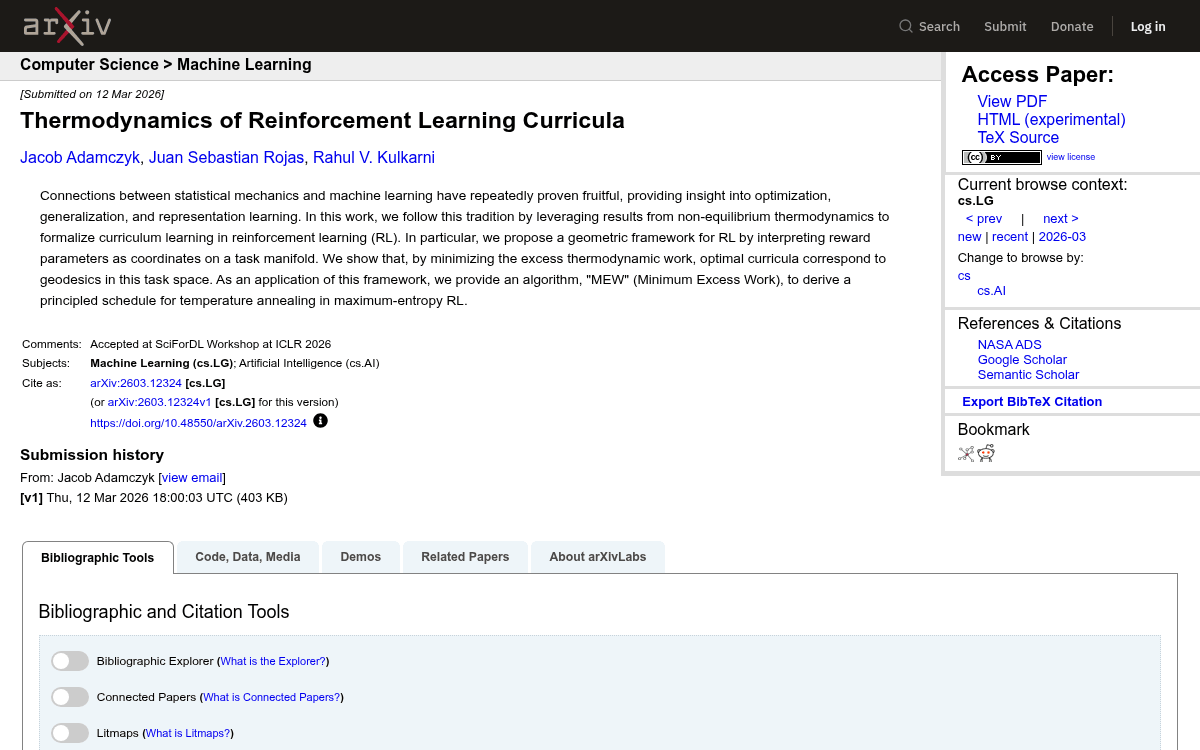
The work, Thermodynamics of Reinforcement Learning Curricula, reframes the space of reward parameters as a curved manifold. By minimizing the excess thermodynamic work, optimal curricula correspond to geodesics in this task space. The authors then turn that abstract result into a concrete algorithm, MEW (Minimum Excess Work), for annealing the entropy temperature in Soft Actor-Critic-style methods.
The hidden geometry of reward schedules
The problem starts with a mundane observation. Modern RL agents are rarely trained on a single static task; they see sequences of related tasks through curricula, temperature annealing, and reward shaping, but the principles governing how tasks should be varied are poorly understood. The default is to interpolate reward parameters linearly in time, which implicitly assumes the task space is flat and isotropic.
The paper's central claim is that this assumption is false. Borrowing from non-equilibrium statistical mechanics, the authors introduce a friction tensor, a matrix that measures how costly it is to move in a given direction of reward space. Large entries correspond to directions in task space where reward gradient fluctuations persist over long timescales, thereby making adaptation costly. Move too fast through a high-friction region and the agent lags behind the shifting objective, burning compute on transient sub-optimality.
Under this metric, curriculum design becomes a geometry problem. Optimal paths satisfy the geodesic equation and, crucially, linear curricula, which are commonly used in RL due to their simplicity and practicality, are only optimal when the induced geometry is flat.

From theory to a temperature scheduler
To make the framework practical, the authors focus on the one-dimensional case that every SAC user cares about: annealing the entropy temperature alpha. Identifying the inverse temperature as the control parameter, the thermodynamic friction reduces to an auto-covariance of the rewards, a quantity that is computationally cheap and readily available during training.
The resulting MEW update rule is simple: temperature should be changed slowly in regions of high variance and more rapidly when fluctuations are small. Rather than using a fixed decay, the entropy coefficient should dynamically wait when the agent encounters high reward variability, and accelerate only when the policy's return stabilizes.
Concretely, the algorithm adds a few lines on top of average-reward SAC:
- Grab the last N rewards from the replay buffer as an approximation of on-policy data.
- Compute the reward auto-covariance (the scalar friction) using an FFT via the Wiener-Khinchin theorem.
- Update the inverse temperature by
Δβ = η / (β·√(ζ + ε)), whereηis a "thermodynamic speed" hyperparameter.
What the experiments show
The team tested MEW on the Humanoid-v5 MuJoCo task, layered on top of ASAC, an average-reward variant of Soft Actor-Critic. The comparison targets are two constant temperatures and Haarnoja's automatic entropy adjustment from the original SAC paper.

Two things stand out. First, MEW's schedule is monotonic, while the standard protocol initially drops the temperature quickly, leading to a nearly-deterministic policy, which must be adjusted as the temperature later rises. Second, run-to-run variance is smaller. A hyperparameter sweep across three orders of magnitude of thermodynamic speed produced a similar, strong performance, suggesting the scheduler is not brittle.
The real contribution
The headline result, a better temperature scheduler for one MuJoCo task, undersells the paper. The deeper point is a unifying language for curriculum phenomena. The authors suggest the framework can, in principle, explain potential-based reward shaping, simulated annealing, and feature collapse as consequences of navigating a curved task manifold. Empirical instabilities in RL may be, in their words, consequences of driving a high-dimensional, non-equilibrium system too aggressively through a curved and evolving parameter manifold.
There are caveats worth flagging before you plug this into your training loop:
- The theory assumes a separation of timescales: the agent must relax to near-optimal between curriculum steps. Aggressive curricula violate this.
- The Humanoid experiment reuses the replay buffer to estimate friction, which the authors acknowledge breaks SAC's off-policy assumption. A cleaner on-policy rollout would be more expensive.
- Scaling the friction tensor to high-dimensional reward parameterizations, as opposed to the 1D temperature case, remains an open engineering problem.
- The paper does not release code, though the algorithm is short enough to implement from the pseudocode in the appendix.
For teams already running maximum-entropy RL, the practical takeaway is narrow but useful: replacing a hand-tuned entropy decay with a variance-aware schedule is a low-risk change that appears to stabilize training. For researchers thinking about curricula more broadly, the geometric framing offers a new vocabulary and, potentially, a diagnostic tool for predicting which task transitions will hurt.