
UMaryland's ACT Trains AI Agents to Judge Actions and Stop Failure Loops
ACT uses RL to teach LLM agents to judge action quality, not just copy experts — boosting performance by 5 points and fixing reasoning collapse
 Pro
Takeaways
- ACT (Agentic Critical Training) trains LLM agents to judge which of two candidate actions is better, using RL rewards instead of imitating pre-written reflections.
- Achieves +5.07 points over imitation learning and +4.62 points over standard RL across ALFWorld, WebShop, and ScienceWorld benchmarks.
- Trained models recover from failures mid-task by reasoning about what went wrong, a behavior that standard IL and RL do not produce.
- Imitation learning causes "reasoning collapse" — degrading GPQA-Diamond performance by 6.91pp; ACT improves it by 1.85pp with zero reasoning-specific training data.
- ACT data collected from a larger model (Qwen3-8B) transfers effectively to a smaller one (Qwen3-4B), reducing data collection costs.
- No code released yet; project page and paper are available; built on OpenRLHF + Qwen3.
Most LLM agents are trained by watching experts and copying what they do. It works, but it leaves a critical gap: the model learns the what but never the why. When something goes wrong mid-task, an imitation-trained agent has no internal compass to diagnose the failure , it just keeps repeating the same broken action until time runs out. A team from the University of Maryland has a fix, and it comes from a surprisingly simple reframe of the training objective.
Their method, Agentic Critical Training (ACT), doesn't teach the model to generate actions. Instead, it teaches the model to judge actions , to look at two candidates and decide which one is better. That single shift, from imitation to discrimination, turns out to unlock genuine self-reflection as an emergent behavior.
The imitation trap
Training LLM agents often begins with imitation learning (IL), where models learn to replicate expert demonstrations through supervised fine-tuning. IL suffers from a well-known limitation: it only teaches agents what to do, not what to avoid. Because agents only observe successful trajectories, they lack understanding of why certain actions are preferable and have no awareness of suboptimal states.
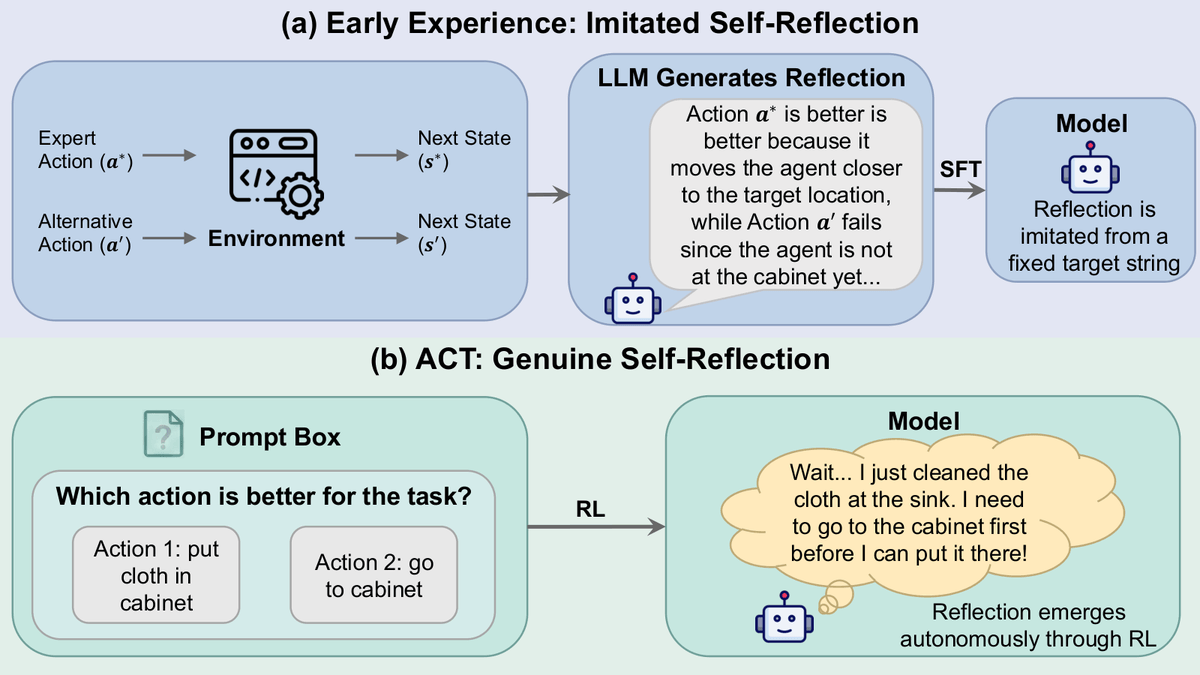
A prior approach called Early Experience tried to patch this by running both the expert action and an alternative in the environment, observing the resulting states, and then prompting the model to write a reflection explaining why the expert action was better. That reflection text was then mixed into the training data. However, this approach fundamentally remains imitation learning: the model is trained to imitate a pre-generated target string rather than to autonomously discover reasoning that leads to correct action selection. The "self-reflection" is imitated from text, not spontaneously developed.
Judgment as a training signal
ACT is a reinforcement learning paradigm that trains agents to identify the better action among alternatives. By rewarding whether the model's judgment is correct, ACT drives the model to autonomously develop reasoning about action quality, producing genuine self-reflection rather than imitating it.
The pipeline has three stages:
- Data Construction: For each expert state-action pair, the initial model is sampled to generate K candidate actions. Any candidate that differs from the expert action becomes a "negative" alternative, forming contrastive pairs (state, expert action, alternative action).
- Agentic Critical Training: The model is shown a state and two candidate actions in randomized order, then trained via GRPO (Group Relative Policy Optimization , an RL algorithm that estimates advantages from group-level reward statistics, avoiding the need for a separate value network) to pick the better one. The only reward signal is whether the selection is correct. No reasoning supervision is provided, so the model must develop its own chain-of-thought to maximize reward.
- RL Action Training: The ACT-enhanced model is then fine-tuned with standard RL for direct action generation, now starting from a much stronger reasoning foundation.

The reward function is a composite of three terms: +1 for exactly matching the expert action, +0.1 for choosing a valid but suboptimal action, and -0.5 for failing to produce properly formatted output tags. This partial credit structure keeps training stable while still strongly incentivizing correct judgments.
What the numbers say
The team evaluated on three benchmarks covering different agent domains: ALFWorld (embodied household navigation), WebShop (e-commerce product search), and ScienceWorld (multi-step scientific experiments). All methods were trained on identical expert trajectories to isolate the effect of the training paradigm alone.
ACT achieves an average improvement of 5.07 points over imitation learning and 4.62 points over reinforcement learning. Compared to approaches that inject reflection capability through knowledge distillation, ACT also demonstrates clear advantages, yielding an average improvement of 2.42 points.
The best configuration, RL with ACT as a warm-up stage, hit 92.86% on ALFWorld ID tasks, 88.06% OOD, 33.80% on WebShop, and 50.34% on ScienceWorld , the top result across every benchmark. ACT's gain on top of RL is larger on OOD tasks (3.73pp) than on in-distribution tasks (2.15pp), indicating that the reasoning acquired through ACT generalizes to unseen task configurations rather than overfitting to the training distribution.
The failure recovery effect
The qualitative case studies are where the story gets concrete. In ALFWorld, when an action fails, the environment returns "Nothing happens." An IL-trained model, having never seen a failure state during training, has no mechanism to respond , it just repeats the same failed action in a loop for 30+ steps until the episode terminates. The ACT-trained model, by contrast, reasons through the failure: it notices the repeated "Nothing happens" feedback, diagnoses that it's in the wrong location, and issues a corrective navigation command. Notably, the self-critique behavior originates from the ACT phase, as RL alone does not produce such reflective reasoning patterns.
A similar pattern shows up on WebShop. The IL model follows a rigid script , search, click item, select attributes, buy , without ever checking whether the item actually satisfies the task constraints. It buys a $55 item on a task that explicitly requires a price below $50, scoring zero. The ACT model internalizes constraint-checking as part of its decision process.
The reasoning collapse problem
One of the more striking findings is what IL does to general reasoning ability. The team took models trained only on ALFWorld agentic data and evaluated them on MATH-500 and GPQA-Diamond , benchmarks the models had never seen during training.
On GPQA-Diamond, IL degrades performance by 6.91pp compared to the CoT prompting baseline (44.61% vs. 51.52%), while Early Experience only recovers to the baseline level (51.85%). This indicates that next-token prediction approaches, even when enriched with self-reflection data, do not transfer agentic training to general reasoning.
The paper calls this reasoning collapse. IL fine-tunes on short, action-heavy expert trajectories that contain minimal extended reasoning. By imitating these behavioral patterns, the model overwrites its deep reasoning capabilities with domain-specific action patterns. The symptoms are vivid in the traces:
- Unfocused meandering: On a high-energy physics problem, the ACT model produces a focused 10,669-character derivation and gets it right. The IL model generates a 37,924-character trace , 3.5x longer , that wanders through vague recollections and contradictory estimates before guessing wrong.
- Algebraic death loops: On a MATH-500 probability problem, the IL model enters a circular algebraic spiral exceeding 80,000 characters without converging, ultimately giving up with an incorrect answer. ACT cleanly identifies the geometric structure and solves it.
ACT achieves the highest scores on both MATH-500 and GPQA-Diamond despite being trained exclusively on agentic data. On GPQA-Diamond, ACT improves over the CoT prompting baseline by 1.85pp, while IL degrades it by 6.91pp. The RL training signal rewards correct critical judgments regardless of response format or length, so ACT not only avoids catastrophic forgetting but actively strengthens reasoning.
Cross-model data reuse
One practical concern with ACT is the cost of generating contrastive pairs , you need to run the initial model to collect alternative actions. The team tested whether data collected from a larger model could be reused to train a smaller one. They trained Qwen3-4B on ACT data collected entirely from Qwen3-8B, with no re-collection. The result: the transferred ACT data remains effective , all ACT-augmented methods improve over their non-ACT counterparts on both ID and OOD tasks for Qwen3-4B, validating that ACT's benefits generalize across model sizes and that the data collection cost can be amortized by reusing data across models of different sizes.
Limitations and what's next
ACT's current formulation assumes that expert actions are generally superior to model-generated ones , a reasonable assumption but not always guaranteed. The method also relies on having expert demonstration trajectories to begin with, so it's not a fully self-supervised approach. The reward is based on exact action matching against the expert, which may be too strict in environments with multiple valid action sequences.
No code or model weights are publicly released yet, but the project page is live with the paper and detailed prompt templates. The method is implemented using OpenRLHF with DeepSpeed ZeRO-3, trained on 4 NVIDIA GH200 GPUs. The base models used are Qwen3-4B and Qwen3-8B.
The deeper implication here is worth sitting with: training an agent to judge actions in a multi-step environment appears to be a general mechanism for improving reasoning, not just a task-specific trick. If agentic RL environments can serve as a training ground for general critical thinking , without any domain-specific reasoning data , that opens a new path for building models that are both better agents and better reasoners at the same time.