
Ulm University Finds a Plain Wooden Box Beats Realistic VR for Trauma Therapy
A feasibility study of VR exposure therapy for complex PTSD finds that a single object can outperform an elaborate virtual scene, and immersion barely matters.
Takeaways
- First feasibility study of VR exposure therapy specifically for complex PTSD, involving 11 inpatients, 2 therapists, and a developer (paper).
- Simple single-object triggers in neutral white rooms often outperformed detailed environmental reconstructions of trauma sites.
- Therapeutic success did not correlate with VR presence scores; patients aware it was simulated still had large physiological responses.
- The scenario design process itself acted as graded pre-exposure and surfaced memories conventional therapy missed.
- Involving a non-clinical developer in sessions caused secondary trauma, role confusion, and altered patient-therapist dynamics.
- Effective scenes were built in Unity with free assets in under three hours, suggesting low-cost individualized VRET is viable.
A team from Ulm University and CYENS Centre of Excellence ran one of the first structured feasibility studies of virtual reality exposure therapy (VRET) for complex post-traumatic stress disorder, and the results push back against several assumptions the VR community has treated as gospel. Their CHI 2026 paper reports that a plain wooden chest in a white void can trigger deeper therapeutic breakthroughs than a photorealistic reconstruction of a trauma site, that presence scores were essentially uncorrelated with clinical progress, and that dragging a Unity developer into a therapy room introduced serious secondary-trauma risks nobody had planned for.
Why complex PTSD breaks the standard VRET playbook
Most published VRET work targets single-incident trauma, especially combat PTSD, where traumatic experiences often share recognizable features that can be simulated across patients. Complex PTSD (C-PTSD) develops from prolonged or repeated interpersonal trauma such as childhood abuse or captivity, and its triggers are fragmented, idiosyncratic, and rarely transferable between patients. That kills the economics of building one reusable VR asset library, and it means the usual trial-and-error scenario design carries a real risk of dropout or retraumatization.
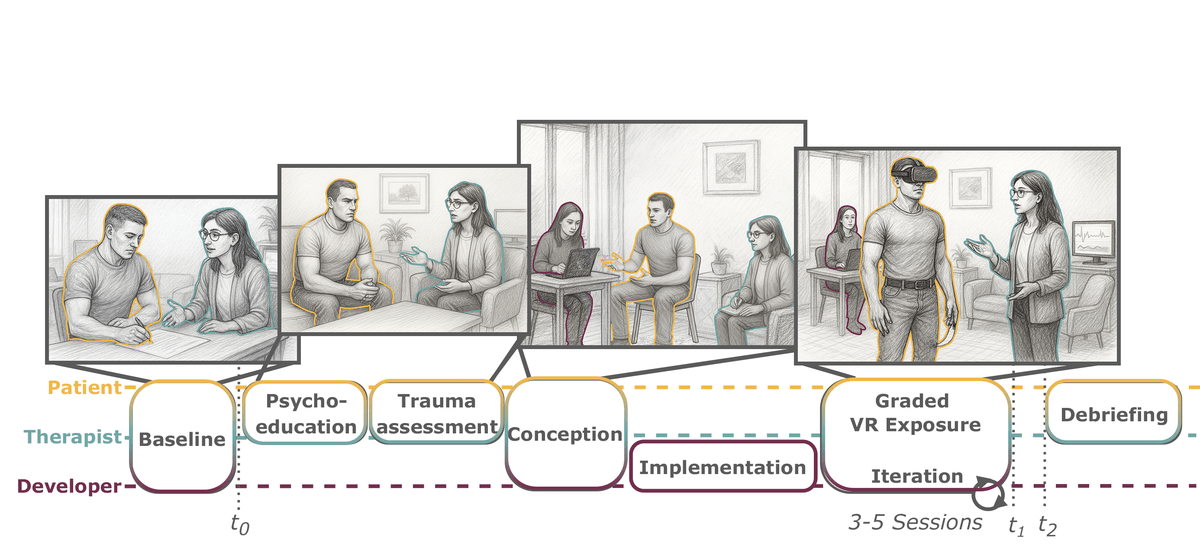
The team recruited 11 inpatients (six with childhood trauma, five with military trauma), two senior trauma therapists, and one HCI PhD student acting as VR developer. Each patient went through psychoeducation, collaborative scenario design, three to five graded exposure sessions on a Vive Pro Eye with skin-conductance monitoring, and a debriefing phase. Because the patients were highly vulnerable, no post-session interviews were done. Instead, the team treated the process itself as data, combining therapist and developer field notes, biofeedback, and standard psychometrics (PTSS-10, IES-R, BSL, CTQ-SF) in a reflexive thematic analysis.