
UIUC's OSExpert Closes 80% of the Gap Between AI Agents and Human Experts
OSExpert teaches AI agents to explore software like a pro, cutting the efficiency gap to human experts by 80% without any human-labeled data
 Pro
Takeaways
- OSExpert is a new framework from UIUC that teaches computer-use agents professional software skills through autonomous exploration, with no human-labeled data required.
- A new benchmark, OSExpert-Eval (113 tasks across GIMP, LibreOffice, Tableau, and a custom editor), reveals current agents are 5x–50x slower than human experts and score near 0% on complex tasks.
- The core algorithm, GUI-DFS, crawls a software application's menus and dialogs depth-first, verifying and saving successful action sequences as a reusable skill library.
- Three innovations on top of the skill set: a LoRA-tuned single-pass planner, a fine-grained action primitive database (using SAM2 for pixel-precise tasks), and a skill boundary check for early stopping on infeasible tasks.
- Results: ~20% performance gain on OSExpert-Eval and ~80% reduction in the efficiency gap to human experts; exploration costs $20–$50 per environment using GPT-5.
- Code and data to be released at github.com/Lumos-Jiateng/OSExpert; paper at arxiv.org/abs/2603.07978.
Computer-use agents (CUAs) , AI systems that operate software by looking at a screen and clicking around , have been on a tear. They went from a 12% success rate on the OSWorld benchmark in 2024 to 85% by mid-2026. But that headline number is deceptive. The best frontier systems still complete only about 20% of real long-horizon workflows, and the moment you put one of these agents in front of professional software like GIMP or LibreOffice Calc and ask it to do something a power user would do in 20 seconds, it either fails outright or takes minutes of painful trial and error to get there.
A new paper from researchers at the University of Illinois Urbana-Champaign introduces OSExpert, a framework that closes this gap by letting agents learn a software environment from the inside out , no human-labeled demonstrations required. The result is a ~20% performance gain on their new benchmark and an ~80% reduction in the efficiency gap between agents and human experts.
The benchmark that exposed the real problem
Before building a solution, the team built a new benchmark called OSExpert-Eval to properly measure the problem. Existing benchmarks like OSWorld are limited to relatively low task complexity and a narrow set of evaluation criteria that don't fully reflect human-level capabilities. OSExpert-Eval fills that gap by testing four things existing benchmarks largely ignore:
- Long-horizon composite workflows , multi-step tasks that chain several unit functions together, like reformatting a spreadsheet while adjusting zoom and inserting charts
- Unseen UI generalization , operating in environments the agent has never seen, including Tableau and a custom-built editor called MiniWord with non-standard layouts
- Fine-grained action execution , pixel-precise operations like dragging to select a specific text span, tracing object boundaries, or rotating an object by a specified angle
- Execution efficiency , how long the agent actually takes, compared to a human expert who practiced the task beforehand
OSExpert-Eval contains 113 evaluation tasks spanning six interactive GUI environments: LibreOffice Writer, LibreOffice Calc, LibreOffice Impress, GIMP, web-based Tableau Public, and the custom MiniWord editor. The results on this benchmark were sobering. On unseen UIs and fine-grained action execution, none of the existing agents exhibited meaningful generalization, with success rates remaining in the 0% to 10% range. Compared to human experts, current agents exhibit about 5x to 50x longer elapsed time on OSExpert-Eval tasks.
Why agents fail at professional software
The root cause isn't model capability , it's how agents acquire knowledge. Today's foundation agents are largely trained on scaled human demonstrations across ~100 digital environments via behavior cloning and reinforcement learning. However, these agents often fail to acquire environment-specific procedural knowledge, and what they do learn transfers poorly as real-world interfaces and workflows evolve.
Even when an agent knows a tool exists, it doesn't know the exact sequence of clicks to use it reliably. This leads to two compounding problems at inference time:
- Step-wise planning overhead: Agents typically generate a new plan from the current observation at each step and then produce a single action, repeated after every UI change. Prior work shows step-wise planning accounts for nearly 50% of total latency.
- Blind test-time scaling: When stuck, agents keep retrying until they exhaust their interaction budget, burning time on tasks they were never going to solve.
The fix: let the agent explore first
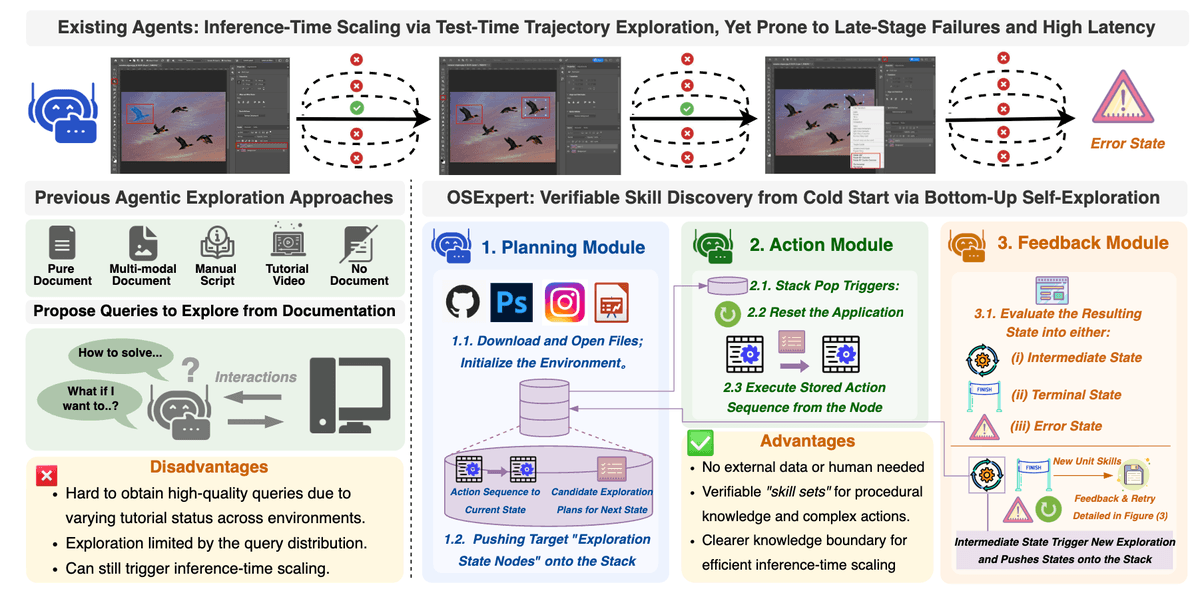
OSExpert flips the paradigm. Instead of training on human demonstrations or hoping the agent figures things out at inference time, OSExpert exposes agents directly to environments, enabling them to explore and autonomously acquire and compose their own skill sets without additional human effort for each environment. The exploration happens once, offline, and produces a reusable skill library the agent draws on at inference time.
The core of the system is a GUI-DFS (depth-first search) algorithm that systematically crawls a software application's interface. Think of it like a spider crawling a website, but instead of following hyperlinks, it follows menus, buttons, and dialogs. The exploration is carried out by three coordinated modules: a planning module that generates exploration plans, an action module that executes UI actions and interacts with the environment, and a feedback module that evaluates the current exploration state and provides state-dependent feedback.
Here's how a single DFS step works:
- Pop a node from the stack (a screenshot + the action sequence to reach that state)
- Reset the environment and replay the stored action sequence to recover the state
- Execute the next planned action
- The feedback module classifies the result as
Continue,Final, orError - On
Continue: push follow-up exploration nodes onto the stack - On
Final: condense the successful plan + action sequence into a unit skill and save it - On
Error: retry with targeted feedback, up to a max retry budget R=4
DFS was chosen deliberately over BFS. A key advantage of GUI-DFS is fast skill yield , DFS commits to one branch of the interface hierarchy and quickly reaches terminal states where a unit function can be verified and condensed into a reusable skill. Even if exploration is terminated early, DFS typically returns a nontrivial set of completed procedures that can already improve downstream performance.
Once unit skills are discovered, the agent self-proposes a curriculum of composite tasks by combining them. For example, if it learned "apply bold" and "change font size" as unit skills, it can compose a skill for "reformat a heading." The discovered unit functions and the validated composite procedures are both consolidated into the agent's skill set.
Three key innovations on top of the skill set
1. Fine-grained action primitives. Many GUI tasks require pixel-level precision that general-purpose models can't reliably produce. The team identifies recurring fine-grained action primitives and organizes them into a database with concise descriptions. When a fine-grained action is required, the feedback module triggers an error state and searches the database for suitable primitives. For example, tracing an object boundary in GIMP triggers a primitive that calls SAM2 (Meta's Segment Anything Model 2) to extract boundary coordinates, then clicks along the contour. The procedure is only added to the skill set if it succeeds under verification.
2. Single-pass fast planner. At inference time, rather than re-planning after every UI change, a small LoRA-tuned language model (Qwen-3-4B) generates a complete plan in a single forward pass using the learned skill set as context. This eliminates most of the per-step planning latency. If execution fails, the system falls back to standard test-time scaling with relevant skills injected into context.
3. Skill boundary check. Failed entries in the skill set record unit functions that the agent repeatedly attempted during exploration but could not complete within bounded retries, suggesting low likelihood of success even with additional trials. If an input query maps to a skill marked as failed, the agent stops early and reports an error, avoiding prolonged futile attempts during inference. This is the single biggest efficiency win , most of the 80% efficiency gain comes from this early-stopping mechanism.
Numbers that matter
The experiments used GPT-5 and UI-TARS-1.5-7B during exploration, and Qwen-3-VL-8B as the inference agent. All exploration was fully automated , no human curation of the resulting skill sets.
While existing computer-use agents peak at roughly ~10% success on long-horizon tasks, OSExpert improves success rate to around 30%. The agent also transfers reliably to unseen UI environments and executes fine-grained actions with high fidelity, achieving ~20% success gain and improving efficiency by roughly ~80% relative to the most efficient existing agent.
The ablation results break down where each gain comes from:
- Long-horizon and unseen UI gains come primarily from environment-specific procedural knowledge in the skill set , agents execute verified plans rather than improvising step by step
- Fine-grained action gains come from the action primitive database , without it, the fine-grained task scores barely move
- Efficiency gains are dominated by the skill boundary check, with the fast planner contributing a smaller but real ~10-second reduction per task
On the standard OSWorld benchmark (simpler tasks), the gains are more modest , GIMP improves from 26.9% to 30.8%, LibreOffice Writer from 30.4% to 34.7% , which makes sense since OSWorld's simpler tasks don't stress the exact capabilities OSExpert is designed to fix.
What it's bad at
The paper is candid about the limitations. Exploration is expensive: it costs around $20 to $50 for exploration on each digital environment using GPT-5 models, and conducting a complete exploration of real-world environments may incur substantially higher computational cost. The GIMP exploration alone visited 721 states; a full exploration of a complex application could reach into the thousands.
The skill set quality is also bounded by the base model used during exploration. Weaker models produce noisier, less complete skill sets. And the fine-grained action primitives still require some manual design upfront , someone has to define the common manipulation patterns and provide feasible action templates before exploration begins.
Finally, the benchmark covers desktop GUI environments only. Mobile interfaces, purely web-native automation, and real-time environments are out of scope for now.
The real shift
The deeper insight here is architectural. The field has been treating inference-time scaling , giving agents more attempts and more compute at query time , as the primary lever for improving performance. OSExpert reframes this: exploration can be viewed as a form of scaling that shifts computation from inference time to a one-time environment learning phase, amortizing the cost by converting accumulated experience into reusable procedural knowledge before the system is deployed.
This matters practically. If you're building an internal automation tool on top of a specific application , say, a data pipeline in Tableau or a document workflow in LibreOffice , you can run OSExpert's exploration once on that application, generate a skill library, and deploy an agent that plans in a single pass and knows when to give up. The code and data will be released at github.com/Lumos-Jiateng/OSExpert, and the project page is at oppugno-rushi.github.io/OSExpert.
The principle also extends well beyond desktop GUIs. The authors note that environment-driven skill discovery applies naturally to software engineering agents navigating codebases, embodied robots interacting with physical tools, and vision-language-action models in robotics. The question of how to let an agent learn a new environment cheaply and reliably , without human annotation , is one of the central unsolved problems in the field, and OSExpert is a concrete, working answer to it.