
UIUC's Idea-Catalyst Pushes AI Brainstorming 407% Beyond Single-Domain Thinking
A new framework from UIUC uses metacognitive reasoning to help LLMs mine distant scientific fields for genuinely useful research ideas.
 Pro
Takeaways
- Idea-Catalyst is a UIUC framework that guides LLMs through metacognitive stages to generate interdisciplinary research ideas.
- It decomposes a research problem into domain-specific and domain-agnostic questions, then retrieves analogous work from distant fields.
- Delivers 21.38% novelty and 16.22% insightfulness gains over guided retrieval baselines on the CHIMERA dataset.
- Uses Qwen3-14B with Semantic Scholar Snippets API for retrieval, and pairwise ranking instead of absolute scoring.
- Code and dataset released on GitHub and Hugging Face.
- Best used for early-stage brainstorming; human study found outputs verbose and more novel than immediately actionable.
Ask a language model to brainstorm a research direction and you tend to get one of two outcomes: a safe, incremental variant of what already exists, or a wild cross-disciplinary leap that sounds impressive but falls apart on closer inspection. A team from the University of Illinois Urbana-Champaign has released Idea-Catalyst, a framework that tries to fix both failure modes by making the ideation process itself more deliberate.
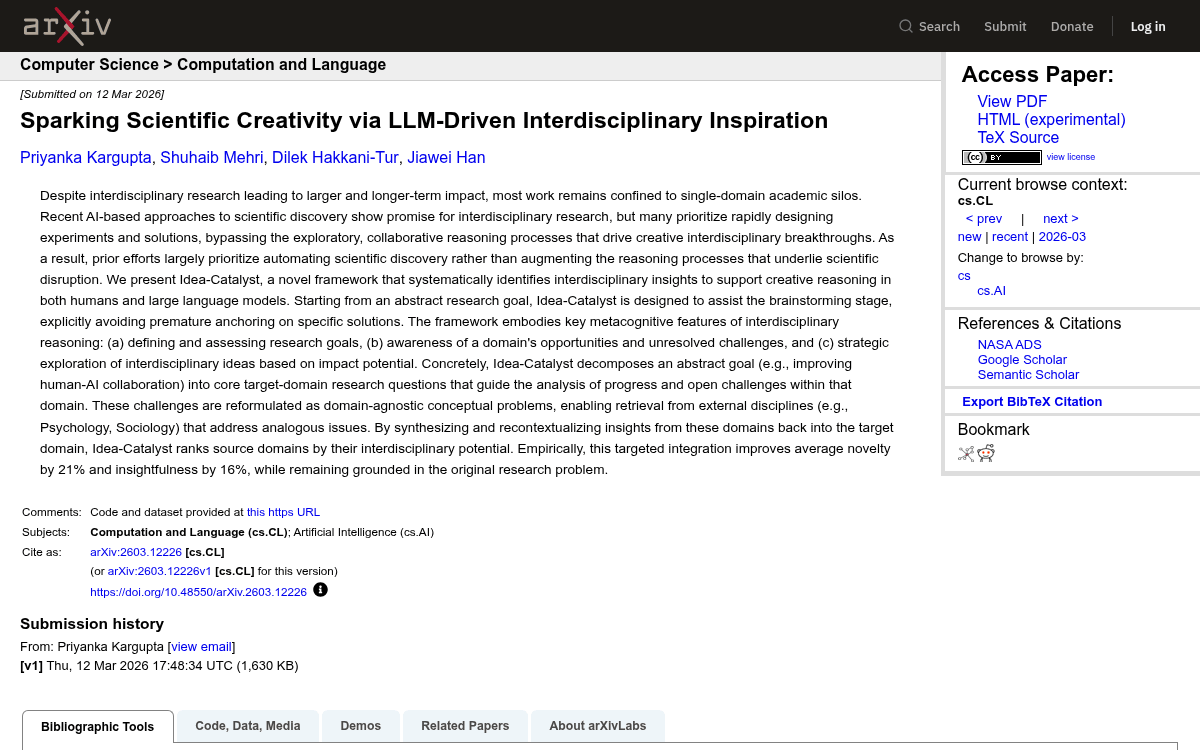
The paper, Sparking Scientific Creativity via LLM-Driven Interdisciplinary Inspiration, argues that most AI co-scientist systems skip the messy, exploratory part of research and jump straight to writing experiments. Empirical evidence shows that interdisciplinary synthesis yields substantially higher long-term impact, with each additional discipline increasing citation impact by approximately 20%, yet only 5% of cross-domain work involves high-involvement collaboration across non-neighboring fields. Idea-Catalyst is designed to close that gap by acting as a brainstorming partner that reaches into distant disciplines for you.
The problem with today's AI co-scientists
Prior work comparing human and LLM ideation has surfaced a persistent tension. Human-generated ideas are typically well grounded in existing literature, datasets, and practical constraints, but tend to remain focused on familiar problem formulations within a single domain. LLM-generated ideas, in contrast, exhibit a stronger tendency to draw inspiration from other disciplines, yet often do so in surface-level or stereotyped ways that undermine motivation, feasibility, and practical grounding.
Attempts to fix this by grafting ideation onto automated experiment execution make the problem worse. While grounding ideas through execution improves feasibility, it also drives convergence toward incremental, single-domain refinements, eroding the exploratory strengths and cross-domain potential that initially distinguish LLM-based ideation. In other words, evaluating too early kills the creative process.
Thinking about thinking
Idea-Catalyst is built around metacognition, the ability to monitor and regulate your own reasoning while solving a problem. Instead of one giant prompt, the system explicitly separates critical reasoning (analyzing what's known) from creative reasoning (exploring what could be borrowed from elsewhere). The pipeline runs in three stages:
- Decompose the target domain. The input research problem gets broken into core research questions, each expressed in two forms: a domain-specific version using the field's jargon, and a domain-agnostic version that strips away terminology. Retrieved literature is then used to label each question as largely resolved, partially addressed, or largely unexplored.
- Find analogous work in distant fields. The domain-agnostic formulations are used to query external disciplines. To promote non-trivial interdisciplinary connections, source domains are restricted to fields that are sufficiently distant from the target domain at a coarse-grained level of similarity (e.g., Computer Science and Psychology), and closely related subfields (e.g., Natural Language Processing and Machine Learning) are excluded.
- Integrate and rank. Insights get recontextualized into the target domain's language as "idea fragments," then ranked by pairwise comparison rather than absolute scores, prioritizing depth of integration and novelty-feasibility balance.
Retrieval is handled through the Semantic Scholar Snippets API, which returns short, relevance-ranked text passages extracted from papers, along with their associated metadata, treating retrieval as a black box so the research focus stays on the reasoning structure.
What the numbers show
The authors evaluate on 400 instances from the CHIMERA dataset, a collection of interdisciplinary research papers drawn from arXiv with annotated inspiration relations between source and target domains, using Qwen3-14B as the generator and gpt-oss-120b as an LLM judge. Compared to two retrieve-then-ideate baselines (Free-Form Source and Guided Dual), Idea-Catalyst wins on the metrics associated with real exploration:
- Idea-Catalyst achieves the highest insightfulness scores across all top-k settings, corresponding to an average relative improvement of 16.22% over Guided Dual and 282.21% over Free-Form Source.
- At the idea level, Idea-Catalyst attains the strongest novelty scores, yielding an average relative gain of 21.38% over Guided Dual and 407.65% over Free-Form Source.
- Ablations confirm that removing target-domain decomposition hurts novelty most, and swapping pairwise ranking for a simple relevance heuristic also degrades performance.
The source-domain distribution analysis is telling. The Free-Form baseline exhibits a severe skew toward Computer Science (947 occurrences), resulting in very low domain diversity, indicating that unconstrained LLM-driven ideation tends to remain within the target domain's immediate conceptual neighborhood even when encouraged to explore externally. Idea-Catalyst instead spans Psychology, Biology, Physics, Linguistics, and Engineering, with Psychology emerging as the most prevalent source across many AI-related targets, reflecting its foundational role in cognition, decision-making, and human-AI interaction.
Where it helps and where it hurts
A small human study with six PhD researchers offers a useful reality check. Participants rated generated research questions highly (4.00/5), takeaways as moderately insightful (3.16/5), and ideas as more novel (3.22/5) than immediately useful (3.00/5). Post-study interviews revealed that participants still perceived the takeaways and ideas as verbose, even after one round of conceptual rewriting. That echoes a broader finding: creative outputs are good at reframing a problem, less good at handing you a ready-to-run experiment.
So the honest use-case is early-stage brainstorming, especially when you suspect your subfield is stuck in a local optimum. It is not a replacement for hypothesis testing or an autonomous research agent. If you need concrete implementation plans, this is the wrong tool. If you want a structured way to surface why a psychology paper on cognitive control might reframe your reinforcement learning problem, it delivers.
Getting your hands on it
The project ships with a GitHub repository and a dataset on Hugging Face, so you can run the pipeline against your own research problem statement and target domain. The output schema is worth noting because it forces the model to be specific about how it plans to combine ideas:
idea_fragment:
  title: str
  core_insight: str
  integration_mechanism:
    target_domain_elements: [str]
    selected_takeaways: [{source_domain_formulation, mechanism_explanation, selection_rationale}]
    synthesis_approach: str
  challenge_resolution:
    addresses_target_challenge: str
    addresses_source_limitations: str
  concrete_realization:
    proposed_approach: str
    key_innovations: [str]
The bigger contribution here is arguably methodological rather than technical. By formalizing metacognitive stages (self-awareness, context awareness, strategy selection, goal management, evaluation) as explicit pipeline steps, the paper offers a template that other ideation systems can plug into. It also pushes back against the current trend of coupling ideation to execution too tightly, arguing that some intellectual friction is worth preserving.