
UIUC's CRAFT Hand Beats Rigid Robots at Half the Power Cost
A $600 open-source anthropomorphic hand puts soft material only at the joints and rigid plastic in the links, cutting motor current in half.
 Pro
Takeaways
- CRAFT is a $600, 800g, 15-DoF tendon-driven hand with soft TPU joints and rigid PLA links, released open-source at craft-hand.github.io.
- Rolling-contact joints and a coupled PIP/DIP linkage keep the compliant joints predictable and fatigue-resistant.
- Pull-out strength of 15.29 N versus 8.67 N for a LEAP hand built with the same motors.
- Roughly 50% lower motor current than LEAP when holding a 5 lb dumbbell for an hour.
- Teleoperation hits 100% success on raspberries and chips where the rigid baseline crushes them 40% of the time.
- Full 33/33 coverage of the Feix grasp taxonomy, with URDF and MuJoCo XML included for policy learning.
Rigid robot hands are precise but shatter on contact. Soft hands survive impacts but wander off their kinematic paths under load. A team from UIUC and UC Irvine is arguing that both failures come from the same mistake: treating the whole hand as one material. Their new CRAFT hand mixes hard and soft plastic based on where contact actually happens, and the resulting hardware runs cheaper, cooler, and more durably than a well-known rigid baseline.
Soft where it helps, rigid where it matters
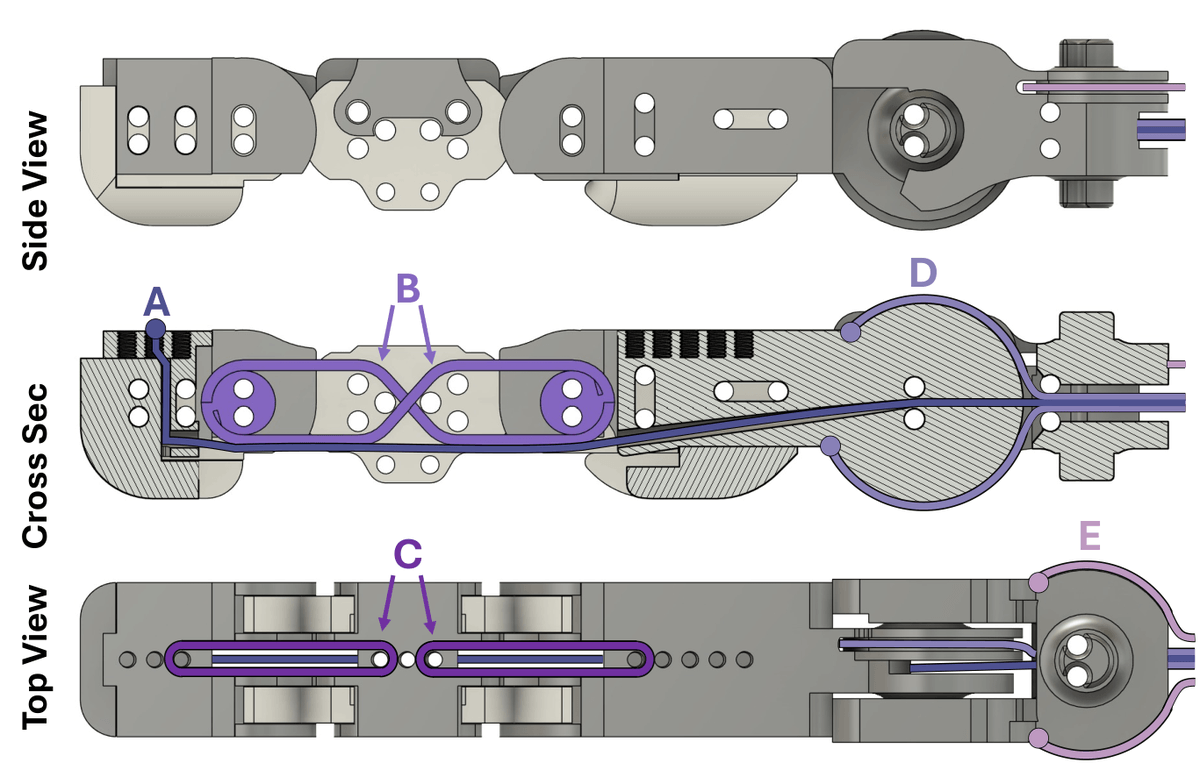
The core observation is spatial. Impacts and conforming contact concentrate at joints, where the hand changes direction and collides with objects, while the segments between joints must reliably transmit actuation forces from the motors, so they must be rigid. CRAFT bakes this into the print job itself: the hand is fully 3D-printed, with finger segments in rigid PLA and finger joints in soft thermoplastic polyurethane (TPU).
Soft joints introduce two headaches. First, a single tendon pulling through both the middle (PIP) and fingertip (DIP) knuckles will bend one more than the other depending on load. Second, flexible plastic fatigues and cracks. The paper addresses both with mechanical tricks:
- Coupled bidirectional linkage: a mechanical linkage that couples the PIP and DIP joints so both bend equally and simultaneously regardless of external load, producing repeatable finger postures.
- Rolling-contact joints: instead of bending a flexure at a fixed point, two curved TPU surfaces roll against each other. This distributes load across the TPU surface and significantly reduces stress concentration.
- Motors in the forearm: 15 actuators located behind the wrist, with three actuators per finger driving flexion and side-to-side motion through tendons, keep the fingers light and out of the collision zone.
The numbers against LEAP
The team benchmarks against the LEAP hand, a widely used rigid open-source design, rebuilt with the same cheaper Dynamixel motors CRAFT uses so the comparison isolates the mechanical design. Three structural tests tell the story.
On pull-out strength, CRAFT withstands 15.29 N of pull-out force, nearly double the 8.67 N measured for the LEAP hand, thanks to the mechanical advantage of tendon routing. Repeatability holds up too: both CRAFT and LEAP maintain consistent performance with mean tracking errors remaining below 0.01 rad across an hour of continuous grasp-release cycles, so compliance does not cost precision.

The endurance result is the most practically useful. Grasping a 5 lb dumbbell for an hour, the average current consumption of CRAFT is approximately 50% lower than that of LEAP. The friction inherent in the tendon routing acts as a passive braking mechanism, assisting in load retention and reducing the active torque required from the motors. That means less thermal throttling and less risk of frying a servo during long data-collection runs.
Fragile objects and full grasp coverage
Structural strength is only half the pitch. The other half is that soft joints let a teleoperator be sloppy without breaking the object. The user study covers five items, from a rigid ball to a raspberry and a Frito chip.

On the egg, the rigid hand frequently failed to find a stable grasp before the time limit or slipped due to the lack of friction, resulting in a 60% failure rate, while CRAFT achieved a 90% success rate. On the raspberry and chip, the rigid hand frequently crushed objects upon contact due to the lack of passive give, resulting in a 60% success rate. CRAFT achieved a 100% success rate on both tasks, as the soft fingers absorbed contact forces.
For general dexterity, the team ran the Feix grasp taxonomy, a standard 33-type classification of human grasps. CRAFT achieves 33/33 successes compared to RUKA's 29/33. The gap comes from CRAFT keeping degrees of freedom that other cheap hands cut: RUKA omits abduction/adduction DoF, which prevents inter-finger grasps such as holding chopsticks or pens, and ORCA employs a fixed DIP joint, which reduces the effective curling range of the fingers.

What ships with the hardware
This is a hardware release, but it comes with the software glue needed for robot-learning work. The teleoperation stack takes a single RGB camera and combines FrankMocap for wrist pose with HaMeR for finger pose, then remaps operator joint ranges onto the robot's calibrated limits. No gloves, no wrist trackers.
For simulation, the authors dodge the sim-to-real gap that soft-body physics creates. They avoid soft-body physics and instead model the rolling-contact joints using equality constraints that enforce surface contact conditions and treat them as revolute joints, and provide URDF and MuJoCo XML files compatible with Isaac Gym and other common simulators.
The tradeoffs to know about
The paper is honest about where CRAFT sits. It is not sensorized, unlike hands built around tactile skins. TPU joints will still wear over enough cycles, even with rolling contacts spreading the load. The simulation model approximates compliance rather than reproducing it, so policies that rely on exact soft-body dynamics will need real-world fine-tuning. And the whole thing is 3D-printed PLA and TPU, which is easy to reprint but not what you would deploy in a factory.
Still, at under $600 in parts and 800g in weight, with 15 active DoF, forearm-mounted motors, and a full open-source stack, CRAFT lands in an interesting spot for anyone running teleoperation data collection or reinforcement learning experiments where the hand keeps hitting things. The design files, teleop code, and simulation assets are on the project page.