
UIUC Builds Immune2V to Stop AI Video Deepfakes Where Old Defenses Fail
A new adversarial framework called Immune2V perturbs static images so modern image-to-video models produce collapsed, unusable footage instead of clean deepfakes.
 Pro
Takeaways
- Immune2V is the first adversarial immunization method that reliably disrupts modern dual-stream image-to-video models like Wan 2.1.
- Naive image-level attacks fail because causal 3D VAEs attenuate perturbations across time and coherent text prompts heal corruption during denoising.
- The framework combines a temporally-balanced VAE loss with a semantic attack that hijacks DiT cross-attention using a precomputed collapse trajectory.
- On DAVIS with a 32/255 perturbation budget, it beats adapted PhotoGuard variants on text alignment, subject consistency, motion smoothness, and aesthetic score.
- Gemini 3.1 Pro pairwise judging confirms stronger structural collapse while keeping the immunized input frame visually clean.
- Code is public but immunization takes 25 minutes per image on an A100 80GB and is white-box per model.
Photo protection tools like Glaze and PhotoGuard were built for a world where the worst thing an attacker could do with your face was paste it into a still image. That world is gone. Modern image-to-video (I2V) systems like Wan 2.1, DynamiCrafter, and I2VGen-XL can take a single JPEG and produce a plausible clip of the subject moving, talking, or performing actions they never did. A team from UIUC and Georgia Tech has now shown that the standard image-immunization playbook mostly stops working once you extend it to video, and they propose Immune2V, a dual-stream attack that breaks these newer pipelines.
Why yesterday's defenses evaporate on video
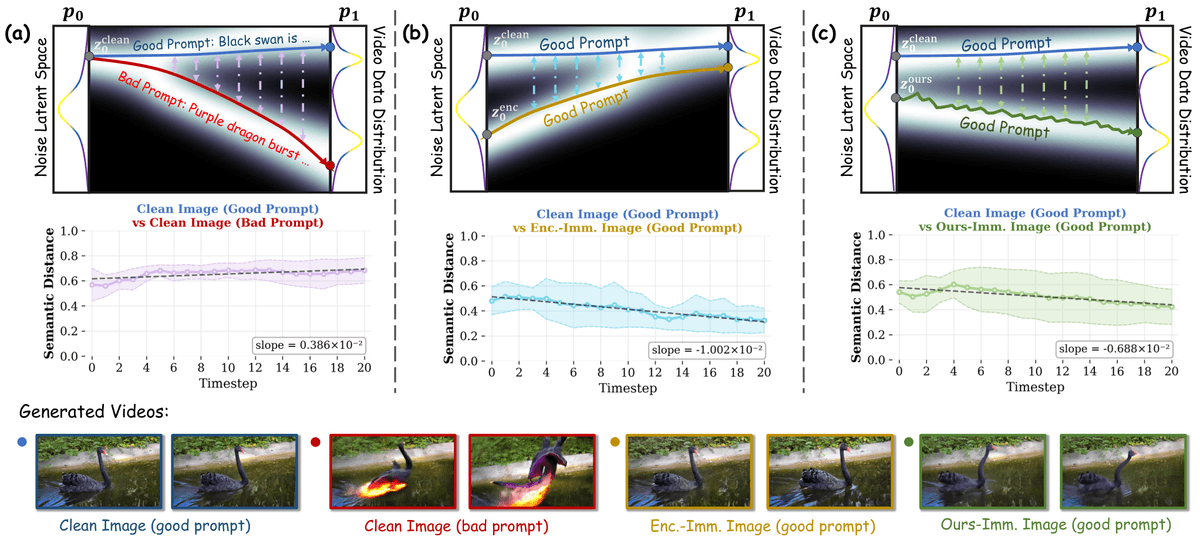
Immunization is a proactive defense: you add an imperceptible adversarial perturbation to your image before uploading it, so any downstream generative model choking on it produces garbage instead of a convincing fake. The authors systematically analyze why this trick, which works well for still-image editing, collapses on I2V. Wan, I2VGen-XL, and DynamiCrafter all rely on a dual-stream architecture for scalable video generation, and each stream neutralizes naive attacks in a different way.

The first bottleneck lives in the spatial-temporal stream. The input image gets padded into a pseudo-video (image followed by zero frames) and encoded by a 3D causal VAE into a latent tensor spread across time. Because the VAE is causal and temporally downsampled, only the first latent slice actually sees the perturbed pixels. In the paper's diagnostic, gradients from later slices shrink to nearly zero, so PGD optimization is dominated by frame one, and the corruption fades as the video plays out.
The second bottleneck is the semantic stream, where a CLIP-style image encoder and a T5-style text encoder feed cross-attention layers in every DiT block. When the text prompt agrees with the image content, that continuous semantic guidance acts like an autopilot that steers the latents back to a coherent scene. The authors measure this directly: a spatial-only attack shows a steep negative slope in DINO feature distance from the clean trajectory, meaning the text prompt actively heals the corruption during denoising.