
UIC's TRIAGE Splits Robot Uncertainty in Two, Boosting Task Success by 21 Points
TRIAGE decomposes robot uncertainty into two independent signals, boosting manipulation success by 21 points and cutting vision compute by 58%
 Pro
Takeaways
- TRIAGE splits robot uncertainty into aleatoric (sensor noise) and epistemic (model mismatch) signals, triggering different fixes for each. [Paper]
- Under compound perturbations, task success jumps from 59.4% to 80.4% -- a 21-point gain over a single combined-uncertainty baseline.
- The combined-uncertainty baseline actually performs worse than no intervention under pure dynamics shift (70.1% vs 72.4% vanilla), because it fires the wrong corrective action.
- The same decomposition guides adaptive detector selection on MOT17, cutting compute by 58.2% with only 0.4% accuracy loss versus always using the largest model.
- The framework is post-hoc: it plugs onto any frozen policy after training, requiring only a short nominal calibration rollout.
- Code and demos are available at the project page; the two signals have near-zero empirical correlation (r = 0.048) confirming they measure independent failure modes.
When a robot fails, it usually does not know why it is failing. Most uncertainty-aware controllers lump all sources of prediction error into a single number and then apply a generic safety response -- slow down, be conservative, try again. That works fine when there is only one thing going wrong. But in the real world, robots face two very different kinds of trouble at the same time: noisy sensors and physics that no longer match what the model learned. Treating those the same way is, it turns out, actively harmful.
A new paper from researchers at the University of Illinois at Chicago and Intel Labs introduces TRIAGE (Type-Routed Interventions via Aleatoric-Epistemic Gated Estimation), a lightweight post-hoc framework that splits uncertainty into two independent signals and fires a different corrective response for each one. The results are striking: on a standard robotic manipulation benchmark, the decomposed controller jumps from 59.4% to 80.4% task success under compound perturbations -- a 21-point gain over a baseline that uses a single combined uncertainty score.
Two kinds of wrong
To understand why this matters, you need to know the difference between aleatoric and epistemic uncertainty -- two terms borrowed from statistics that describe fundamentally different failure modes.
- Aleatoric uncertainty is randomness baked into the data itself -- sensor noise, encoder drift, measurement corruption. No matter how good your model is, you cannot eliminate it by training more. The observations are just dirty.
- Epistemic uncertainty is model ignorance -- the gap between what your dynamics model learned and how the real system actually behaves right now. A heavier object, a slippery surface, a worn actuator. The model has never seen this, so its predictions are wrong.
Aleatoric uncertainty reflects stochastic variation in observations that affects state estimation, whereas epistemic uncertainty reflects model mismatch or distributional shift that affects action consistency with the true system dynamics. Collapsing these quantities into a single score removes structural information about the origin of the disturbance and therefore about the appropriate corrective action.
The key insight is that these two problems live in different parts of the control loop. Sensor noise corrupts the observation before it reaches the policy. Dynamics shift corrupts the policy's predictions after the observation is already clean. Fixing the wrong one does not help -- and as the paper shows, it can actually make things worse.
How TRIAGE works
TRIAGE introduces a lightweight post hoc framework that decomposes uncertainty into aleatoric and epistemic components and uses these signals to regulate system responses at inference time. Crucially, it is post-hoc: you plug it onto a frozen, already-trained policy without any retraining or labeled out-of-distribution data.
The framework has two estimators running in parallel at inference time:
- Aleatoric estimator (Mahalanobis distance): During a short calibration rollout under nominal conditions, TRIAGE records the mean and covariance of the observation distribution. At runtime, it computes the Mahalanobis distance of each new observation from that nominal distribution. A large distance means the sensor readings have drifted -- the observation is corrupted. The threshold is set at the 95th percentile of calibration scores.
- Epistemic estimator (noise-robust dynamics ensemble): An ensemble of 5 small MLPs learns to predict the next state transition from the current observation and action. The trick is in the training: each model sees clean observations, moderately noisy observations, and heavily noisy observations, but always predicts the same clean target transition. This forces the ensemble to become invariant to sensor noise, so that its prediction error only spikes when the underlying physics have actually changed -- not just when the sensors are dirty.
Once both signals are running, the responses are simple and surgical:
- High aleatoric signal triggers observation recovery -- re-sample the sensor model multiple times and average the results to get a cleaner observation. The control action is left untouched.
- High epistemic signal triggers action dampening -- scale down the control magnitude by 30% to reduce the impact of model mismatch. The observation is left untouched.
- Both can fire simultaneously and independently under compound perturbations.

The near-orthogonality of the two signals is not just a design goal -- it is empirically verified. Orthogonality between aleatoric and epistemic signals holds consistently across all sequences (r ≤ 0.05). This means the two estimators are genuinely measuring different things and will not interfere with each other's triggers.
Where the single-score baseline breaks down
The paper's most revealing result is not that TRIAGE is better -- it is how the combined-uncertainty baseline fails. Under pure dynamics shift (heavier object, different friction), the Total-U baseline achieves only 70.1% task success, which is actually below the vanilla unmodified policy at 72.4%. Why? Because Total-U fires observation recovery even when the sensors are perfectly fine, introducing resampling artifacts that corrupt an already-clean state estimate and offset any benefit from action dampening.
In robotic manipulation, the decomposed controller improves task success from 59.4% to 80.4% under compound perturbations and outperforms a combined uncertainty baseline by up to 21.0%. The gap grows with perturbation complexity: +2.8 points under nominal conditions, +13.6 under sensor noise alone, +14.1 under dynamics shift alone, and +21.0 under both simultaneously.
Another telling ablation: when you vary the dampening strength (how aggressively you scale down actions), Total-U degrades monotonically as you increase it -- because it is also dampening during sensor-noise episodes where dampening hurts. TRIAGE stays nearly flat across the full range, because dampening only fires when dynamics actually shift.
The same trick, applied to computer vision
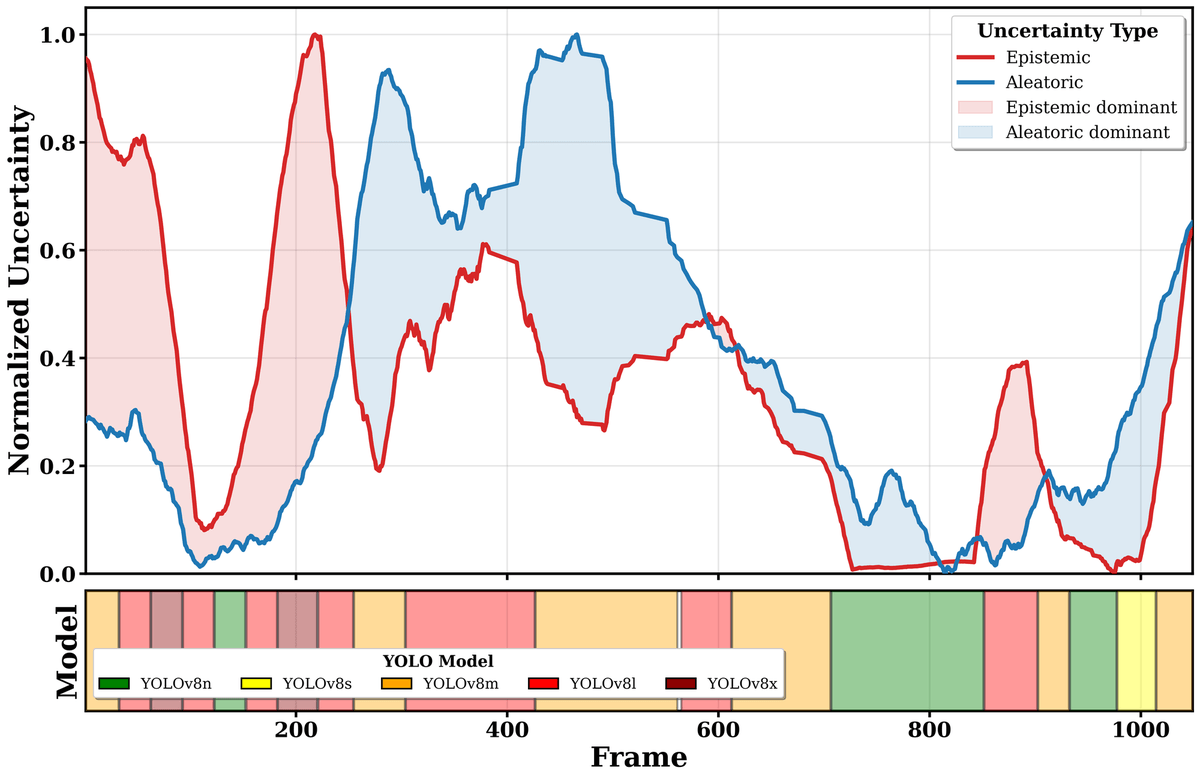
The authors extend the same decomposition to a completely different problem: adaptive model selection for multi-object tracking. The idea is that not every video frame needs a 68M-parameter detector. Most frames are easy. You only need the big gun when the scene is genuinely hard for the model -- which is an epistemic problem, not an aleatoric one.
Total uncertainty conservatively uses larger models when combined uncertainty is high, while the decomposed method recognizes that high aleatoric uncertainty alone does not require increased model capacity. Blur and measurement noise (aleatoric) do not mean the model is confused -- they mean the data is messy. Viewpoint changes, occlusions, and illumination shifts (epistemic) are when you actually need a bigger model.

An RL controller uses the two uncertainty signals to pick among five YOLOv8 detectors ranging from Nano (3.2M parameters) to XLarge (68.2M parameters). In adaptive tracking inference on MOT17, uncertainty-guided model selection reduces average compute by 58.2% relative to a fixed high-capacity detector while preserving detection quality within 0.4%. The XLarge model only activates on 8.6% of frames -- short bursts around genuine representation shifts. The decomposed approach beats a combined-uncertainty baseline by 13.6 percentage points in compute savings.
What it is and is not good for
TRIAGE is designed for systems where you already have a trained policy and want to make it more robust without retraining. It requires only a short nominal calibration rollout (256K transitions for manipulation, 300 steps for the epistemic threshold). The dynamics ensemble is small (5 MLPs) and adds minimal overhead.
The limitations are worth noting. The observation recovery mechanism in the paper uses simulator access to resample a clean physics state -- a luxury that does not exist on physical hardware. The authors acknowledge this and suggest Kalman filtering or a learned denoiser as drop-in replacements for real robots. The epistemic estimator also requires that the calibration rollout covers the nominal operating distribution reasonably well; if the nominal policy itself is highly variable, threshold calibration becomes harder.
The importance of principled uncertainty handling extends beyond robotics to language and vision-language models, where conformal abstention policies have been shown to improve risk management under distribution shift. The authors hint at this direction explicitly, noting that the same decomposition principle applies to trajectory-level risk assessment in agentic reasoning systems.
Code and demo videos are available at the project page, and the full paper is on arXiv. The dynamics ensemble and Mahalanobis estimator are both straightforward to implement -- here is the core inference logic:
# At each timestep t:
sigma_alea = mahalanobis_distance(obs_t, mu_cal, Sigma_cal_inv)
sigma_epis = ensemble_prediction_error(obs_prev, action_prev, obs_t)
if sigma_alea > tau_alea:
    obs_t = average_resampled_observations(physics_state, N=5)  # or Kalman filter
if sigma_epis > tau_epis:
    action_t = action_t * (1 - alpha)  # alpha=0.30 default
The real breakthrough here is not a new architecture or a new training recipe. It is the recognition that asking "how uncertain are you?" is the wrong question. The right question is "uncertain about what?" -- and that the answer should determine which part of the system you fix.