
UHasselt Exposes Why HCI Fabrication Research Almost Never Works Outside the Lab
A CHI 2026 workshop paper argues that HCI fabrication research keeps shipping prototypes without the knowledge required to actually transfer them, and proposes a vocabulary to fix that.
 Pro
Takeaways
- Position paper reframes engineering maturity in HCI fabrication as knowledge-producing work, not cleanup after research.
- Introduces Fab-ilities: buildability, executability, reliability, maintainability, transferability, scalability.
- Argues transfer knowledge often does not exist at publication because generating it is not rewarded.
- Grounds the argument in five postmortems: JigFab, StoryStick++, Silicone Devices, LamiFold, PaperPulse.
- LamiFold case shows laser calibrations that worked in one lab routinely failed on other machines.
- Accepted at the RealFab'26 workshop at CHI 2026 in Barcelona.
If you have ever tried to reproduce a slick fabrication demo from an HCI paper and found yourself calibrating a laser cutter for a week, you already know the pattern. A short position paper from the Digital Future Lab at UHasselt argues this is a structural problem in how the field publishes work, not an accident of adoption timelines. The authors reflect on a decade of their own attempts to push research prototypes toward markets, and propose a vocabulary to talk about the gap.
The diagnosis
Many HCI fabrication systems are compelling as prototypes but remain difficult to reuse, extend, or transfer beyond their original publication. A common explanation is that adoption simply takes time. The authors argue the issue runs deeper: the knowledge needed to make these systems transferable, meaning how they behave across different materials, machines, and users, usually does not exist at the time of publication because the work required to generate it is rarely incentivized or rewarded.
Engineering as knowledge production
The reframing borrows from engineering epistemology. The paper treats engineering maturity as epistemic work: sustained effort that produces knowledge which prototyping alone cannot reveal. Tuning a workflow until it survives a different lab bench is not janitorial cleanup after the real science. It is the science, because it is the only way to find out what generalizes.
Epistemic work here just means work that generates knowledge. A one-off demo proves an idea is possible on one machine. Figuring out the tolerance windows, failure modes, and calibration procedures that let someone else reproduce it is a different kind of contribution, and today it mostly happens invisibly, if at all.
Six words for what is missing
To make the argument actionable, the authors propose a vocabulary they call Fab-ilities. The six dimensions capture what a contribution makes buildable, runnable, and transferable beyond the original lab setting, inspired by a prior workshop on an Interaction Engineering Glossary for interactive software. The Fab-ilities are descriptors for articulating what kind of maturity a contribution achieves, what remains unresolved, and what that maturity enables for others, rather than a checklist or compliance target.
- Buildability - can someone else physically assemble the system from the published artifacts?
- Executability - does the software and toolchain actually run outside the original setup?
- Reliability - does it produce the same result twice?
- Maintainability - can the system be fixed, updated, or debugged over time?
- Transferability - does it survive different materials, machines, and users?
- Scalability - can it grow beyond a demo into production?
Five postmortems
The vocabulary is grounded in five of the group's own projects that were pushed toward the market and hit different walls: JigFab, StoryStick++, Silicone Devices, LamiFold, and PaperPulse. Attempts at commercialization, spin-offs, and market exploration each ran into gaps between what had been published and what was actually needed.

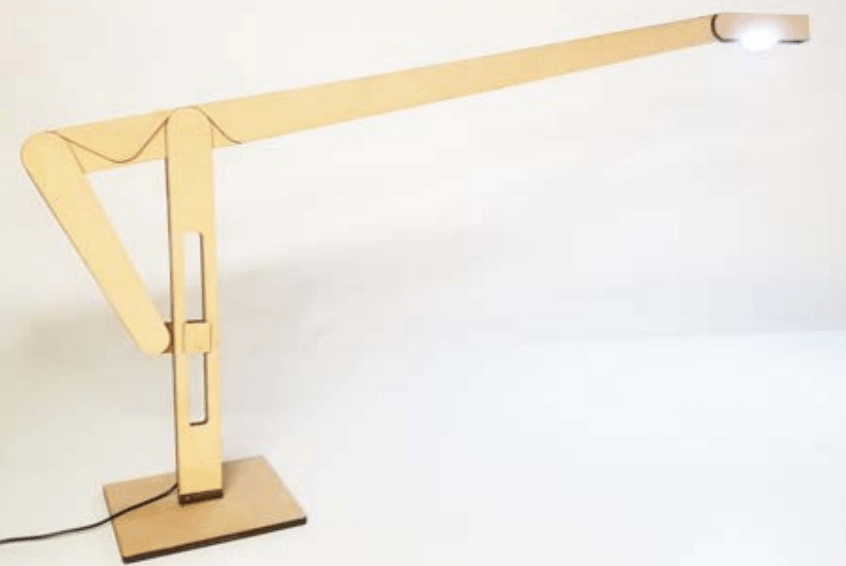
JigFab helps makers design and fabricate custom woodworking jigs, and commercialization exposed gaps in robustness, documentation, cross-context reliability, and multi-institution IP complexity. LamiFold hit a subtler wall. Its lamination workflow selectively cuts and glues stacks of sheet material to embed functional mechanisms, but in practice the process is highly sensitive to machine and material parameters, and laser power, cutting speed, kerf width, and material thickness interact in ways that are hard to describe in general terms. Calibration settings that worked on one laser cutter often failed on another, and the know-how required to make it work reliably stayed tied to hands-on experience rather than transferable instructions.
Silicone Devices tells a related story on a longer timeline. During its trajectory, the focus shifted from the original HCI goal of democratizing fabrication toward industrial applications, where it faced strong competition from established manufacturing techniques. The track ended when the lead researcher moved into a different role, and the work continues to inform research in both materials science and HCI. The published workflow used a CO2 laser cutter and liquid metal for stretchable electronics, but transfer required process control and industrialization knowledge beyond that workflow.

Why this matters if you build systems
There is no code or model release here, and it is worth being explicit about that. This is a position paper for the RealFab'26 workshop at CHI 2026, not a system contribution. It will not help you calibrate a laser cutter today. What it does offer is a way to name what you are doing when you spend three months hardening someone else's prototype, and a way to review papers that separates a novel idea from an idea that anyone else can actually run.
The limits are also honest. The authors do not claim these dimensions are exhaustive or final, and offer them to make maturity discussable and reviewable, and to prompt a broader conversation about what fabrication research in HCI should value beyond novelty. The framework will not tell you whether a system is good. It will tell you what parts of good you have not proven yet, which is a more useful thing than it sounds.