
UESTC's SeGP-CL Uses Adversarial Tricks to Stop AI From Forgetting Old Classes
A new method for CLIP-style continual learning targets the exact boundary regions where new tasks overwrite old knowledge, hitting state of the art on five benchmarks.
 Pro
Takeaways
- SeGP-CL is a new exemplar-free continual learning framework for CLIP-style vision-language models
- Key insight: forgetting concentrates near the old-new semantic interface, not uniformly in embedding space
- Uses dual-targeted PGD to build adversarial anchors that probe vulnerable boundary regions
- Beats prior state of the art on CIFAR100, ImageNet-R, ImageNet-Sub, CUB-200, UCF101 benchmarks
- Preserves zero-shot ability on Food-101, Oxford-Pets, ImageNet-1K after continual training
- Uses only LoRA adapters, adding under 20% training overhead versus naive fine-tuning
Continual learning on vision-language models like CLIP has a nasty failure mode. Every time you fine-tune on a new batch of classes, the model quietly rewires the shared image-text embedding space, and previously learned concepts get pulled out of position. A new paper from researchers at UESTC proposes SeGP-CL, a framework that treats this drift as a geometry problem and attacks it with a surprising tool: adversarial examples.
The core observation is that catastrophic forgetting is not uniform across the embedding space. Drift concentrates around the old-new semantic interface, where incoming samples share visual patterns with previously learned concepts and these shared visual patterns are prone to being re-explained by newly introduced textual semantics. In other words, a new class of "tigers" quietly hijacks the region of feature space that used to belong to "cats," because both share stripes, whiskers, and pointed ears.
Measuring where the geometry breaks
To confirm this, the authors quantified how much the cross-modal similarity distribution shifts after an incremental update using Jensen-Shannon divergence, a symmetric measure of how far two probability distributions are from each other. They observed markedly larger drift around the semantic interface (where visual features have a low similarity with their corresponding text embedding) after an incremental-task update, indicating that cross-modal geometry distortion is primarily triggered by boundary neighborhoods rather than the core regions of old semantics.

Prior methods handle this either conservatively (early stopping, freezing the backbone, keeping reference datasets around) or by injecting task-specific components that isolate old and new knowledge. Both approaches sidestep the actual issue rather than solve it. SeGP-CL instead tries to explicitly probe and protect those vulnerable boundary regions, and does so under an exemplar-free constraint, meaning no images from previous tasks are stored.
Adversarial anchors as boundary probes
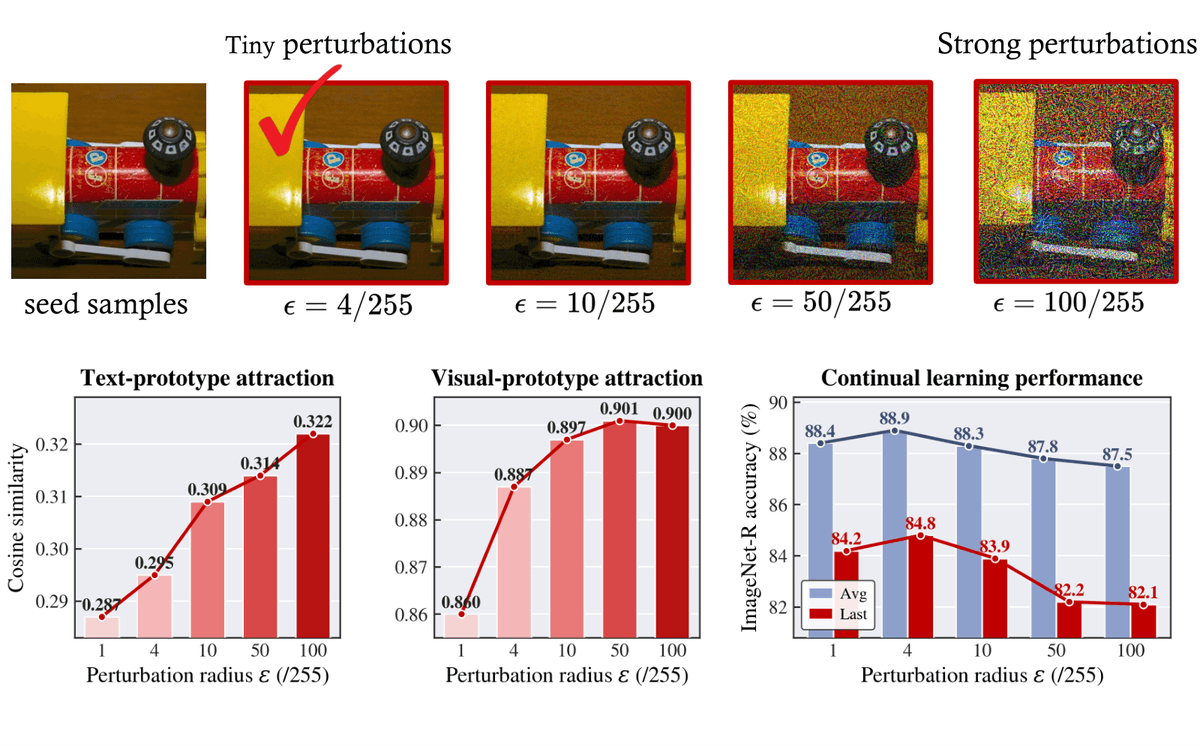
The clever part is how the paper finds those vulnerable regions without access to old data. It borrows from adversarial robustness research: if a tiny perturbation can push a new image into an old class's decision region, that perturbed image is essentially sitting on the boundary you want to defend. The authors call these Dual-targeted Projected Gradient Descent (DPGD) anchors. Standard PGD would just push a new sample toward an old-class text embedding, but that alone is unreliable. Because of the modality gap between visual and textual embedding spaces, driving an image embedding toward a target text embedding alone may match the direction of textual semantics while deviating from class-consistent visual patterns, yielding unstable or visually implausible anchors.
DPGD fixes this by attacking with two objectives simultaneously:
- Push the sample toward an old-class text embedding (softmax cross-entropy over old classes)
- Keep the sample close to the old class's raw visual prototype (cosine similarity in raw feature space)
The combined objective is optimized under an L-infinity budget, so anchors remain nearly indistinguishable from the original new-task image while landing squarely in the old-class neighborhood.
Three losses working together
Once the anchors are built, training a task uses three objectives on top of standard cross-entropy on the new classes:
- Anchor-guided Cross-modal Geometry Distillation (ACGD). On each anchor, the student's softmax distribution over old classes is pulled toward the frozen teacher's distribution via KL divergence with a fairly high temperature (20). This preserves the global relational structure the teacher inherited from pretraining.
- Text Semantic Geometry Regularization (TSGR). The text encoder itself drifts as LoRA adapters update. TSGR resets the LoRA weights to get a stable reference text encoder, then for each new class it builds a k-NN subgraph (k=10) of nearest textual concepts and forces the student to match the teacher's relative similarity distribution over that neighborhood.
- Standard cross-entropy on new-task labels.
Only LoRA up-projection matrices are trained, keeping the trainable parameter count between 0.25M and 3.44M depending on where adapters are inserted.
After training: drift compensation and dual-path inference
Because old images are not available, old-class visual prototypes go stale as the encoder updates. SeGP-CL reuses the anchors to estimate this drift. For each old class, it takes the anchors targeted at that class, measures how their raw features shifted between the teacher and updated encoder, and applies a weighted average of those displacements as the class-wise translation. Anchor weights are proportional to how close each anchor was to the previous prototype under the teacher.

At inference, predictions combine two signals: the CLIP cross-modal score and a raw visual prototype score, fused with a coefficient of 0.5.
Results across five benchmarks
On CIFAR100, ImageNet-R, ImageNet-Sub, CUB-200, and UCF101 with a CLIP ViT-B/16 backbone, SeGP-CL beats every prior method reported. Some highlights:
- On CIFAR100, SeGP-CL improves the Last accuracy from 80.6 (MG-CLIP) to 84.6, and on CUB-200 it boosts Last from 76.2 (RAPF) to 80.1.
- On ImageNet-R, Last accuracy hits 84.8 versus 82.7 for the closest competitor.
- Forward Transfer, Backward Transfer, and Forgetting metrics are all best in class, with Forgetting on CIFAR100 dropping to 0.9 versus 4.9 for MG-CLIP.

Zero-shot capability is also preserved. After 10 stages of continual training on CIFAR100, the model still hits 84.5% on Food-101, 87.7% on Oxford-Pets, and 67.6% on ImageNet-1K, matching or slightly beating the untouched zero-shot CLIP baseline. Methods that inject task-specific modules, like PROOF and RAPF, degrade to 22.8% and 28.6% respectively on Oxford-Pets, showing how much they rewire the shared embedding space.
Where it fits and where it doesn't
SeGP-CL is particularly relevant if you are running class-incremental fine-tuning on top of a CLIP-style backbone and cannot store exemplars for privacy or storage reasons. The training overhead is modest (under 20% extra time compared to naive LoRA fine-tuning) and inference cost is essentially unchanged, since the auxiliary visual branch adds only 0.00013 GFLOPs on top of CLIP's 17.56 GFLOPs.
Limitations worth noting: the method still stores raw text labels and per-class visual prototypes as lightweight memory, and its effectiveness depends on prompt-template quality. It also targets class-incremental settings rather than cross-domain or multi-task cooperative learning. And the authors note the approach may struggle in severely out-of-distribution scenarios where the pretrained vision-language alignment no longer holds.