
UCLA's MiNI-Q Is a $300 Backflipping Robot With No Joint Limits
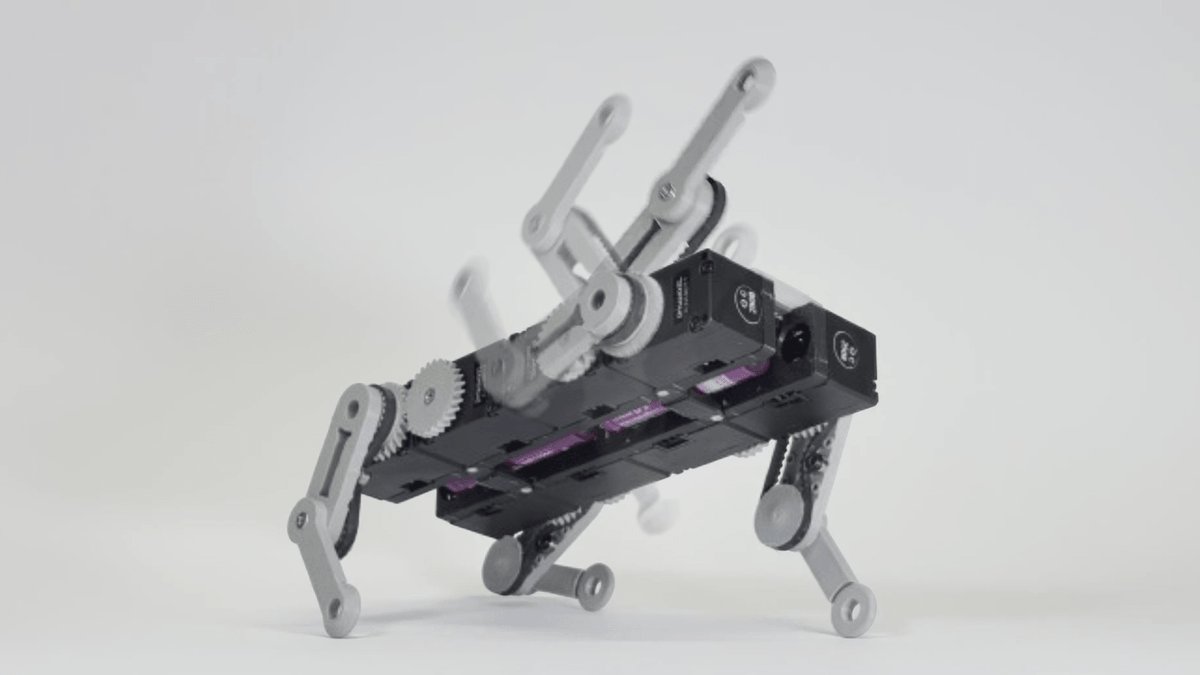
A palm-sized, cable-free quadruped from UCLA's RoMeLa eliminates joint stops entirely, unlocking backflips, wheel-like rotation, and 45mm crawl clearance.
 Pro
Takeaways
- UCLA RoMeLa released MiNI-Q, a 240g wire-free quadruped with unbounded 2-DOF leg joints.
- Belt-driven 2R leg mechanism lets both shoulder and knee rotate continuously and independently, no hard stops.
- Hits 0.46 m/s top speed (5.22 body lengths/sec), jumps 220 mm, backflips, and folds to 2.5 cm.
- Climbs steps 2.2x its body height and crawls through 45 mm gaps using splayed legs.
- Built on ESP32C3-MINI, DYNAMIXEL XL330 servos, BNO055 IMU; JLCPCB-assemblable, hobbyist 3D-printable.
- All design files open source at RoMeLaUCLA/miniq-public; control is currently open-loop.
Most legged robots hit a wall the moment their joints do. Cables snag, hard stops crack, and the reachable workspace of the leg shrinks to whatever the mechanical designer could squeeze in before something jammed. A team at UCLA's Robotics and Mechanisms Laboratory has taken a swing at that constraint with MiNI-Q, a 240-gram quadruped whose shoulder and knee joints can spin freely and independently, with no hard stops anywhere.
The design comes from Daniel Koh, Suraj Shah, Yufeng Wu, and Dennis Hong, and it builds directly on the earlier Q8bot, a wire-free miniature quadruped the same lab published in 2025. Where Q8bot leaned on a compact five-bar parallel linkage, MiNI-Q swaps in a belt-driven 2R serial leg that can rotate through a full circle in either joint. The entire mechanical and electrical package is open source on GitHub.
Why joint limits are a bigger deal than they sound
In a typical quadruped, cables routed through the leg fatigue and eventually snap under repeated large motions, so designers add hard stops that keep the joints inside a safe range. Those stops can also protect the hardware from bad motion commands, but they carve chunks out of the reachable workspace and constrain what gaits are even expressible.
Parallel mechanisms like five-bar linkages sidestep some of this by keeping actuators stationary at the base, and coaxial variants can even permit continuous rotation, but that trick is common in wheel-leg transformable robots where the design is biased toward wheeled operation. MiNI-Q's contribution is enabling independent unbounded rotation of both joints in a purely legged robot, rather than coupled continuous motion tied to a wheel mode.
How the leg actually works
The hip is driven directly by the first actuator, and the knee is driven remotely by a second actuator that stays rigidly attached to the first. A helical gear pair drives a compound idler with an integrated timing belt pulley, and an MXL belt tensioned by a miniature ball bearing runs along the upper link to the knee. Because the transmission stages avoid physical overlap, both joints can rotate continuously without interfering with each other.

The kinematics are the classical 2R manipulator solution with a fixed joint-to-actuator mapping matrix applied on top:
theta = A_inv @ q,  where A_inv = [[1, 0],
                                   [1, 1]]
With equal link lengths and no hard stops, the reachable workspace becomes a full circle at maximum extension, and the Yoshikawa manipulability index ends up radially symmetric rather than concentrated in narrow bands like on the parent Q8bot design.
The hardware stack
MiNI-Q is standalone and cable-free. The build list is short and buyable:
- Eight DYNAMIXEL XL330-M077-T servos mounted horizontally to a 3D-printed chassis
- An ESP32C3-MINI system-in-package with a built-in PCB antenna, replacing the Seeed XIAO module used on Q8bot
- A BNO055 IMU on an I2C bus, plus a Qwiic connector for future sensors
- An onboard lithium-ion charger and a 2S battery pack feeding a 6V step-down converter
- PLA parts printed on a hobby FDM printer with a 0.2 mm nozzle for gear and pulley accuracy
Moving from Q8bot's 1S boost topology to a 2S step-down bumps rated stall torque by roughly 6 percent and no-load speed by 19 percent, which matters a lot for the dynamic tricks the robot pulls off later. The PCB is designed to be fully compatible with JLCPCB's automated assembly service so builders don't need reflow gear or turnkey quoting.

What it can actually do
The performance numbers are competitive for the size class, though not class-leading on efficiency:
| Gait | Speed | Body lengths/sec | Cost of Transport |
|---|---|---|---|
| Slow trot | 0.12 m/s | 1.36 | 11.5 |
| Fast trot | 0.46 m/s | 5.22 | 8.1 |
| High trot | 0.16 m/s | 1.81 | 7.1 |
| Crawl | 0.03 m/s | 0.32 | 19.7 |
Cost of Transport is the classic Vi/(mgv) efficiency metric, and MiNI-Q's number is worse than Stanford Doggo's 3.2 or Q8bot's 6.04. The team attributes the gap to the serial leg configuration losing the mechanical advantage that Q8bot's five-bar linkage distributes across actuators, plus friction and backlash in the belt transmission. They frame it as a deliberate trade for a workspace that isn't there in the parallel design.
The unbounded workspace unlocks behaviors that would be awkward or impossible on a conventional quadruped:
- Ledge climbing up steps 2.2x the robot's own body height, using full leg rotations to hoist the chassis
- Low crawl through a 45 mm gap by splaying the legs sideways with near-zero vertical offset
- Gravel traversal using a continuous-rotation gait where splayed legs act like eccentric wheels, hitting 0.13 m/s versus 0.038 m/s in fast trot on the same substrate
- Vertical jumps to 220 mm, about nine times the chassis height, initiated from a legs-up rest position by slamming the limbs downward
- Backflips, generated by a coordinated leg wrench that the parallel Q8bot linkage could not produce
- Instant flip recovery in under 0.5 seconds by pivoting all limbs 180 degrees, since the mechanism is symmetric about the horizontal plane

What it isn't ready for
Everything shown in the paper runs open-loop. Joint trajectories are pre-computed on a host laptop, because the ESP32-C3 hits FreeRTOS scheduling delays when it has to juggle ESP-NOW communication, half-duplex DYNAMIXEL bus traffic, and high-frequency IMU polling at the same time. That means the current robot can't react to unexpected terrain or disturbances. The DYNAMIXEL internal current sensors are also noisy enough that the COT numbers should be read as approximations.
The team's next PCB revision moves to a dual-core ESP32-S3, adds INA260 current-shunt monitors for cleaner power measurements, and exposes UART and SPI so a single-board computer can drop in and run ROS 2. They also flag reinforcement learning and swarm robotics as follow-on directions, citing prior work showing that minimizing mechanical energy tends to produce naturally efficient gaits across varied terrain as motivation for a sim-to-real pipeline on MiNI-Q.
Why this matters as a platform
The interesting thing here isn't just the mechanism, it's the accessibility. A $300-ish class quadruped that assembles without solder paste, has no wires to route, prints on a hobbyist FDM machine, and now backflips is a plausible starting point for classroom robotics, swarm experiments, and locomotion research where a Unitree or Spot is overkill. The full mechanical and electrical design files are released open source specifically to support reproducibility and further research, and the earlier Q8bot repository is already being used in undergraduate and even high-school workshops. If you've been looking for a research-grade legged platform that fits in a backpack, this one just got a lot more interesting.