
UCLA and Cisco's ReTabSyn Beats Real Data With Just 32 Training Rows
A new fine-tuning pipeline teaches language model tabular generators to preserve feature-target correlations, beating diffusion and GAN baselines on tiny, imbalanced datasets.
 Pro
Takeaways
- ReTabSyn applies DPO to a GReaT-based generator to prioritize P(y|X) over the full joint distribution.
- Preference pairs are built oracle-free via rule-based perturbations of features and targets in the paper.
- Beats GReaT, TVAE, TabSyn, SMOTE, PTA and SynRL on datasets sized 32 to 512 rows.
- Cuts structural constraint violations on Adult to 0%, versus 2 to 3% for TabSyn and GReaT.
- Two-stage pipeline: augmented pre-training then DPO fine-tuning; ablations show both are needed.
- Sometimes beats training on the original real data when that data is extremely scarce.
Synthetic tabular data has become the go-to workaround when real datasets are too small, too imbalanced, or too sensitive to share. But most deep generators still stumble on the exact regimes where you need them most: a few hundred rows, a heavily skewed target column, or a shifted test distribution. A team from UCLA and Cisco is proposing a fix called ReTabSyn, which borrows the alignment machinery from LLM post-training and points it at a very different objective: preserving the statistical relationships that downstream classifiers actually rely on.
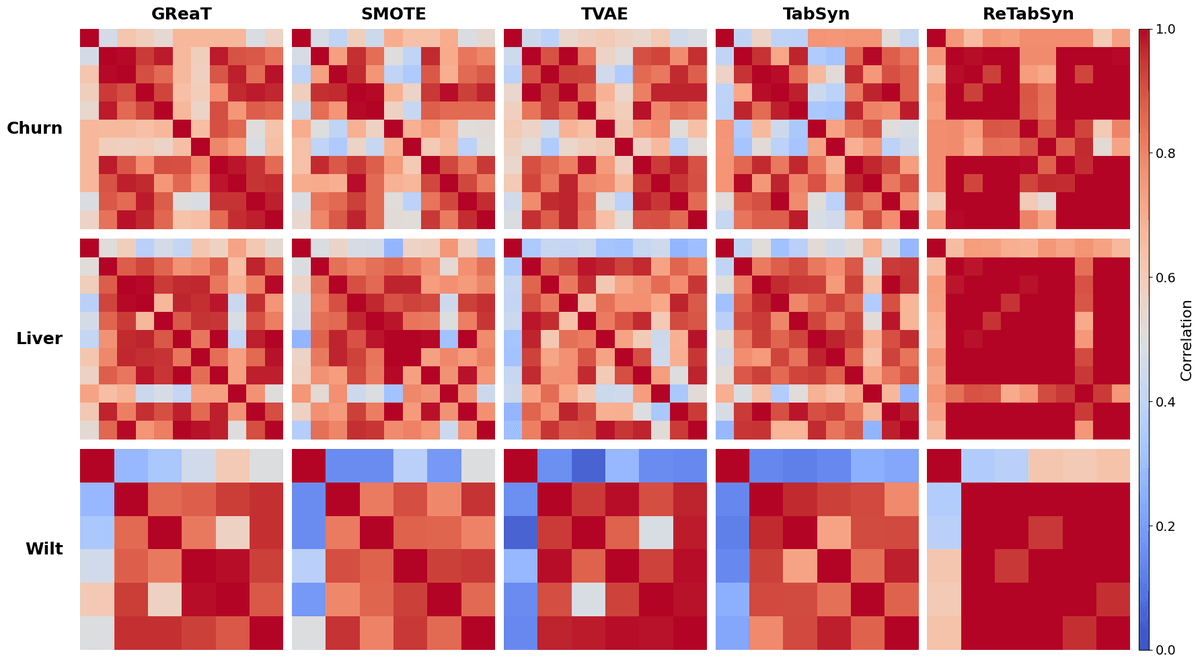
The core argument is that deep generative models can help with data scarcity and privacy by producing synthetic training data, but they struggle in low-data, imbalanced tabular settings to fully learn the complex data distribution, and striving for the full joint distribution could be overkill; for greater data efficiency, models should prioritize learning the conditional distribution P(y | X). In plain terms, the paper says most generators waste capacity trying to model everything about the data when what a downstream classifier really needs is a faithful picture of how features predict the label.
Why joint distributions are the wrong target
Tabular generators like GReaT (a fine-tuned GPT-2 that serializes rows into text), TabSyn (a latent diffusion model), and TVAE all try to approximate the joint distribution P(X, y). That is fine when you have tens of thousands of clean rows. It falls apart with a few dozen imbalanced examples, because the model spends effort matching marginal quirks of individual columns instead of the feature-target dependencies that carry the predictive signal.
SMOTE, the two-decade-old interpolation trick, keeps beating fancier generators on this exact problem. As one recent benchmark bluntly puts it, the interpolation-based method SMOTE continues to outperform many generative models. That awkward result is the backdrop for ReTabSyn.

The trick: preference optimization on perturbed rows
ReTabSyn starts from GReaT as its base generator and then applies Direct Preference Optimization (DPO), the same offline alignment method used to post-train chat models. Instead of human labelers picking between two responses, ReTabSyn builds preference pairs automatically by perturbing structured tables.
The construction is deliberately oracle-free. Unlike classic RLHF for LLMs and recent tabular RL approaches that rely on an external oracle classifier, ReTabSyn is both oracle-free and human-label-free. Structured tables permit reliable, rule-based perturbations (type checks, monotonic constraints, logical rules) that yield high-purity supervision at scale. In other words, you can flip a target label or nudge a feature to create a "rejected" row that provably violates a dependency, without needing a trained classifier in the loop.
The DPO objective then does what it always does: by enlarging the log-likelihood margin between the preferred and perturbed conditional probabilities, ReTabSyn effectively "locks in" the conditional relationships essential for downstream tasks, even when data volume is insufficient to learn the full joint distribution.

Two stages, one goal
Ablations confirm the pipeline needs both halves to work. Removing either training stage, skipping augmented pre-training or skipping DPO fine-tuning, reduces both AUROC and fidelity, confirming that the two-stage pipeline is necessary: augmentation provides diverse feature relationships, while DPO sharpens the conditional distribution.
- Augmented pre-training on serialized rows exposes the generator to a wide variety of feature relationships. A dynamic augmentation schedule scales with dataset size, since fixing augmentation size underperforms the dynamic schedule, while very large augmentation (Nx20) yields diminishing returns.
- DPO fine-tuning on preference pairs built from rule-based perturbations, teaching the model to assign higher likelihood to rows whose target matches the features and lower likelihood to rows that break the dependency.
The authors also tested oracle-based alternatives for building preference pairs. Both underperform the oracle-free default, suggesting that oracle noise degrades preference quality. A weak classifier trained on the same scarce data introduces its own errors into the supervision signal, defeating the point.
Numbers on the small-data regime
The evaluation focuses on classification datasets like Wilt, Magic, and Adult, sub-sampled to sizes ranging from 32 to 512 rows. Baselines include GReaT, TVAE, TabSyn, the interpolation baseline SMOTE, and two RL-based tabular methods, PTA and SynRL.
In the low-data regime of 32 to 128 rows, ReTabSyn consistently outperforms all deep generator baselines. Remarkably, when training data is extremely limited, ReTabSyn even surpasses the performance achieved with real data, likely due to the advantage conferred by the large volume of synthetic samples. That last result is unusual: a synthetic dataset producing higher downstream AUROC than the tiny real dataset it was distilled from.

As the size of the training set increases, the overall utility of synthetic data improves for all generators; however, ReTabSyn maintains its lead, consistently delivering the highest AUROC scores. The gap narrows once you have enough real data, which is exactly what you would expect if the method is genuinely closing the small-data gap rather than winning on some unrelated metric.
Fewer illegal rows, for free
One underrated benefit shows up in constraint compliance. Tabular datasets often carry implicit rules such as "age must be positive" or "education level and years-of-schooling must agree." On the Adult benchmark, ReTabSyn eliminates all violations at 0.00% across rules, while TabSyn and GReaT incur roughly 2 to 3%. This improvement stems from the preference-pair construction: perturbing constraint-related variables and letting DPO penalize rows that break the corresponding dependencies.
Because the preference labels are generated by rules, you can plug in expert-specified constraints and get a generator that respects them by construction, which matters for regulated domains like healthcare and finance.
Where it fits and where it does not
ReTabSyn is a good candidate when you have:
- A small classification dataset (roughly 32 to 512 rows in the paper's tests) that you want to augment or replace with synthetic samples.
- Heavy class imbalance where SMOTE-style interpolation blurs decision boundaries.
- Structural constraints that a plain LLM-based generator regularly violates.
- Distribution shift between train and test where preserving conditional structure matters more than marginal fidelity.
The method inherits GReaT's runtime cost, since it fine-tunes a language model on serialized rows, and it is currently demonstrated primarily on cross-sectional classification tables. Regression results are reported but the sweet spot is clearly small imbalanced classification. Once real data is abundant, the advantage over strong baselines shrinks.
The broader shift
The interesting move here is conceptual. Tabular synthesis has spent years chasing better generative models: bigger GANs, then diffusion, then LLMs. ReTabSyn instead treats synthesis as an alignment problem. You take an already-decent generator and post-train it against a task-shaped reward, exactly as chat-model teams do with human preferences. Because tables come with checkable structure, that reward can be built from rules rather than raters.
That framing also opens the door to controllable synthesis: beyond accuracy, fidelity-aware alignment provides a practical path to controllable synthesis: enforcing domain constraints and steering the generator toward whatever properties a downstream task cares about. If the pattern holds, the next generation of tabular synthesizers will look less like new architectures and more like existing generators plus a domain-specific DPO stage. The full paper is available on arXiv, and the related utility-driven RL synthesis line of work is documented in the SynRL paper that serves as one of its baselines.