
UCL Turns Broken AI Experiment Design Into a Solvable Sampling Problem
A new distributional formulation replaces gradient ascent on the expected information gain with particle-based flows that escape local optima in batch experimental design.
 Pro
Takeaways
- New paper reformulates batch Bayesian optimal experimental design as convex optimization over probability measures.
- Entropic regularization yields a Gibbs distribution as the unique minimizer, replacing non-convex EIG maximization.
- Wasserstein gradient flows implemented as doubly stochastic interacting particle systems handle intractable nested Monte Carlo gradients.
- Four algorithms trade off expressiveness and scalability: joint, mean-field, i.i.d., and i.i.d. with repulsion.
- Beats gradient ascent on multimodal sensor placement; matches or beats coordinate exchange on pharmacokinetic and FitzHugh-Nagumo benchmarks.
- Theoretical error bounds decompose into finite-particle, discretization, and stochastic-gradient contributions under strong confinement.
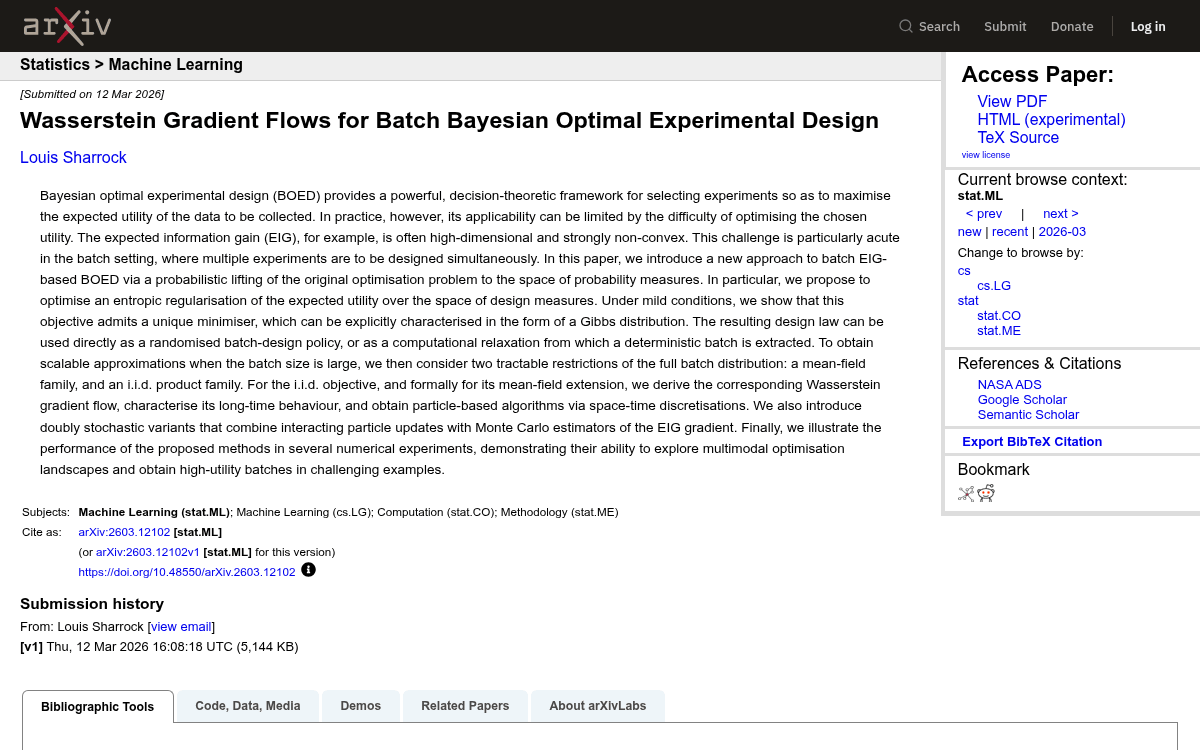
Choosing which experiments to run is often the most consequential decision in a scientific pipeline, and when experiments are expensive, slow, or ethically constrained, that choice matters even more. A new paper from University College London proposes a fresh attack on Bayesian optimal experimental design that swaps the usual gradient ascent for a particle-based flow over probability measures, and shows it consistently beats standard baselines on hard, multimodal problems.
The work targets a specific pain point: the expected information gain (EIG) is often high-dimensional and strongly non-convex, and this challenge is particularly acute in the batch setting, where multiple experiments are to be designed simultaneously. Rather than hunting for a single best batch, the method learns a distribution over batches, samples from it, and picks the best one.
Why point optimization keeps failing
Bayesian optimal experimental design (BOED) picks a design that maximizes the expected information gain, which is the expected Kullback-Leibler divergence between the posterior and the prior, equivalently the mutual information between the parameter of interest and the prospective observation. In practice this quantity is nasty to work with.
Three things go wrong at once. Evaluating the EIG and its gradient entails nested expectations that are rarely available in closed form, so estimators are noisy and sometimes biased. Even when the design space is low- or moderate-dimensional, the expected-utility landscape is typically multimodal and strongly non-convex. And in the batch setting where you must pick m experiments at once, the ambient dimension grows to md, and the utility landscape becomes increasingly complex due to interactions between design points.
Gradient ascent with restarts gets stuck. The paper's 1D toy problem shows this vividly: given a poorly chosen initialization, gradient ascent collapses onto local maxima and never finds the global one.
Lifting the problem into measure space
The core idea is a change of variables. Instead of optimizing over a design vector, optimize over a probability distribution on the design space. Then add an entropy penalty to make the problem well-behaved. The paper minimizes a free energy functional of the form:
F(v) = -E_v[EIG(x)] + lambda * KL(v || rho)Here rho is a reference measure and lambda is a temperature. Large values favor exploration, while small values concentrate the design measure around batches that achieve a high value of the EIG. The magic: under an exponential-integrability condition ensuring the normaliser is finite, the objective is strictly convex, and admits a unique minimiser with explicit Gibbs form. So instead of a non-convex mess with many local optima, you get a single, well-defined target distribution that concentrates on high-utility regions.
Two ways to use it: sample directly from the learned law as a randomized policy, or use it as a computational relaxation where you draw many candidate batches and pick the one with the highest estimated EIG.
Making it scale with Wasserstein gradient flows
Sampling the joint Gibbs distribution on the full batch space is prohibitive when m is large. The authors introduce two structured approximations:
- Mean-field: batch factorizes as independent but non-identical marginals, one per batch position
- i.i.d. product: a single shared design law, with batch elements drawn independently
For these restricted families, the minimizer no longer admits a closed form. Instead, the authors derive the corresponding Wasserstein gradient flow, a steepest-descent dynamics over probability measures. In practice this becomes a McKean-Vlasov stochastic differential equation, approximated by an interacting particle system with an Euler-Maruyama discretization. Each particle update looks like Langevin dynamics with a drift that couples the particle to the empirical distribution of the others.
Because the EIG gradient itself is intractable, the algorithm is doubly stochastic. It uses Monte Carlo both to approximate the mean-field interaction (via the tuples) and to approximate the intractable gradient (via the auxiliary variables). Concretely, at each step you subsample a small number of partner tuples from the current particle cloud and use a nested Monte Carlo estimator for the gradient. The interaction cost drops from an infeasible O(N^(m-1)) per particle to just O(K), where K can be as small as 1.
The paper delivers a finite-horizon error decomposition separating three sources of error: propagation of chaos (finite particle count), Euler discretization, and stochastic gradient noise.
Four algorithms, one framework
The paper crystallizes the design space into four concrete algorithms, ranging from expressive to scalable:
- WGF (Joint): evolves full batches on the m-dimensional product space. Most expressive but scales poorly with batch size.
- WGF (MF): evolves m coupled particle systems, one per batch coordinate. Allows within-batch specialization.
- WGF (MF-IID): evolves one particle system for a shared design law. Simplest and most scalable.
- WGF (MF-IID-REP): adds a repulsive potential to the i.i.d. variant to prevent particle collapse and encourage diversity.
What the experiments show
The authors run five experiments, ranging from a 1D toy to established BOED benchmarks. A few results stand out.
On a 2D non-linear sensor-placement problem with a bimodal Gaussian mixture prior, gradient ascent gets trapped: given an initialisation around the local mode, SGA never discovers the global mode, and given an initialisation far from either mode in an uninformative region of the design space, SGA never discovers either mode. The WGF variants, thanks to injected diffusion noise, find both modes consistently and produce designs with lower posterior uncertainty.
On a batch-design problem on the torus, an interesting effect appears at scale. The i.i.d. mean-field methods can outperform the joint method for large batch sizes. This is not because a restricted family can beat the true optimum, but because as the batch size increases, it becomes increasingly hard to explore the joint space, as mixing degrades rapidly, while the mean-field method always operates on a space which is much easier to explore. Sampling many candidate batches from a well-learned i.i.d. design law and picking the best turns out to be a surprisingly effective global search.
On two established benchmarks, a pharmacokinetic sampling-time problem and the FitzHugh-Nagumo neuron model, the mean-field variants attain the highest or near-highest EIG across seeds, matching or beating coordinate-exchange baselines and annealed SMC. The recovered pharmacokinetic designs reproduce the characteristic pattern from the literature: sampling times cluster in early and late phases with fewer mid-horizon points.
Where it works, where it doesn't
The framework is a fit when your EIG landscape is genuinely multimodal, your design space is continuous, and you need batches rather than a single point. Concrete applications the paper motivates include Bayesian adaptive clinical trials, sensor placement and data acquisition for large-scale inverse problems governed by PDEs, and systems biology and pharmacometrics.
Two caveats matter. First, the theoretical convergence guarantees hold in a strong-confinement regime where the entropic regularization dominates the curvature of the interaction terms, a condition which is somewhat conservative, and may not hold in low-temperature, highly multimodal settings. The numerical experiments explore the harder regime empirically. Second, the i.i.d. family cannot represent optimal batches whose coordinates should differ substantially, so an extraction step or an explicit diversity term is essential in those cases.
The paper does not appear to include a public code release, though the algorithms are described in enough detail to reimplement, and the ingredients (interacting particle Langevin, nested Monte Carlo EIG estimators) exist in standard PyTorch and JAX stacks. The doubly stochastic update itself is only a few lines beyond a standard Langevin sampler, with the added twist of subsampling partner tuples for the mean-field interaction.
The bigger takeaway is a shift in mindset. Instead of viewing BOED as a hard non-convex optimization problem and reaching for restarts and heuristics, the paper reframes it as a sampling problem with a convex, well-posed target. Once you accept that framing, particle-based algorithms with clean theoretical guarantees follow almost mechanically.