
UChicago Exposes How Most AI Benchmarks Are Just Expensive Duplicates
A new framework uses token-level perplexity from real-world text to fingerprint LLM benchmarks, revealing hidden overlaps that raw performance scores completely miss
 Pro
Takeaways
- New method: Benchmark signatures use token-level perplexity from real-world text to fingerprint what each LLM benchmark actually measures.
- Performance correlations are misleading: Models rank similarly on MMLU history and MMLU chemistry not because the topics overlap, but because they share a question format.
- Key finding: Coding benchmarks are the most isolated capability; logic benchmarks heavily overlap with instruction-following, not with each other.
- LLMs organize knowledge differently: Signature tokens for coding include literary text; logic signatures contain genetic code strings, suggesting non-human conceptual structure.
- Scale: Evaluated across 32 models and 89 benchmarks using the RedPajama corpus; robust results confirmed on a second corpus (Dolma).
- Open source: Code and data available at github.com/siyangwu1/Benchmark-Signature-Repository.
The LLM evaluation ecosystem has a dirty secret: most of the benchmarks we use to compare models are measuring the same things. A new paper from the University of Chicago introduces benchmark signatures, a principled method to map which benchmarks actually test distinct capabilities and which are just expensive duplicates of each other.
The scale of the problem is hard to overstate. The NeurIPS Datasets and Benchmarks Track received 252 submissions in 2021 and 1,820 in 2024, a more than sevenfold increase. While these resources often claim to assess distinct capabilities, it is frequently unclear whether they truly do so, or whether they merely capture narrow proxies, prompt-specific heuristics, or overlapping skills that have already been extensively tested elsewhere.
The Benchmark Overlap Problem
There are three obvious ways to check if two benchmarks overlap: compare the text of their questions (semantic similarity), see if models rank the same way on both (performance correlation), or look at something deeper. The first two approaches, it turns out, are deeply flawed.
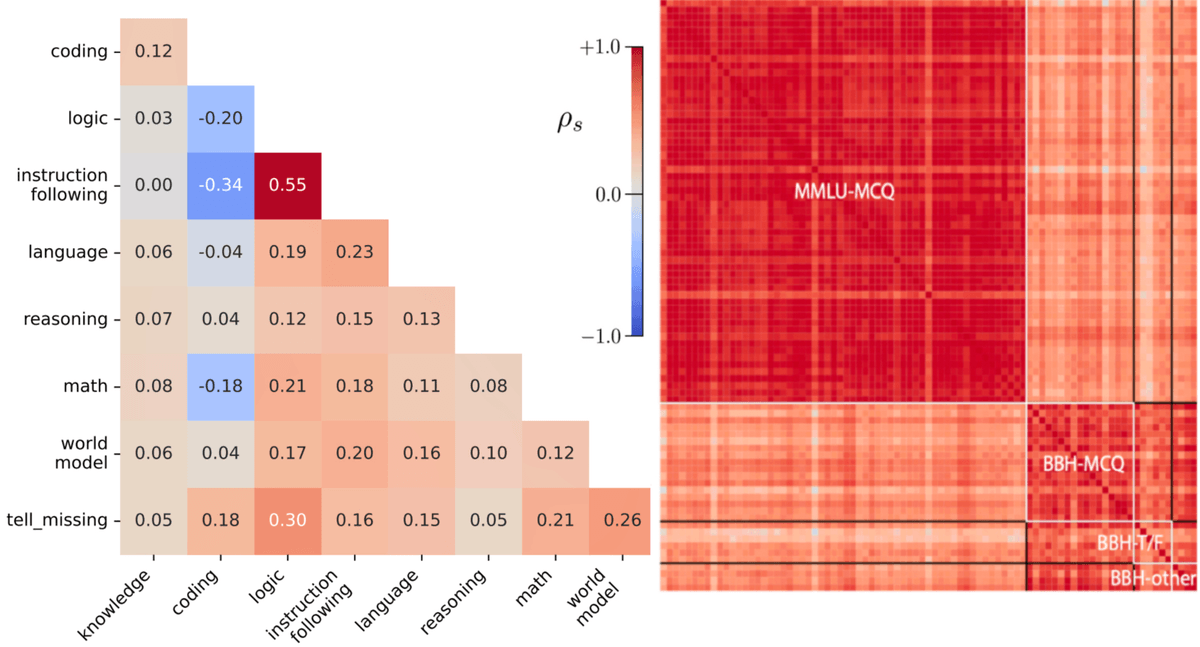
Performance-level results show strong segregation: model behaviors on certain cross-category benchmarks are as closely aligned as they are within categories. When examining these unexpectedly high alignments, the authors find they occur within the same broad benchmark families (e.g., MMLU or BigBench-Hard) or under the same question format (e.g., True/False versus multiple-choice questions). In other words, MMLU history aligns more closely with MMLU chemistry than with a non-MMLU history benchmark, simply because they share a question format. That is a benchmark artifact, not a signal about what the model knows.
Semantic overlap scores remain in a narrow range (typically 0.1 to 0.4) regardless of whether benchmarks come from the same or different categories. Surface-level text embeddings just cannot tell you whether two differently-worded questions are testing the same underlying skill.

The Signature Idea
The core insight is elegant. Every capability an LLM has, whether it is solving math problems, writing code, or reasoning about history, came from patterns in its training data. That means real-world text (news articles, Wikipedia, GitHub repos, academic papers) implicitly encodes those capabilities. If you can find the specific tokens in that text whose perplexity scores predict benchmark performance, you have found a fingerprint for what that benchmark is actually measuring.
A benchmark signature is defined as a set of salient tokens extracted from large-scale in-the-wild corpora, such that the perplexity of a collection of language models on those tokens is highly predictive of their performance on the benchmark. Perplexity here is a measure of how surprised a model is by a token. Low perplexity means the model has seen similar patterns during training; high perplexity signals unfamiliarity.
The key intuition: even if a benchmark item never appears verbatim in the wild, its function recurs pervasively. Unit-aware arithmetic appears in recipes, commonsense causality in narratives, claim-to-inference chains in scientific abstracts, and code repair patterns in GitHub issues.
How It Works, Step by Step
The pipeline runs in two stages against the open-sourced codebase:
- Pre-filtering with Thrush correlation: For each benchmark, compute a rank-based correlation between every token's perplexity vector (across 32 models) and the benchmark's performance vector. This screening is highly efficient, requiring linear time in the number of features O(md), and the distribution of these coefficients is sharply peaked at zero, with small tails representing potentially informative tokens. The top and bottom 1% of tokens are kept.
- Forward selection with AIC: On the filtered candidate set, run greedy stepwise regression. At each step, add the single token that most improves the Akaike Information Criterion (AIC), a score that penalizes model complexity to prevent overfitting. The process terminates when no additional token can improve the model's AIC score by a meaningful amount. Across benchmarks, the selected set typically has around 30 features.
The raw numbers are staggering. The covariate matrix P has dimensions 32 models by approximately 1.69 x 10^7 token instances, after downsampling from an initial pool of approximately 8.45 x 10^9 token-level contexts. The whole thing runs on 2x A100 GPUs, with perplexity extraction taking about 2 hours per model and 30 to 40 minutes of regression per benchmark.

What the Signatures Reveal
The experiment spans 32 models and 89 benchmarks, with signatures extracted from RedPajama, which contains large-scale textual data across multiple domains including CommonCrawl, C4, GitHub, arXiv, Books, Wikipedia, and StackExchange. The models range from GPT-2 variants to Llama 3.1, Qwen3, Gemma 3, Phi-4, and DeepSeek.
Several findings stand out:
- Knowledge and reasoning benchmarks heavily overlap. Signatures uncover substantial overlap between benchmarks in knowledge and reasoning tasks, whereas benchmarks in culture- and humanity-oriented domains show low similarity with each other.
- Coding is uniquely isolated. Coding appears far less entangled with other functions. Its low cross-function overlap suggests that coding benchmarks are comparatively clean, in the sense that success relies more specifically on coding competence and less on auxiliary abilities.
- Logic benchmarks are not really testing logic. Cross-function overlap exceeds within-function overlap in cases such as between instruction following and logic. This could imply that within-function overlap is underestimated due to poorly aligned benchmark design and execution, or that cross-function contamination is stronger than anticipated.
- Benchmark families corrupt performance comparisons. The signature-level analysis reveals statistically insignificant tiny differences based on the Mann-Whitney U test for within versus between benchmark families, yielding results around 0. In contrast, the performance-level analysis shows a large value of overlap around 0.8 and a statistically significant increase in within-family overlap.
LLMs Do Not Think Like Humans
Perhaps the most philosophically interesting finding is about what the signatures actually contain. The researchers compared each signature's text content to the benchmark's stated purpose. When a benchmark targets knowledge in a specific field, its signature tends to reflect that semantic content. In some cases, the cosine similarity reaches as high as 0.4 for social science knowledge benchmarks. On the other hand, some meta-ability benchmark signatures bear little relation to their intended functions, such as logical reasoning.
The coding signature, for example, contains tokens from Edgar Allan Poe's The Raven. The logic signature is full of genetic code strings. This suggests that LLM semantic organization may differ from human conceptual structure. Models are not grouping knowledge the way humans do; they are grouping it by statistical co-occurrence patterns in their training data.

Why This Matters in Practice
The framework has real utility for anyone building or selecting benchmarks:
- Benchmark designers can check whether a proposed benchmark is actually measuring something new before publishing it.
- Evaluators can prune redundant benchmarks from evaluation suites, saving compute without losing coverage.
- Researchers can identify capability gaps: domains where no benchmark currently exists that is genuinely distinct from existing ones.
- Model trainers can use signatures to understand which pretraining data domains are most predictive of specific downstream capabilities.
The method has one important limitation: scaling to 10B tokens would increase extraction time to roughly 20 hours per model and 5 hours per benchmark for regression, rendering 100B+ scales computationally infeasible under the current setting. That said, signatures are unstable below 100M tokens but converge at rho greater than 0.99 in the 100M to 1B range, so 1B tokens act as a sufficient statistical proxy.
The robustness story is solid. Replicating the pipeline on Dolma, a completely different pretraining corpus, yielded a high agreement of 0.895 Spearman correlation between the matrices derived from RedPajama and Dolma. Leave-one-out cross-validation on 32 models achieved a mean absolute error of 0.076, versus a 0.181 baseline from simply predicting the mean.
The authors frame the long-term vision as a "benchmark algebra": a toolkit for decomposing, recombining, and comparing benchmarks to expose gaps or redundancies. Given that the field is drowning in benchmarks that may all be measuring the same handful of things, that algebra is long overdue.