
UCF Researchers Fix BERT's Overconfidence Deep Inside Its Attention
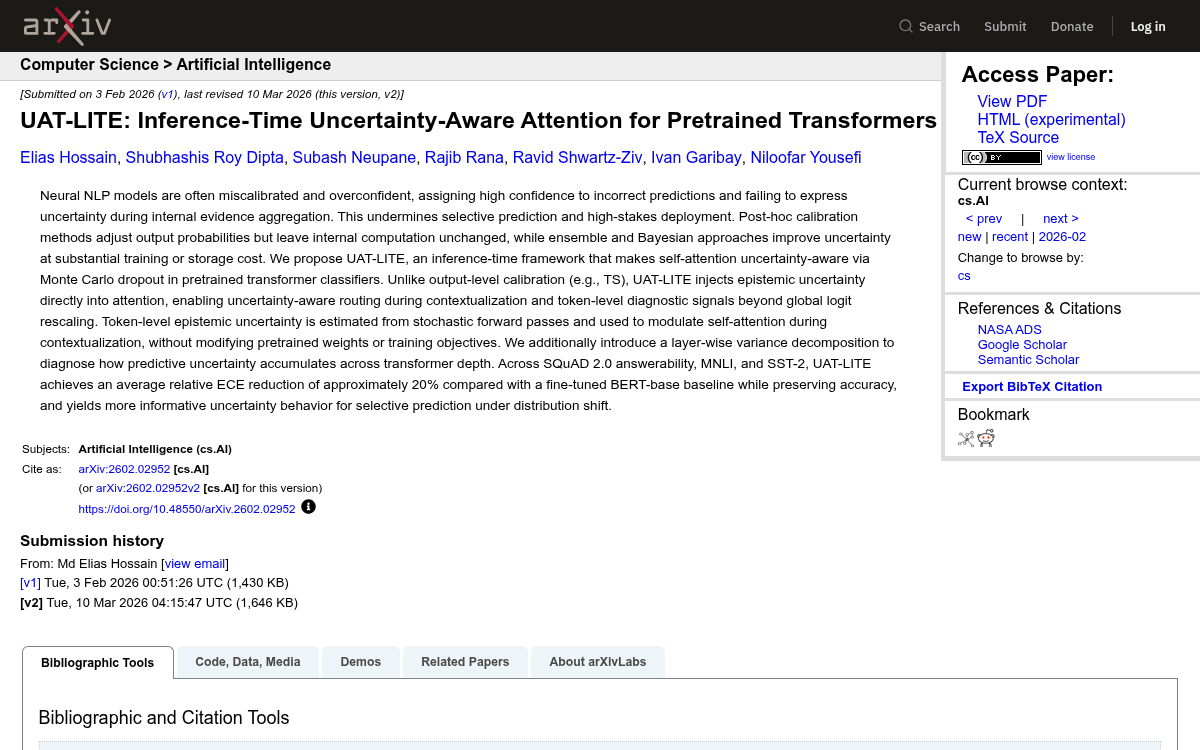
UAT-LITE injects uncertainty estimates directly into transformer attention at inference time, cutting calibration error by ~20% without retraining or touching model weights
 Pro
Takeaways
- UAT-LITE injects token-level epistemic uncertainty into self-attention at inference time, achieving ~20% average relative ECE reduction over BERT-base without retraining.
- It uses Monte Carlo dropout to estimate per-token embedding variance, then exponentially downweights uncertain tokens in pre-softmax attention logits.
- UAT-LITE is complementary to temperature scaling: the two methods act at different pipeline stages and compose cleanly, with UAT-LITE + TS being the most reliable configuration under distribution shift.
- A layer-wise variance decomposition diagnostic reveals where uncertainty accumulates across transformer depth, a signal unavailable from output-level calibration methods.
- The main limitation is a 22.7x inference overhead at M=10; the paper recommends selective triggering only for low-confidence inputs rather than always-on use.
- Code is open-source and works across BERT-family encoders; BERT-large and decoder-only models are explicitly out of scope.
Your BERT-based classifier is probably more confident than it should be. Not just at the output level, but deep inside, in the very attention patterns that decide which tokens to trust when building up a prediction. A new paper from researchers at UCF, NYU, and collaborating institutions proposes a fix that operates entirely at inference time, no retraining, no new parameters, no architectural surgery.
The framework is called UAT-LITE, short for Uncertainty-Aware Attention for Pretrained Transformers. The core idea: use Monte Carlo dropout to estimate how uncertain the model is about each token, then use that uncertainty to downweight unreliable tokens inside self-attention before the softmax ever fires.
The overconfidence problem is deeper than you think
The standard fix for miscalibrated transformers is temperature scaling (TS): fit a single scalar on a validation set, divide your logits by it, done. It is cheap, effective in-domain, and widely used. But it only touches the final output. The internal attention mechanism, which decides how tokens aggregate evidence from each other, remains completely unchanged.
This gap reflects a broader issue: transformers are trained to optimize predictive accuracy rather than confidence reliability. When a model encounters an ambiguous input, it still routes attention deterministically through every layer, propagating early, possibly wrong, evidence aggregation decisions all the way to the final prediction. Large language models deployed as autonomous agents face a fundamental reliability problem: they are simultaneously powerful reasoners and poor judges of their own limitations, and alignment training systematically degrades calibration, rewarding confident-sounding answers whether or not the model actually knows the answer.
Existing stochastic approaches like standard MC dropout or deep ensembles do improve uncertainty estimates, but they still treat uncertainty as an output-level signal. They never ask: which tokens are driving this prediction, and how stable are they?
How UAT-LITE works
UAT-LITE runs M stochastic forward passes through a frozen pretrained transformer by keeping dropout active at test time. This is standard MC dropout. The twist is what happens with the resulting variability.
For each token, UAT-LITE computes a scalar uncertainty score by measuring how much that token's embedding fluctuates across the M passes:
# Simplified UAT-LITE token uncertainty estimation
# z_samples: [M, seq_len, hidden_dim] stochastic embeddings
import torch
def token_uncertainty(z_samples):
    # Average std across embedding dimensions
    # z_samples shape: [M, seq_len, d]
    return z_samples.std(dim=0).mean(dim=-1)  # [seq_len]
def uncertainty_weighted_attention(Q, K, V, token_uncertainty, lam=0.5):
    d_k = Q.shape[-1]
    # Standard scaled dot-product attention logits
    scores = (Q @ K.transpose(-2, -1)) / (d_k ** 0.5)  # [B, heads, T, T]
    # Penalize attention to uncertain query tokens (Q-only variant)
    u_q = token_uncertainty.unsqueeze(-1)  # [B, T, 1]
    scores = scores * torch.exp(-lam * u_q.unsqueeze(1))
    return torch.softmax(scores, dim=-1) @ V
The penalty is applied to the pre-softmax attention logits using an exponential decay, so tokens with high embedding variance get downweighted as evidence sources. The paper tests Q-only, K-only, V-only, and joint QKV variants. Q-only provides the most balanced behavior, improving calibration while largely preserving accuracy across tasks, whereas V-only best preserves accuracy while yielding more modest ECE gains, and joint QKV gating can further reduce ECE on some datasets but tends to over-regularize and degrade accuracy.
To avoid running two separate passes (one to estimate uncertainty, one to run the model), UAT-LITE uses a single-pass online protocol. It maintains a running estimate of each token's uncertainty using Welford updates, and uses the lagged estimate from pass m-1 to modulate attention in pass m. No circular dependency, no extra compute stage.
The dropout rates are component-specific and fixed across all tasks: 0.1 for embeddings, 0.2 for attention layers, 0.3 for feed-forward layers. The uncertainty penalty lambda is selected once on a dev set and held fixed. Across lambda values of 0.1, 0.5, and 1.0 and MC budgets M of 3, 5, and 10, ECE varies within a narrow band with a range under 0.007, while accuracy changes are negligible.
A second diagnostic: where does uncertainty live in the network?
UAT-LITE also ships a layer-wise variance decomposition that tells you where in the transformer depth predictive uncertainty is accumulating. This is purely diagnostic and does not affect the forward pass. Using the law of total variance applied recursively across layers, it attributes what fraction of total predictive variance came from each layer group.
The results are revealing. For unanswerable SQuAD examples, uncertainty grows progressively through the self-attention stack, with the largest contribution arising from layers 9-11 at 12.5%, consistent with uncertainty emerging during later reasoning stages when sufficient evidence is unavailable. Answerable examples show a similar distribution but with a different internal character: mid-layer attention contributes more strongly to evidence aggregation rather than unresolved ambiguity. This kind of per-layer signal is something temperature scaling simply cannot provide.
Benchmarks and numbers
The team evaluated UAT-LITE on three standard NLP benchmarks using BERT-base as the backbone:
- SQuAD 2.0: answerability prediction (does this question have an answer in the passage?)
- MNLI: natural language inference with matched and mismatched splits for distribution shift analysis
- SST-2: binary sentiment classification
Calibration is measured with Expected Calibration Error (ECE), which bins predictions by confidence and measures the gap between average confidence and actual accuracy. Lower is better. Across tasks, UAT-LITE improves calibration relative to the unscaled fine-tuned BERT baseline, with average ECE decreasing from 0.1072 to 0.0964, and the largest improvement on MNLI where ECE drops from 0.0816 to 0.0638.
| Method | SQuAD ECE | MNLI ECE | SST-2 ECE | Avg ECE |
|---|---|---|---|---|
| BERT-base | 0.1868 | 0.0816 | 0.0531 | 0.1072 |
| MC Dropout (uniform) | 0.173 | 0.090 | 0.039 | 0.101 |
| Deep Ensemble (5x) | 0.168 | 0.060 | 0.037 | 0.089 |
| Base + TS | 0.0788 | 0.0148 | 0.0163 | 0.0366 |
| UAT-LITE (M=10) | 0.1647 | 0.0638 | 0.0608 | 0.0964 |
| UAT-LITE + TS (M=10) | 0.0760 | 0.0201 | 0.0191 | 0.0384 |
Temperature scaling is still the strongest single method for in-domain ECE. UAT-LITE is not trying to beat it on that metric. The two methods act at different stages of the pipeline and compose cleanly: UAT-LITE + TS matches or beats TS alone on distribution shift while adding the internal uncertainty-aware routing that TS cannot provide.
Where it shines: selective prediction under shift
The more compelling story is in selective prediction, the setting where a model can abstain on low-confidence inputs rather than always returning an answer. This is the regime that matters for medical triage tools, content moderation systems, or any pipeline where a wrong confident answer is worse than no answer.
Across OOD suites including HANS, ANLI, SNLI, and IMDb, TS reliably reduces ECE but does not uniformly dominate selective prediction, especially when score compression reduces high-threshold coverage. UAT-LITE + TS is the most reliable configuration, preserving TS-level calibration while retaining attention-level gating.
The HANS benchmark, which probes whether models rely on shallow heuristics like lexical overlap, is particularly telling. On the non-entailment-only subset, UAT-LITE and UAT-LITE + TS improve substantially over the baseline, with the largest gains on constituent examples, indicating better behavior when superficial heuristic matches are misleading.
The real cost: 22x inference overhead
UAT-LITE is not free. Running M=10 stochastic forward passes sequentially on an A100 GPU takes about 1,427 ms per batch versus 63 ms for deterministic inference. That is approximately a 22.7x overhead, making UAT-LITE unsuitable as an always-on mechanism in latency-critical deployments.
The paper's recommended use pattern is selective triggering: run the model deterministically by default, and invoke UAT-LITE only when a first-pass confidence score falls below a threshold. This keeps average latency manageable while reserving the deeper uncertainty analysis for inputs that actually need it. At M=5, most of the calibration gains are already captured at roughly half the cost of M=10.
Generalization and limits
UAT-LITE was tested across five BERT-family backbones spanning general, clinical, biomedical, and scientific domains. The average relative ECE reduction across these backbones is approximately 32%, with the largest gains for BERT-base on SQuAD (52% reduction) and BioBERT on PubMedQA (40% reduction).
There are clear failure modes to know about:
- BERT-large degrades: ECE increases by 13% on BERT-large. Highly overparameterized models may have attention patterns that are disrupted rather than improved by MC stochasticity.
- Not an adversarial defense: Under 5% character-swap attacks on SST-2, UAT-LITE offers no meaningful robustness advantage over the baseline. Calibration improvements on clean data do not transfer to adversarial settings.
- Encoder-only scope: The entire paper covers BERT-family encoders. Decoder-only models like GPT or LLaMA are explicitly out of scope and left for future work.
- Residual overconfidence: Fine-grained linguistic probes show the model remains overconfident on unresolved lexical ambiguity (e.g., the word "bank" without context) and subtle epistemic hedges like "probably" or "possibly."
What this unlocks in practice
The practical use cases are narrower but real. UAT-LITE is a good fit when:
- You have a fine-tuned BERT-class encoder and cannot retrain it
- You need token-level uncertainty signals for interpretability or routing decisions
- You are running batch or offline inference where latency is not the bottleneck
- You want to build a selective prediction system that abstains on ambiguous inputs
- You are deploying in a domain-shifted setting (e.g., a model trained on general NLI being applied to clinical text)
The code is publicly available on GitHub, implemented in HuggingFace Transformers and PyTorch, with full training scripts and evaluation pipelines. The real breakthrough here is not the ECE number. It is the demonstration that uncertainty can be a first-class signal inside a transformer's attention mechanism, not just a post-processing footnote, and that you can get there without touching a single pretrained weight.