
UC Santa Cruz's OpenVision 3 Beats Two Specialized Encoders With Just One
A joint team from UC Santa Cruz, JHU, and NVIDIA built a single vision encoder that handles both image understanding and generation, beating CLIP at both.
 Pro
Takeaways
- OpenVision 3 is a single frozen encoder for both image understanding and generation, from UCSC, JHU, and NVIDIA.
- Architecture stacks a ViT on top of a frozen FLUX.1 VAE, trained with joint reconstruction, contrastive, and captioning losses.
- Hits gFID 1.87 on ImageNet under the RAE framework, beating CLIP+RAE at 2.54 and SD-VAE+SiT at 2.06.
- Matches or beats CLIP on SeedBench and GQA inside LLaVA-1.5 and LLaVA-NeXT.
- Ablations show reconstruction and semantic losses are mutually reinforcing, not competing objectives.
- Code, data recipe, and checkpoints open-sourced at github.com/UCSC-VLAA/OpenVision.
Most unified multimodal models today cheat a little. When they need to both understand an image and generate one, they typically run the same picture through two different encoders: one semantic tokenizer like SigLIP for the understanding side, and one pixel-level tokenizer like a VAE for the generation side. It works, but it doubles the compute, complicates the plumbing, and leaves the two representations siloed. A team from UC Santa Cruz, Johns Hopkins, UNC, UC Berkeley, and NVIDIA thinks that split is unnecessary, and they have published a paper showing a single encoder that beats specialized ones at both jobs.
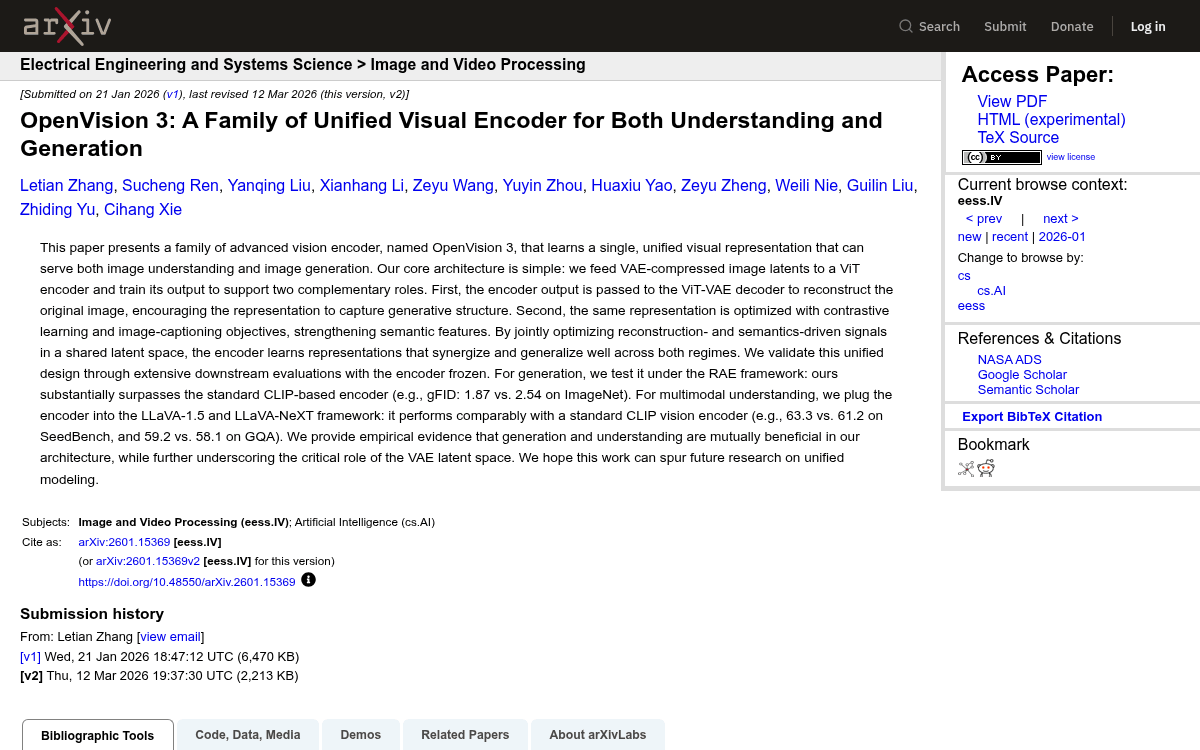
The system is called OpenVision 3, and its pitch is straightforward: a single, unified visual representation that can serve both image understanding and image generation. Under the RAE generation framework it hits gFID: 1.87 vs. 2.54 on ImageNet against a CLIP-based encoder, while on multimodal understanding it matches or beats CLIP inside LLaVA-1.5 and LLaVA-NeXT.
Why one encoder is hard
Understanding and generation want opposite things from a representation. Understanding wants abstract semantics: is this a dog, what is it doing, what does the sign say. Generation wants pixels: exact colors, textures, edges, and text glyphs you can actually reconstruct. That is why a common UMM design, exemplified by Uni-Fluid, BAGEL, and MOGAO, employs two distinct visual tokenizers that encode the same image twice, producing one set of high-level semantic tokens and another set of low-level, pixel-reconstructable tokens.
The alternative has been discrete unified tokenizers built on vector quantization, like TokenFlow, UniTok, and VILA-U. Those work, but these approaches typically rely on quantized hidden representations, which inevitably introduce discretization errors and limit generation quality. OpenVision 3 stays continuous.
The recipe: stack a ViT on top of a frozen VAE
The architecture is deliberately unglamorous. An input image is first pushed through a pretrained, frozen FLUX.1 VAE encoder. Those VAE latents, not raw pixels, become the input to a Vision Transformer. Because the VAE latents are then fed into a Vision Transformer encoder, which uses a patch size of 2x2 on the VAE latent grid. This effectively gives an overall compression of 16x in height and width relative to the original image (8x from VAE, then 2x from ViT), the token count stays comparable to a standard ViT-L/14 CLIP.
From that shared representation, the model branches:
- Reconstruction branch: A near-symmetric ViT decoder plus the frozen VAE decoder tries to rebuild the original image. Loss combines pixel L1, latent-space L1, and LPIPS perceptual loss.
- Understanding branch: A text encoder and text decoder apply contrastive loss (CLIP-style) and image-captioning loss on the same features.
One small trick matters here. Before the reconstruction decoder sees the unified features, the model injects Gaussian noise with a per-sample intensity sampled uniformly from a range. This is what the authors credit for pushing the representation to be robust enough for downstream generative modeling, not just replay.
Training runs in two resolution stages, roughly 4000 epochs at 128x128 followed by 400 epochs at 224 or 256, with the understanding loss weighted twice the reconstruction loss. Pre-trained FLUX.1 VAE is used and frozen during the whole training process. All other components (including ViT encoder, ViT decoder, text encoder, text decoder, and linear layer) are randomly initialized and remain unfrozen throughout the training.
The numbers
On ImageNet class-conditional generation under RAE, OpenVision 3 lands at gFID 1.87 with an Inception Score of 290, beating not just the CLIP+RAE baseline (2.54) but also SD-VAE paired with SiT (2.06) and UniTok with LlamaGen (2.51). On reconstruction it posts rFID 0.187 on ImageNet, an order of magnitude better than the unified competitor RAE (1.06) and cleanly ahead of UniTok (0.362).

The understanding side is where skeptics usually expect a tax. There isn't much of one. Under LLaVA-NeXT with a Base-size encoder, OpenVision 3 scores 63.3 on SeedBench versus CLIP B/16's 61.2, and 59.2 on GQA versus 58.1. Scale up to Large and the gap widens: 68.6 vs 61.8 on SeedBench, 62.0 vs 59.4 on GQA. POPE and MME are within a point in most configurations.
The finding that actually matters
The headline is a shared encoder that ties or wins on both tasks. The more interesting result is what the ablations show about why. When the team trained with only the semantic loss, the reconstruction loss still fell substantially, and when they trained with only the reconstruction loss, the captioning loss drifted downward too. In plain terms, reconstruction and understanding objectives are mutually beneficial rather than conflicting; semantic supervision helps reconstruction, and reconstruction helps generative-style semantic tasks, enabling a balanced unified tokenizer. Combining both losses produced a lower reconstruction loss than either alone.
The second finding is that operating in VAE latent space rather than raw pixel space isn't just a compute trick. In a controlled swap, replacing the VAE input with a plain ViT-B/16 over pixels degraded rFID from 0.216 to 0.980 and hurt gFID by 1.23 points. It also lost ground on four of six understanding benchmarks under LLaVA-1.5 and on all six under LLaVA-NeXT. That is a stronger claim than expected: VAE latents help semantic learning too, even though VAEs were designed for low-level compression.
Where the ceiling shows up
The authors are candid that scaling the encoder from Base to Large barely moved reconstruction (PSNR 30.92 to 30.96) or generation quality (gFID actually got slightly worse). They attribute this to the outer VAE imposing a theoretical ceiling on how much extra signal a bigger ViT can carry, which means simply buying more parameters will not keep pushing generation quality on this architecture. Understanding, by contrast, does keep scaling.
There is also an oddity in the training-stability results: the Large-sized ViT decoder training was unstable in their setup, so they recommend a Base-size decoder as the sweet spot for both quality and cost.
Getting your hands on it
Code, training data recipe, and tokenizer checkpoints are open-source under the same repository that hosts the earlier OpenVision and OpenVision 2 releases. The repository contains the code for training and fine-tuning vision-language models based on the OpenVision framework, and OpenVision 3 is grouped with the prior versions on GitHub and Hugging Face.
If you are building a unified multimodal stack today and currently paying for two encoders, this is the strongest continuous-tokenizer alternative to try as a drop-in. If you are training a diffusion or flow-matching image generator and using CLIP features as your representation autoencoder, the RAE-framework numbers suggest a meaningful FID improvement is available essentially for free.