
UC Santa Cruz's Kestrel Cuts Vision AI Hallucinations by 28 Points Without Retraining
A training-free pipeline uses SAM3 grounding and iterative claim verification to cut vision-language hallucinations by up to 28 points on MME.
 Pro
Takeaways
- Kestrel is a training-free framework that reduces vision-language hallucinations without touching model weights.
- It decomposes answers into claims, grounds them with SAM3 segmentation, and verifies each claim with citations.
- Gains: +3.31% average on POPE and +28.34 on MME-Hallucination with Qwen3-VL 8B.
- Only method tested that also improves the strong InternVL3.5 backbone on MME-Hallucination.
- Cost: roughly 24x slower per query than a single-pass LVLM call, with 23% more GPU memory.
- Prompts and pipeline details on the project website; code not yet public.
Vision-language models keep getting sharper, but they still confidently describe objects that are not in the picture, miscount what is there, or invent spatial relationships. A team from UC Santa Cruz, UC Berkeley, UNC-Chapel Hill and Apple is proposing a fix that skips retraining and instead wraps the model in a verification loop backed by a segmentation agent.
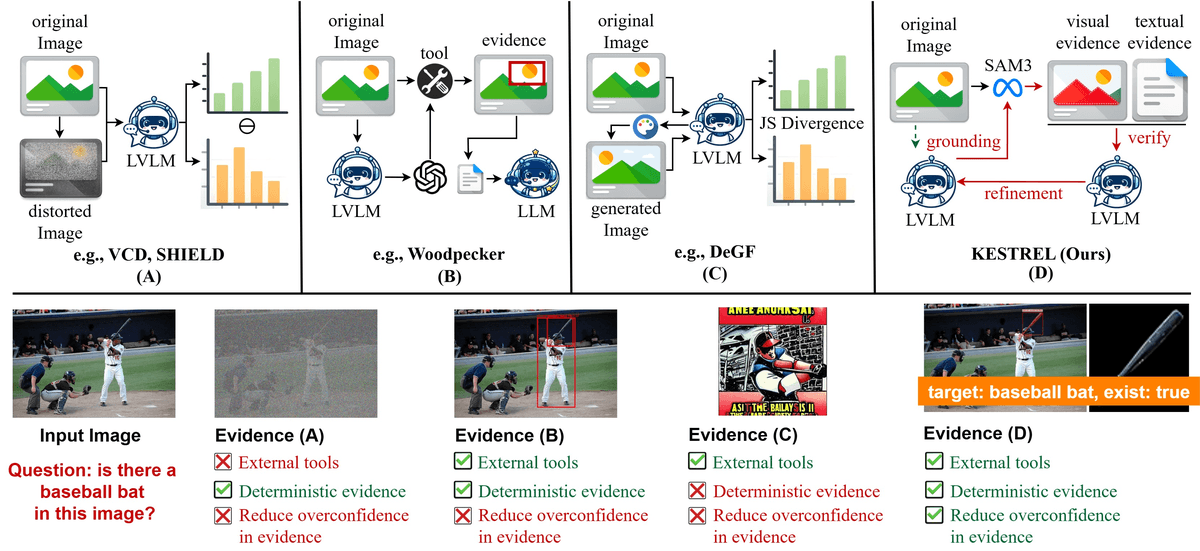
Their framework, called Kestrel, decomposes an answer into small verifiable claims, grounds each one with explicit visual evidence from SAM3, and then iteratively refines the response only when the evidence is strong enough. On POPE it improves accuracy by an average of +3.31% with Qwen3-VL, and on MME-Hallucination it boosts the same backbone by +28.34 points.
Why hallucinations still block deployment
Large vision-language models (LVLMs) fluently answer questions about images, but they remain prone to hallucinations in multimodal tasks, which significantly narrows where they can be deployed. The two established fixes both have downsides. Training-based mitigation needs annotated hallucination data, preference pairs, or RLHF, which gets expensive fast as backbones grow. Training-free methods that intervene at decoding time, like contrastive decoding or attention re-weighting, are cheap but often deliver modest gains and are hard to audit when they go wrong.
A separate line of work, exemplified by Woodpecker and DeGF, uses external tools to verify outputs after generation. Those helped, but the authors point out two persistent problems: tool outputs can be noisy and non-deterministic, and one-shot correction tends to over-correct answers that were actually right in the first place.