
UC Santa Barbara's ARES Cuts AI Agent Reasoning Costs by 45%
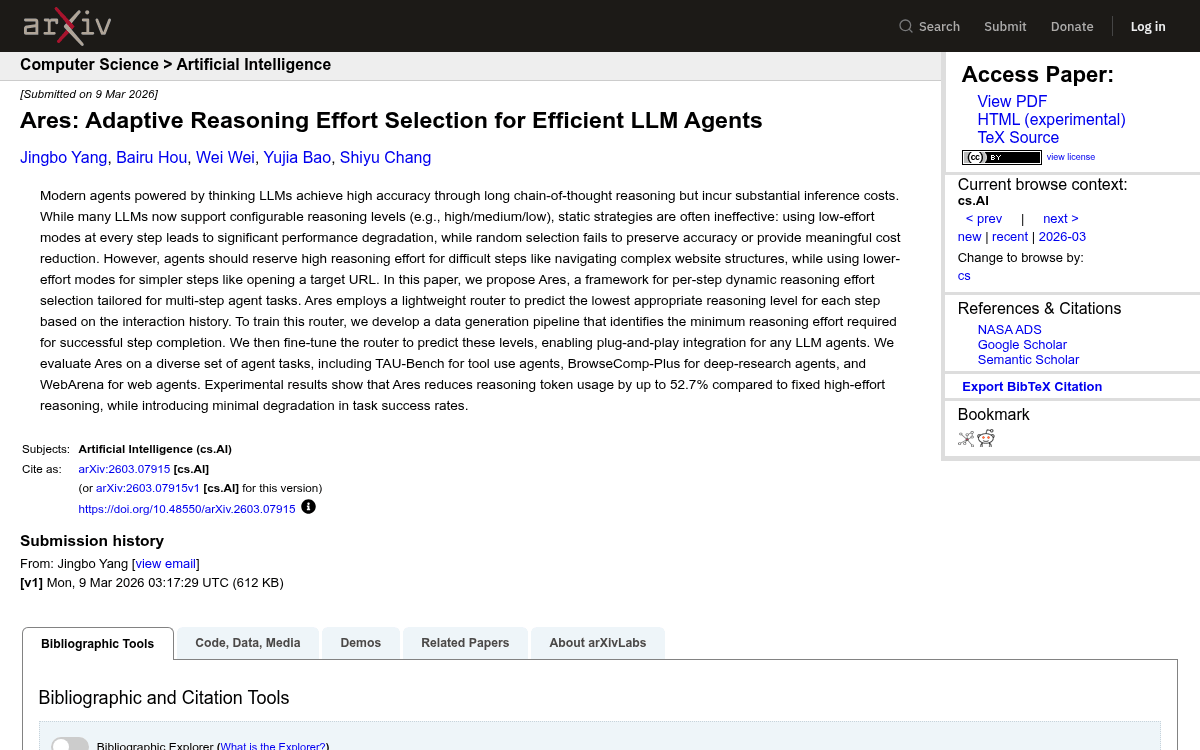
ARES cuts LLM agent reasoning costs by up to 52.7% using a tiny router that decides, step by step, how hard the main model needs to think
 Pro
Takeaways
- ARES is a lightweight router (Qwen3-1.7B) that picks the right reasoning effort level (low/medium/high) for each step of a multi-step LLM agent task.
- It cuts reasoning token usage by up to 52.7% vs. always using high effort, with minimal accuracy loss across tool-use, web, and research agents.
- Training uses a 3-phase pipeline: collect successful trajectories, annotate minimum sufficient effort per step, generate rationales with a teacher model.
- An RL phase (GRPO) on top of SFT further boosts both accuracy and efficiency, cutting tokens by ~80% on TAU-Bench Airline while improving accuracy.
- The router also fixes "overthinking" -- on WebArena it actually beats the always-high-effort baseline (46.5% vs. 45.0%) by avoiding reasoning drift.
- Code is open-source at github.com/UCSB-NLP-Chang/Ares; plug-and-play with any LLM agent architecture.
Thinking models like GPT-o series and Gemini 2.5 have made AI agents dramatically more capable, but they come with a steep bill. Every step in a multi-step agent task accumulates reasoning tokens, and that cost compounds fast across long trajectories. The obvious fix -- just dial the reasoning effort down -- turns out to be a trap. A team from UC Santa Barbara and Accenture's AI lab has a smarter answer: a paper called ARES (Adaptive Reasoning Effort Selection), a plug-and-play framework that decides, at each individual step, exactly how hard the agent needs to think.
The problem with "just think less"
Modern LLMs now support configurable "thinking levels" -- high, medium, or low -- to balance performance and budget. Reasoning tokens are billed as output tokens and can easily dwarf the visible response in cost; a "high effort" request might spend 20,000 tokens thinking before producing a 500-token answer. The temptation is to just lock everything to "low" and save money. But that backfires badly.
Switching the reasoning effort from "high" to "low" at every decision step causes a nearly 20% performance drop on tool-use benchmarks. Random effort selection fares no better -- it neither preserves accuracy nor delivers meaningful savings. The core insight the ARES paper surfaces is that not all steps are equally hard. Navigating a complex web page structure demands deep reasoning; opening a target URL does not.
A tiny router that watches every step
ARES introduces a lightweight language model -- specifically a fine-tuned Qwen3-1.7B -- that sits alongside the main agent and acts as a reasoning-effort router. Before each agent action, the router reads the full interaction history and current observation, then outputs one word: low, medium, or high. The main agent then uses that effort level for its next step.

This design has a key practical advantage over traditional model routing (where you'd switch between a large and a small model entirely): by leveraging intra-model thinking levels, ARES preserves and reuses the KV cache across different reasoning effort levels, avoiding the significant latency or computational costs associated with re-encoding context for a different model. You stay on one model; you just tell it how hard to think.
How the router gets trained
The hardest part of building ARES was generating training labels. You can't just ask "what effort level is right here?" -- you have to empirically find the minimum effort that still produces the correct action. The team built a three-phase pipeline to do this automatically.

- Trajectory Collection: Run the main agent at maximum effort and collect successful trajectories. Keep only the most concise ones -- fewer steps means a cleaner signal of what reasoning is actually required.
- Effort Annotation: For each step in a successful trajectory, test all three effort levels (low, medium, high) by sampling the agent's response three times each. The minimum effort that reliably reproduces the correct action becomes the label for that step.
- Rationale Generation: A teacher model (GPT-5 in the experiments) writes a 3-5 sentence justification for each label, explaining why that effort level is appropriate given the current task state. The router is then trained to generate this rationale before predicting the effort level -- a chain-of-thought step that meaningfully improves accuracy.
After supervised fine-tuning (SFT), the router is further trained with reinforcement learning using GRPO (Group Relative Policy Optimization -- a method that trains a model by comparing groups of its own outputs against each other). The RL reward has three components: a large positive reward for task success, a per-step penalty scaled by effort level, and a format penalty. Crucially, the cost penalty only applies to successful trajectories, preventing the router from learning to fail fast on hard tasks just to avoid the penalty.
What the numbers look like
ARES was evaluated on three benchmarks covering different agent types:
- TAU-Bench -- tool-use agents handling retail and airline customer service tasks
- BrowseComp-Plus -- deep-research agents doing multi-step retrieval over a fixed corpus
- WebArena -- web navigation agents interacting with real functional websites
Across all benchmarks, ARES maintains high task success rates while delivering significant reasoning token reductions: approximately 35.2% on TAU-Bench (Retail), 41.8% on BrowseComp-Plus, and 45.3% on WebArena in total reasoning token consumption. On TAU-Bench Retail, ARES actually matches the high-effort baseline's accuracy of 54.8% while spending far fewer tokens. On WebArena, it surpasses the high effort baseline (46.5% vs. 45.0%), suggesting that increased reasoning effort does not consistently yield better outcomes in web navigation.
The RL phase on top of SFT pushes things further. In the Airline domain, the RL-optimized router achieves a 6.0% absolute increase in accuracy (from 36.0% to 42.0%) and drastically cuts total token usage by nearly 80% (from 678k to 133k). Compared to always using high effort, ARES (RL) achieves superior accuracy across both TAU-Bench domains while consuming less than half the total reasoning tokens.
The "overthinking" problem it quietly solves
One of the more interesting findings is that more thinking is not always better. In the Airline domain, the medium strategy surpasses the high strategy, signaling an "overthinking" risk where excessive reasoning leads to logic drift. ARES learns to suppress this: after RL training, the router drops high-effort usage from over 50% of steps to under 20%, and increases low-effort usage to roughly 70%.
The router also learns sensible patterns about when to think hard. On WebArena, it uses low effort for early navigation steps (opening a page, landing on a forum) and ramps up high effort for go_back and branch actions -- the moments when the agent needs to recover from a wrong path or revise its plan.
Limitations and what to watch for
ARES has real constraints worth knowing before you reach for it:
- Backbone dependency: The router was trained on trajectories from
gpt-oss-20b. Cross-scale tests on a 6x larger model showed it still works well (65.2% accuracy vs. 67.8% high-effort ceiling), but there will be a gap when the backbone changes significantly. - Deep-research sensitivity: On BrowseComp-Plus, a single suboptimal selection -- such as choosing low effort for a complex retrieval step -- can result in poorly formulated search queries, triggering detrimental error propagation throughout the remainder of the task. The router has to be very precise in long-horizon tasks.
- Training cost: The annotation pipeline requires running the agent at all three effort levels multiple times per step across all training trajectories, which is expensive to bootstrap.
- No multimodal support yet: The paper notes future work will extend ARES to multimodal inputs.
Getting the code
The code is available at github.com/UCSB-NLP-Chang/Ares. The framework is designed to be model-agnostic -- the router can be dropped into any existing agent architecture as a pre-step classifier. If you're running multi-step agents on thinking models and watching your token bills climb, ARES offers a principled way to spend those tokens only where they actually move the needle.