
UC Santa Barbara's $3 Haptic Pixel Delivers Real Touch at 10 Volts
UCSB researchers built millimeter-scale haptic actuators that hit 1 newton of force at 10 volts, using wire, tape, and silicone.
 Pro
Takeaways
- UCSB researchers introduced thermopneumatic pixels, low-voltage tactile actuators using heated air in a sealed cavity.
- Each module runs at 10 V, hits over 1 N of force, and produces displacements approaching 1 mm.
- Response time is 5 to 100 ms, with a 110 ms thermal relaxation constant after each pulse.
- Bill of materials is $3.02 per module and $43.49 for a driver board handling 40 pixels.
- Users identified which pixel fired in a 2x2 fingertip array with 95.5% accuracy.
- Design uses NiCr wire, PDMS membrane, and a Teensy 4.1 with MOSFET switching.
Building haptic hardware that feels convincing on a fingertip usually means choosing between three bad options: bulky voice coils, dielectric elastomers that need kilovolt power supplies, or slow thermal bimorphs that take seconds to respond. Two researchers at UC Santa Barbara have proposed a fourth path that runs on 10 volts, costs about three dollars per module, and hits over one newton of force in tens of milliseconds.
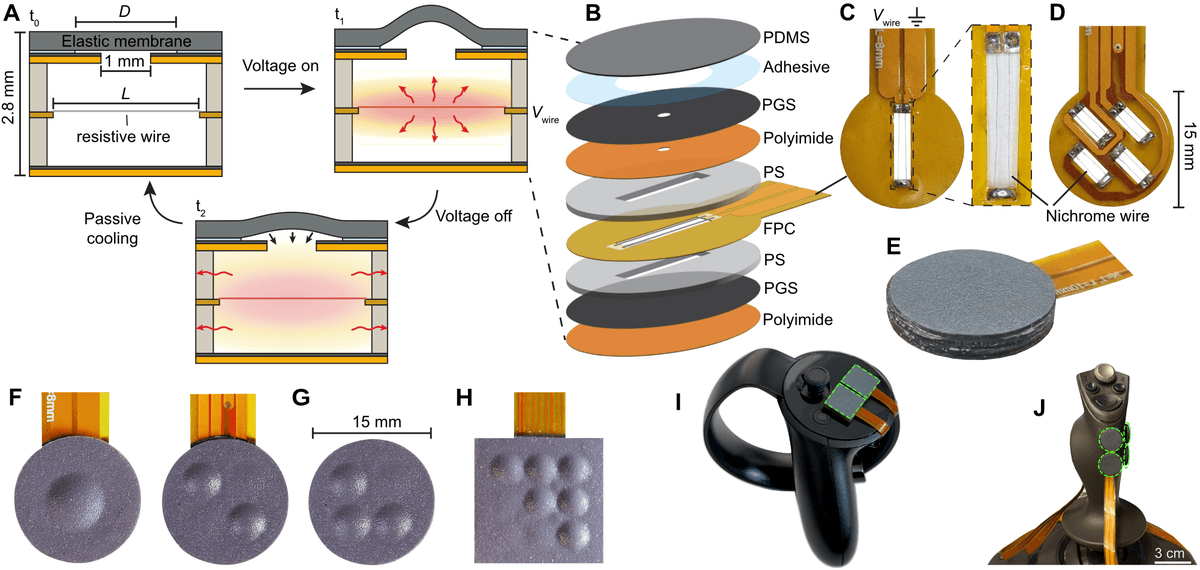
The device is called a thermopneumatic pixel (TPP). It works by rapidly heating a tiny volume of trapped air with a suspended resistive wire, using the resulting pressure spike to push a silicone membrane against your skin. Max Linnander and Yon Visell published mechanical characterization, driver electronics, and perceptual studies showing users can reliably distinguish stimuli from a 2x2 grid of pixels under a single fingertip.
Why haptics keeps hitting a wall
Tactile actuators need to cover a wide envelope of outputs to feel realistic. A practical target is forces from a milli-newton to about a newton, displacements from microns to millimeters, and response times spanning milliseconds to seconds. No single existing technology hits all of that cleanly in a small, cheap package.
The tradeoffs the authors call out are familiar to anyone who has tried to embed haptics into a wearable:
- Electromagnetic actuators get limited by current density, heat, and magnetic packaging as they shrink.
- Electrostatic and dielectric-elastomer devices can be fast and high-strain, but their kilovolt drive voltages complicate insulation and safety in compact arrays.
- Conventional thermal actuators are dragged down by thermal inertia, since much of the deposited energy goes into heating solid or liquid mass, producing time constants in the tens to hundreds of seconds.
Thermopneumatic designs sidestep the last problem by heating gas instead of solids. Gases have volumetric heat capacities around 0.001 J per cubic centimeter per kelvin, roughly a thousand times lower than solids and liquids, which opens the door to fast responses. Earlier attempts baked the heater into the cavity wall, which lost most of the heat to the structure. A recent workaround used projected light hitting an absorber suspended inside the cavity, but that requires optics and takes an efficiency hit converting electricity to light.