
UC Santa Barbara Proves Personalized AI Models Can Explain Themselves Worse
A new framework proves that personalizing ML models with demographic data can silently harm explanation quality — even when prediction accuracy stays the same
 Pro
Takeaways
- Prediction and explanation can diverge: Personalizing an ML model with demographic attributes can improve or degrade explanation quality even when prediction accuracy is completely unchanged.
- Formal proofs, not just empirics: The paper provides four theorems proving the full landscape of divergence between prediction benefit and explanation benefit across demographic groups.
- Untestable effects are common: A finite-sample lower bound on hypothesis test error shows that in many real datasets, it is statistically impossible to confirm whether personalization helped or hurt — for any test.
- MIMIC-III case study: On ICU length-of-stay prediction, the largest apparent benefit (sufficiency, ĝamma=0.19) was statistically untestable, while the smallest apparent benefit (prediction, ĝamma=0.002) was the only one that could be validated.
- Classification vs. regression behave differently: In classification, prediction and explanation testability are always coupled; in regression, they can decouple, requiring separate feasibility checks.
- No code released, but the framework uses closed-form bounds compatible with standard attribution tools like Captum (Integrated Gradients, DeepLIFT, Shapley Value Sampling).
There is a quiet assumption baked into personalized medicine: if you give a model more information about who you are , your age, race, sex , it will not only predict better, but explain itself better too. A new paper from UC Santa Barbara formally dismantles that assumption, and the implications ripple across every high-stakes ML deployment from ICU triage to loan approvals.
The core finding is deceptively simple but mathematically rigorous: personalization's effect on prediction accuracy and its effect on explanation quality can diverge completely. A model can become more accurate without becoming more explainable. It can stay equally accurate while its explanations get worse for specific demographic groups. And critically, even when a dataset shows a large apparent benefit from personalization, it may be statistically impossible to verify that benefit is real.
The problem no one was measuring
In high-stakes domains like healthcare, users often expect that sharing personal information with ML systems will yield tangible benefits , more accurate diagnoses and clearer explanations of contributing factors. But the validity of this assumption has remained largely unexplored. The field has been measuring prediction accuracy and assuming explanation quality follows. It does not.
Personalization may benefit overall accuracy while harming specific groups, making such risks harder to detect. In sleep apnea classification, for example, adding age and sex improved overall performance but increased errors for older women and younger men. Similar group disparities have been observed in explainable ML, where some users receive less faithful or reliable explanations than others. When explanations are less faithful to the true model logic, they can give users an inaccurate picture of how the model makes decisions, leading to misplaced trust or missed warning signs.
What makes this particularly dangerous in clinical settings: a doctor relying on a model's explanation to override a bad prediction may be working from a corrupted explanation , one that looks reasonable but does not reflect what the model actually learned.
Two things that can move independently
The paper introduces a unified framework built around a quantity called the Group Benefit of Personalization (G-BoP) , essentially the performance gap between a generic model and a personalized one, measured per demographic group. The key insight is that G-BoP can be computed separately for prediction accuracy and for explanation quality, and the two values need not agree.
The authors prove four theorems that map out the full landscape of possible divergences:
- Prediction unchanged, explanations improve: Adding a personal attribute that is redundant with existing features does not change accuracy, but an explainer may now assign all importance to the new, cleaner feature , making the explanation sharper. Imagine adding a "pre-approved by another bank" flag to a loan model: predictions stay the same, but the explanation becomes clearer.
- Prediction unchanged, explanations degrade: A pneumonia model using chest X-rays predicts perfectly. Adding white blood cell count leaves accuracy identical, but now the explainer splits importance between two features , making the explanation murkier even though nothing predictively changed.
- Prediction unchanged, explanations diverge across groups: Some demographic groups get better explanations from the personalized model, others get worse , with zero change in prediction accuracy for any of them.
- The partial converse (additive models only): Under an additive linear model, if explanations show no benefit from personalization, then prediction accuracy also shows no benefit. This boundary case clarifies when practitioners can trust prediction and explanation to align , but it requires a strong linearity assumption that rarely holds in practice.
The explanation quality metrics used are sufficiency and incomprehensiveness , two standard faithfulness measures from the XAI literature. Sufficiency asks: if you keep only the features the explainer ranked as most important, does the model's output stay the same? Incomprehensiveness asks: if you remove those top features, does the output change significantly? Both are model-agnostic and work with any feature-attribution method.
When you cannot even test for a benefit
The second major contribution is a statistical framework for knowing when you simply cannot draw conclusions from your data , even if the numbers look good.
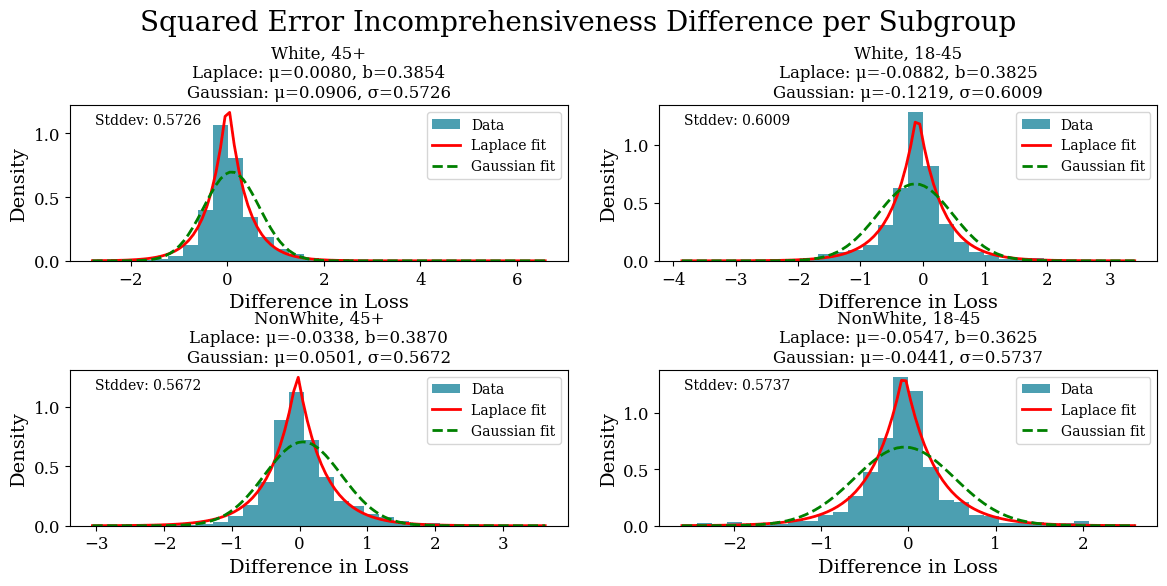
The authors derive a finite-sample lower bound on the probability of error for any hypothesis test designed to detect personalization effects, as a function of group sizes, number of personal attributes, and desired benefit from personalization. This is a minimax bound , it applies to the best possible test, not just naive ones. If the bound says your error rate exceeds 25%, no statistical test can reliably tell you whether personalization helped or hurt.
The key variables that drive this bound are:
- Number of personal attributes (k): Each binary attribute doubles the number of demographic groups, halving the samples per group. With k=5 attributes, you have 32 groups. With k=10, you have 1,024.
- Group sizes (m): Smaller groups mean noisier estimates of per-group benefit.
- Desired minimum benefit (ε): The smaller the effect you want to detect, the more data you need.
- Task type: Classification and regression behave differently. In classification, prediction and explanation testability are coupled , either both are testable or neither is. In regression, they can decouple: prediction may be testable while explanation quality is not, or vice versa.
A striking corollary: even with a dataset the size of Earth's entire population (8 billion samples), a personalized classifier using more than 17 binary demographic attributes hits a 25% error floor for any hypothesis test at a 1% improvement threshold. The math is unforgiving.
Applied to real ICU data
The framework was applied to the MIMIC-III critical care database, predicting patient length of stay , both as a regression (exact days) and classification (over/under 3 days). The personalization attributes were age group and race: four demographic groups total.
The analysis uncovered scenarios where effects are fundamentally untestable due to dataset statistics. Specifically:
- For the classification model, the lower bound on error probability exceeded 40% at ε=0.002 , meaning no test could reliably confirm or deny a benefit. The practitioner's rational move: keep the generic model.
- For the regression model, prediction and incomprehensiveness were testable (error bound under 5%), but sufficiency was not (error bound over 40%) , a split that only exists in regression tasks.
- The largest apparent empirical benefit came from sufficiency in regression (ĝamma = 0.19), yet this was the metric that was statistically untestable. The smallest apparent benefit came from prediction (ĝamma = 0.002), yet this was the one that could actually be validated.
The same analysis was run on the UCI Heart Disease dataset and a MIMIC-III kidney injury cohort, using three different explainers: Integrated Gradients, DeepLIFT, and Shapley Value Sampling. Results were largely consistent across explainers, though effect sizes varied , suggesting the framework's conclusions are robust to the choice of attribution method.
What this changes in practice
The paper is not arguing against personalization. It is arguing that the current practice of evaluating personalization only through prediction accuracy is incomplete , and potentially misleading. The practical takeaways are concrete:
- Always evaluate explanation quality separately from prediction accuracy when adding demographic attributes to a model. A model that predicts better for a group may explain itself worse to that same group.
- Run the feasibility check before interpreting results. Compute the lower bound on error probability given your dataset's group sizes, number of attributes, and target improvement threshold. If the bound is high, your empirical results are inconclusive regardless of what they show.
- Be suspicious of large empirical benefits. The MIMIC-III results showed the largest apparent gain was also the least statistically verifiable. Big numbers can be noise.
- Classification and regression need different treatment. In classification, if you cannot test prediction, you also cannot test explanation. In regression, these can decouple , requiring separate feasibility checks for each metric.
The authors release no code repository alongside the paper, but the framework itself is described with enough mathematical precision that implementation is straightforward for practitioners familiar with standard hypothesis testing and feature-attribution libraries like Captum. The bounds are closed-form for Gaussian, Laplace, and categorical distributions of the individual benefit , the three cases most likely to arise in practice.
The deeper message is a cautionary one for personalized medicine: the promise of personalization is real, but so is the epistemic gap between observing a benefit and being able to prove one. In settings where collecting personal attributes carries ethical or logistical costs , genetic markers, mental health assessments, sensitive demographic data , that gap matters enormously. Deploying a personalized model without verifying its benefit is not neutral. It is a choice with consequences that fall unevenly across groups.