
UC San Diego Turns Physics Symmetry Into an Equation Discovery Superpower
A UC San Diego team shows that baking physical symmetry into symbolic regression guarantees physics-respecting PDEs and dramatically boosts discovery accuracy
 Pro
Takeaways
- Core idea: Replace raw variables and derivatives with symmetry-invariant functions as the atomic units in symbolic regression, guaranteeing discovered PDEs respect the specified physical symmetry.
- Key result: Success rates jump from 0% to 79-100% on Boussinesq, Darcy flow, and reaction-diffusion benchmarks where standard tools completely failed.
- Backend-agnostic: Works as a drop-in enhancement for PySR, PySINDy, Weak SINDy, and symbolic transformers with no architectural changes.
- Noise-robust: Symmetry-constrained Weak SINDy consistently outperforms unconstrained baselines under noisy data; a relaxed mode handles systems with imperfect symmetry.
- Main limitation: The symmetry group must be specified by the user in advance; misspecified symmetry produces incorrect results.
- First general framework: Prior symmetry-constrained discovery methods were restricted to ODEs or specific SR backends; this is the first approach that handles arbitrary Lie point symmetries for general symbolic regression.
Symbolic regression has long promised to let machines rediscover the equations of physics directly from data. Tools like PySR and SINDy can already recover many canonical laws, but they face a fundamental tension: the search space of possible equations is astronomically large, and nothing stops the algorithm from returning an expression that fits the data yet violates a known physical symmetry. A new paper from UC San Diego and IBM Research attacks both problems at once by changing what the algorithms search over.
The core problem with equation discovery today
Discovering symbolic differential equations from data uncovers fundamental dynamical laws underlying complex systems, but existing methods often struggle with the vast search space of equations and may produce equations that violate known physical laws. The standard fix is to hand-engineer a function library of candidate terms and hope the true equation lives inside it. If the library is too small, the algorithm fails by construction. If it is too large, the search becomes intractable and the algorithm overfits.
A deeper issue is that most methods treat symmetry as an afterthought. Rotational invariance, scaling symmetry, translation symmetry, and phase-space symmetry are fundamental constraints in physics, but standard symbolic regression has no built-in mechanism to enforce them. The result is equations that look plausible numerically but are physically nonsensical.
Symmetry invariants as the new atomic unit
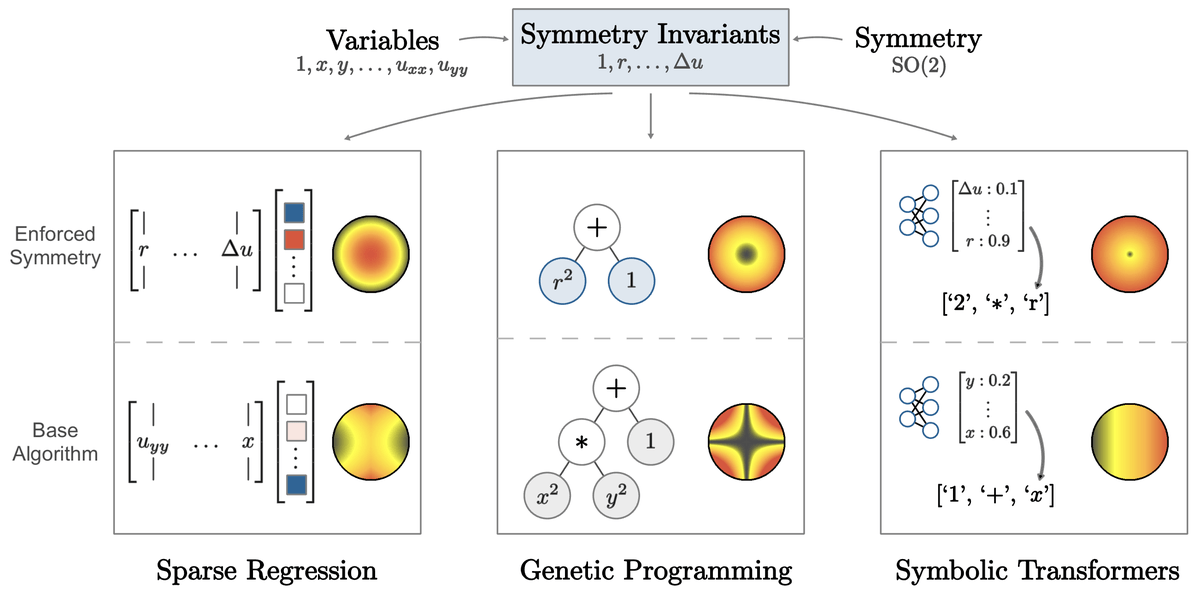
The authors address these problems by introducing the concept of symmetry invariants in equation discovery, leveraging the fact that differential equations admitting a symmetry group can be expressed in terms of differential invariants of symmetry transformations, and proposing to use these invariants as atomic entities in equation discovery, ensuring the discovered equations satisfy the specified symmetry.
The key mathematical insight comes from Lie group theory. A differential invariant is a function of the variables and their partial derivatives that stays unchanged under a given symmetry transformation. For example, under 2D rotation symmetry, the Laplacian u_xx + u_yy is invariant, as is the radial distance r² = x² + y². Any PDE that genuinely respects rotational symmetry must be expressible purely in terms of such invariants. The paper proves this formally and then builds a practical algorithm around it.
The procedure has three steps:
- Specify the symmetry. The user provides the infinitesimal generators of the symmetry group (e.g., the vector field
v = y∂_x - x∂_yfor 2D rotation). - Compute differential invariants. The algorithm solves a first-order linear PDE to find a complete set of invariant functions up to the required derivative order, then recursively constructs higher-order invariants using a determinant-based formula.
- Run symbolic regression in invariant space. Instead of searching over raw variables and derivatives, the algorithm searches over combinations of these invariants. Any equation it finds is guaranteed to respect the specified symmetry.
Works with your existing tools
The approach integrates seamlessly with existing equation discovery methods such as sparse regression and genetic programming, improving their accuracy and efficiency. For SINDy-style sparse regression, the invariants replace the raw feature library. For genetic programming tools like PySR, the invariants replace the variable set. For symbolic transformers, they replace the input tokens. No architectural changes are needed.
For sparse regression specifically, the paper also derives a complementary approach: rather than switching to invariant features, it converts the symmetry constraint into a set of linear constraints on the SINDy coefficient matrix. This is particularly useful for Weak SINDy (WSINDy), which avoids noisy derivative estimation by integrating against test functions. The symmetry constraint can be directly substituted into the WSINDy objective without reformulating the whole problem.
There is also a relaxed mode for systems with imperfect symmetry. Real systems often break symmetry slightly due to external forces or unequal parameters. The method borrows the Residual Pathway Prior technique from equivariant neural networks: it parameterizes the coefficient matrix as a sum of a symmetry-preserving component and a symmetry-breaking component, placing stronger regularization on the latter. This lets the model favor symmetric equations while still fitting data that deviates slightly from perfect symmetry.
Benchmarks: where it matters most
The team tested on three PDE systems, each chosen to stress a different aspect of the problem:
- Boussinesq equation (shallow-water wave, 4th-order, scaling symmetry): Standard PySINDy achieved 0% success because its library omitted the
u_x²term. With symmetry invariants, success rate jumped to 100%. - Darcy flow (2D fluid, rotational symmetry, exponential terms): Standard genetic programming achieved 0% success. With invariants, PySR reached 79% success and prediction error dropped from 0.114 to 0.051.
- Reaction-diffusion system (two coupled PDEs, phase-space rotational symmetry): Standard PySR achieved 0% success. With invariants, it reached 81% success.
The efficiency gains are just as striking as the accuracy gains. Because the invariant space is smaller than the raw jet space, genetic programming finds the correct equation with fewer iterations. The paper shows this directly in a success-probability-vs-iterations plot: the invariant-based method reaches high success probability at a fraction of the iteration budget required by the baseline.
Robustness under noise and broken symmetry
Under noisy data, the symmetry-constrained WSINDy consistently outperforms unconstrained WSINDy across all tested noise levels. The inductive bias of symmetry acts as a regularizer, keeping the model from fitting noise-induced spurious terms.
For the reaction-diffusion system with deliberately broken symmetry (unequal diffusion coefficients or external forcing), the strictly-enforced symmetry model degrades gracefully as the symmetry-breaking parameter grows, while the relaxed version remains competitive and consistently beats the no-symmetry baseline. This is a practically important result: even an approximate symmetry prior is better than no prior at all.
What it cannot do (yet)
The method has two clear limitations worth knowing before you reach for it. First, the symmetry must be known in advance. The paper explicitly states that the framework cannot be applied if symmetry is unknown, and will produce incorrect results with misspecified symmetry. Automated symmetry discovery from data is left as future work. Second, computing differential invariants for complicated symmetry groups can produce algebraically messy expressions that require manual simplification before they are numerically well-conditioned. The authors note this is a one-time cost per symmetry group, and the results can be reused across any PDE with the same symmetry.
The method also does not eliminate the need for some domain knowledge: the user must still specify which symmetry group applies, and for sparse regression, must still choose a function library (though the invariant formulation automatically narrows it to the physically relevant terms).
The real breakthrough
The deeper contribution here is a unification. Prior work on symmetry-constrained equation discovery was fragmented: some methods handled only ODEs, others only sparse regression, others only specific symmetries like rotation. To the best of the authors' knowledge, this work is the first attempt to strictly enforce general symmetries of differential equations for general symbolic regression methods. The differential invariant framework works for any Lie point symmetry, any PDE order, and any SR backend.
The practical upshot is that systems which were previously undiscoverable by automated methods, because their governing equations contain terms that no reasonable library would include, become discoverable once you work in the invariant space where those terms appear naturally. The Boussinesq and Darcy flow results are the clearest demonstrations of this: 0% to 79-100% success, not by changing the algorithm, but by changing the coordinate system the algorithm searches in.
Code is not yet publicly released as a standalone package, but the paper provides detailed algorithmic descriptions and the experiments use PySR and PySINDy as backends, making the approach reproducible with existing open-source tools.