
UC San Diego's Zephyrus Lets LLMs Reason Over Petabytes of Weather Data
A new agentic framework pairs LLMs with weather tools, hitting 90% location accuracy but stumbling on complex forecast reports and long-range climate reasoning.
 Pro
Takeaways
- Zephyrus is the first agentic framework pairing LLMs with weather-specific tools for interactive scientific workflows. Paper
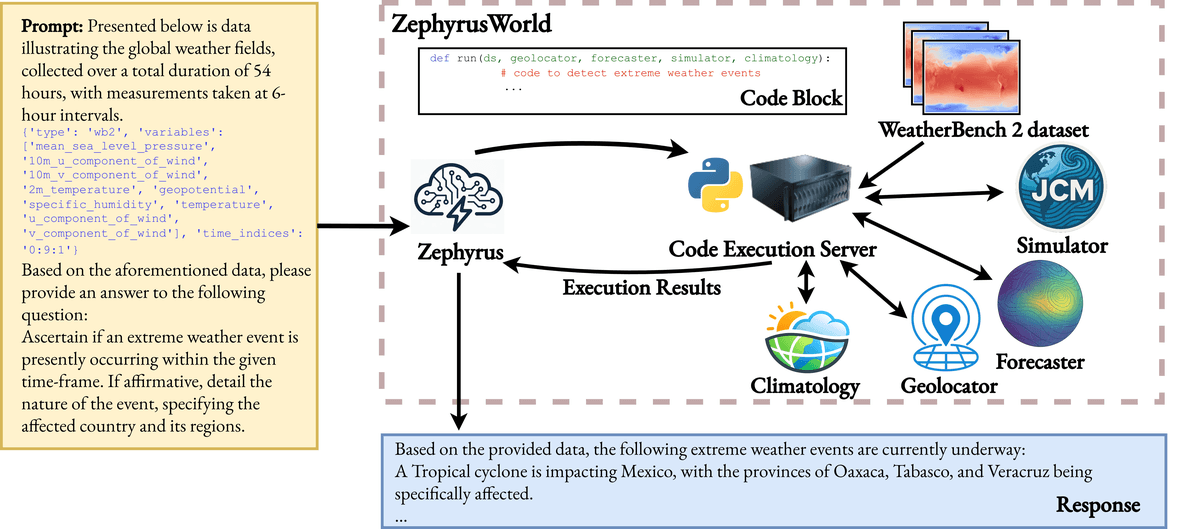
- ZephyrusWorld exposes WeatherBench 2, Stormer forecasting, JCM simulator, geolocator, and climatology through Python APIs.
- Two agents ship: Zephyrus-Direct (single-shot code) and Zephyrus-Reflective (multi-turn ReAct loop, 20 max turns).
- ZephyrusBench includes 2,230 QA pairs across 49 tasks spanning easy lookups to counterfactual reasoning.
- Agents beat text-only baselines by up to 44 points; GPT-5.2 reaches 90.4% location accuracy.
- Hard tasks like ENSO outlooks and global climate reports remain unsolved. Code
Weather foundation models can predict global atmospheric conditions with impressive skill, but they cannot answer a question. Large language models can answer questions, but they cannot reason over petabytes of gridded atmospheric data. A team from UC San Diego just built the connective tissue between the two, and along with it, the first serious benchmark for agentic weather reasoning.
The project is called Zephyrus, and it consists of three pieces: an execution environment stocked with meteorological tools, two LLM agents that use those tools, and a benchmark of 2,230 weather questions designed to break them. Experiments on this benchmark demonstrate the strong performance of Zephyrus agents over text-only baselines, outperforming them by up to 44 percentage points in correctness. The catch is that the hardest tasks remain out of reach even for frontier models.
The gap between grids and language
Modern neural weather models like GraphCast, Pangu-Weather, and Stormer have quietly overtaken traditional physics simulations on medium-range forecasts. But these architectures are predominantly trained for forecasting. In particular, they do not support conversational interfaces or cross-domain, multimodal reasoning capabilities. A meteorologist who wants to ask "which regions are currently seeing temperatures more than two standard deviations above their climatological baseline?" still has to write custom code against xarray datasets, coordinate multiple APIs, and stitch outputs together by hand.
Prior attempts to bolt vision-language models onto weather data have generally focused on narrow slices, like extreme event detection from a few variables. Zephyrus takes a different approach: instead of training a new multimodal model, it treats weather science as a code-generation and tool-use problem.
Inside ZephyrusWorld
The environment, ZephyrusWorld, exposes weather capabilities through Python APIs the LLM can call. Given a question, we leverage LLMs' ability to generate Python code and execute it in a sandboxed environment. The output is then fed back to the model along with any execution errors. Five tools sit behind the interface:
- WeatherBench 2 indexer: access to ERA5 reanalysis data from 1979 to 2022 at 1.5 degree resolution, 6-hour intervals, via xarray.
- Geolocator: forward and reverse geocoding, boolean region masks, area-weighted maps, and geodesic distances, built on the Natural Earth dataset with precomputed spatial caches.
- Forecaster: the Stormer model, a transformer-based neural weather prediction system trained on WeatherBench 2, chosen for strong short to medium range forecasts while being orders of magnitude more efficient than traditional numerical models.
- Simulator: the JCM intermediate-complexity atmospheric model built on NeuralGCM's dynamical core, running 5-day simulations in roughly 25 seconds on an A100.
- Climatology: precomputed means, extremes, standard deviations, and quantiles for the 1979-2000 reference period across seasonal, monthly, daily, and six-hourly timescales.
Everything runs through a FastAPI code execution server that parallelizes requests, maintains resource pools per tool, and enforces acquire/release semantics so multiple worker threads do not step on each other.

Two agents, one loop
On top of ZephyrusWorld, the authors built two agent variants that deliberately stay simple to isolate what LLMs can actually do:
- Zephyrus-Direct generates a complete Python solution in one shot and returns the execution output. It only re-enters the loop if the code errors out, up to 20 tries.
- Zephyrus-Reflective follows a ReAct-style execute-observe-refine cycle. It runs a code block, reads the result, decides whether to run another block or emit a final answer, and can catch its own logical mistakes across up to 20 turns.
The benchmark that breaks them
ZephyrusBench is where the work really earns its keep. The benchmark comprises 49 distinct meteorological tasks with answers derived from curated weather reports and human-generated or verified code. The capabilities measured by our curated tasks range from basic data lookups and computations to more advanced problems involving forecasting, challenging research problems including extreme event detection, forecast report generation, prediction analysis, and counterfactual reasoning.
Half the tasks are hand-authored by graduate students working with a domain expert. The other half come from a semi-synthetic pipeline that extracts scientifically meaningful claims from NOAA weather reports using GPT-4.1, converts them into templates, and generates verifier code that a human reviews. Ground-truth reports for the hardest tasks are sourced from NOAA Global Climate Reports, Area Forecast Discussions, and WMO ENSO Reports, with extreme events matched against the EM-DAT international disaster database.
What the numbers say
The headline result is that giving an LLM tools helps a lot. For GPT-5-Mini, Zephyrus-Direct and Zephyrus-Reflective achieve 58.5% and 61.2% correctness respectively, compared to only 17% for the text-only baseline. On location prediction tasks, Zephyrus-Reflective with GPT-5.2 achieves strong performance with 90.4% accuracy.
Performance falls off a cliff with task difficulty:
- Easy tasks (data lookups, extrema, computations): 76 to 91 percent correct across models.
- Medium tasks (forecasting, threshold checks, area comparisons): 49 to 64 percent.
- Hard tasks (extreme event detection, report generation, counterfactuals): 14 to 38 percent.
The reflective loop helps modestly, giving OpenAI models a 0.8 to 2.7 percentage point bump over Direct, though for Qwen3-30B and Gemini 2.5 Flash the single-shot approach sometimes wins. An ablation with a ground-truth forecaster jumped medium-task performance from 60.5% to 83.2%, but hard-task correctness barely moved, showing that better forecasts alone do not fix the reasoning gap.
Where it falls apart
The most striking failure mode is textual forecast generation. The best performing model (Zephyrus-Reflective with GPT-5.2) only achieves a discussion score of 0.27. Continental US forecasts fare better, reaching an average discussion score of 0.43, but three-month global climate outlooks fail across the board. The authors document a representative extreme-weather failure where the agent chased the deepest global pressure center into the Bering Sea and completely missed a large storm system affecting fifteen US states, because its detection pipeline was anchored to a single global minimum rather than examining continental patterns.
Tool selection is also imperfect. When both the forecaster and the climate simulator are available, models sometimes reach for the simulator on short-term forecasting tasks even though the documentation explicitly points them at the forecaster.
Getting your hands on it
The full codebase and benchmark are open source at the Rose-STL-Lab/Zephyrus repository. Because ZephyrusWorld is modular, adding a new tool means writing a Python class with documented APIs and registering it with the resource manager. The authors position the framework as a sandbox that could extend to hydrology, geosensing, and climate science, though the harder open question is whether future agents will develop the meteorological reasoning that current LLMs, even with perfect data access, still lack.