
UC San Diego's ORIC Catches GPT-5 Hallucinating Objects That Aren't There
ORIC exposes a hidden failure mode in vision-language models: scene context hijacks object recognition, causing both missed detections and hallucinations — and a 600-sample RL fine-tune fixes it
 Pro
Takeaways
- ORIC introduces a benchmark and framework exposing how scene context causes LVLMs to miss real objects and hallucinate absent ones in unexpected settings.
- All 18 tested LVLMs show dramatic F1 drops (~96 → ~60) when object-context pairs are made incongruous, even with identical images.
- Two-pronged data construction: LLM-guided sampling finds hard-to-spot real objects; CLIP-guided sampling mines plausible-but-absent objects for hallucination traps.
- Visual-RFT fine-tuning on just 600 ORIC samples boosts Qwen3-VL-8B-Instruct from 79.55 to 82.79 F1 on ORIC-Bench, and from 87.48 to 90.49 on AMBER.
- Open-source Qwen3-VL-8B-Instruct (79.55 F1) matches or beats GPT-5 (78.61 F1) on the benchmark.
- Dataset, benchmark, and fine-tuning code are publicly available on GitHub.
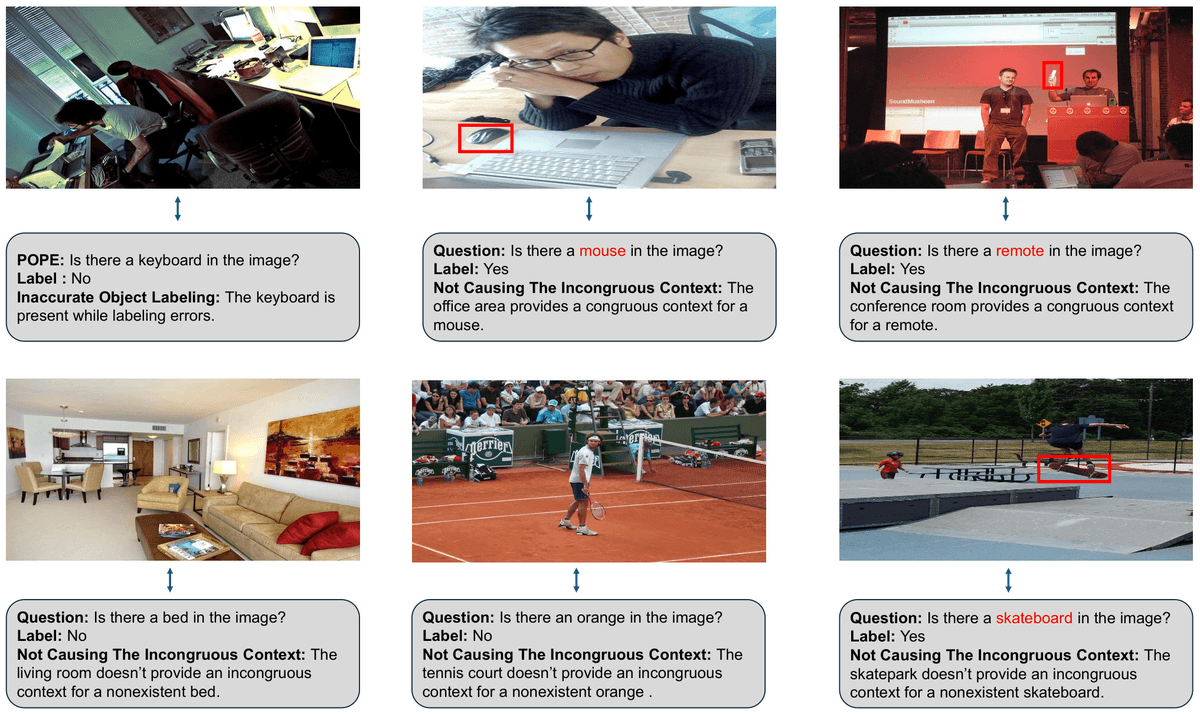
Ask GPT-5 whether there is a train in an office, and it will say no , even when a train is clearly visible in the image. Ask it whether there is a sports ball on a baseball field, and it will say yes , even when no ball exists. These are not edge cases. They are symptoms of a systematic flaw that a new paper from UC San Diego has now formally characterized, benchmarked, and partially fixed.
The paper introduces ORIC (Object Recognition in Incongruous Context), a framework and benchmark designed to stress-test large vision-language models (LVLMs) in exactly the scenarios where they silently break down: when an object appears in an unexpected setting, or when a contextually plausible object is simply absent.
The scene is doing the talking
The core insight is deceptively simple. A particularly challenging regime for LVLMs is contextual incongruity, where objects appear in unexpected settings or are absent from expected ones. Under such conditions, LVLMs often misread visual evidence, either overlooking valid objects or hallucinating contextually plausible ones.
The mechanism behind this is a well-known property of how these models learn. When the visual signal for an object is weak or ambiguous, the model falls back on what the scene implies should be there. When evidence from the ROI (region of interest) is weak, contextual priors tend to dominate the inference. If the context strongly implies that an object should exist (e.g., a sports ball on a baseball field), the model is biased toward answering "yes," resulting in hallucinations. Conversely, when the context implies that the object is unlikely to appear (e.g., a train in an office), the model confidently predicts "no," causing misidentification.
What makes this particularly damaging is that existing benchmarks like POPE, AMBER, and HallusionBench largely avoid this regime. Across these benchmarks, queried objects remain context-consistent with their scenes, leaving the high-uncertainty regime where weak local evidence opposes strong contextual priors largely unexplored. ORIC is the first benchmark built specifically to probe this blind spot.

How ORIC constructs hard questions
The ORIC framework generates binary yes/no object-presence questions using two complementary strategies, each targeting one failure mode:
- LLM-guided sampling (positive questions): Given an image, GPT-5 is asked whether each small/foreground object (the ROI) is logically consistent with the background objects. If GPT-5 says the object shouldn't be there based on common sense, that object becomes a hard positive question , the model must confirm the presence of something the scene context argues against.
- CLIP-guided sampling (negative questions): For absent objects, ORIC finds a visually similar image and uses CLIP to score which non-existent objects have the highest semantic alignment with the scene. The top-scoring absent objects become hard negative questions , the model must deny the presence of something the scene context strongly implies.
A human evaluation of 300 sampled questions found only a 2% error rate, confirming the robustness of the pipeline. Applied to the MSCOCO validation set, this produces ORIC-Bench: 1,000 images, each yielding two positive and two negative questions, for a total of 2,000 balanced binary queries.

Every model falls off a cliff
The team evaluated 18 LVLMs and 2 open-vocabulary detectors. The results are striking. To establish a baseline, they first tested four models on a small set of standard POPE questions, then replaced the queried objects with incongruous ones while keeping the images identical. All four models achieve near-perfect performance on the original subset (macro F1 between 96.0 and 100.0), but macro F1 drops dramatically to around 60 on the incongruous questions, despite the images being identical.
On the full ORIC-Bench, the picture is similar. The best-performing open-source model, Qwen3-VL-8B-Instruct, reaches an F1 of 79.55 , and that is the ceiling. Most models land between 60 and 77. The full leaderboard reveals clear architectural patterns:
- Qwen3-VL-8B-Instruct: 79.55 F1 (best open-source)
- GPT-5: 78.61 F1 (best closed-source, trails the open-source leader by under 1 point)
- InternVL3-9B: 76.87 F1
- Janus-Pro-7B: 74.83 F1
- Grounding DINO 1.5 Pro: 72.48 F1
- Emu3-Chat (encoder-free): 64.78 F1
- Llama-3.2-11B-Vision: 33.33 F1 (predicts "no" for everything due to a safety heuristic)
The gap between vision-encoder-based and encoder-free models stems from ViT-style encoders providing structured visual features for fine-grained perception, whereas encoder-free models using raw pixels remain fragile in complex scenes. Notably, among closed-source systems, GPT-5 trails Qwen3-VL-8B-Instruct by only 0.94 points, showing open-source LVLMs can match or surpass proprietary ones.
The benchmark also reveals a consistent bias: most models are "yes-conservative," preferring to deny uncertain objects rather than hallucinate them. This reduces false positives but suppresses true positives , a tradeoff that matters in applications like robotics or medical imaging where missing an object can be as dangerous as hallucinating one.
A 600-sample RL fix that generalizes
The paper's most practically useful contribution is the mitigation strategy. The team fine-tuned Qwen3-VL-8B-Instruct using Visual Reinforcement Fine-Tuning (Visual-RFT), a technique that applies GRPO (Group Relative Policy Optimization) with verifiable binary rewards instead of supervised label matching.
GRPO works by sampling multiple candidate responses for each question, then computing relative rewards within the group to update the policy. GRPO samples multiple outputs for each input and computes group-wise relative advantages to guide policy updates. By eliminating the need for generalized advantage estimation, GRPO substantially reduces computational overhead while maintaining stable optimization dynamics. Each response gets two binary rewards: one for answer correctness and one for format compliance (the model must reason inside <REASONING> tags before giving a <SOLUTION>).
The training set is intentionally tiny: 600 ORIC-style binary questions (300 yes, 300 no) generated from the COCO-2014 training split, with ORIC-Bench using disjoint validation images. Training ran for 15 epochs on 4x H100 GPUs.
The results show meaningful gains across the board:
- ORIC-Bench macro F1: 79.55 → 82.79 (+3.24)
- Yes-label F1: 78.51 → 81.59
- No-label F1: 80.59 → 83.99
- AMBER (compositional reasoning): 87.48 → 90.49 (+3.01)
- HallusionBench (visual illusions): 69.37 → 69.81 (stable, no regression)
On a human-labeled subset of 200 ORIC-Bench questions, Visual-RFT improves macro F1 from 78.63 to 83.62, indicating closer agreement with human judgments under ambiguous contexts. The gains on AMBER , a benchmark the model was never trained on , confirm that the improvement is not overfitting to ORIC-style data but reflects a genuine shift toward evidence-grounded reasoning.
What it's good for , and where it falls short
ORIC is directly relevant for any system where a vision-language model must make reliable object-presence decisions in real-world, uncontrolled environments. The failure mode it captures is especially dangerous in:
- Robotics and embodied AI: A robot that hallucinates a tool because the scene implies it should be there, or misses an obstacle because it looks out of place, can cause physical failures.
- Visual QA pipelines: Downstream reasoning chains that depend on object-existence answers will silently propagate errors.
- Document and scene understanding: Unusual object placements (a laptop on a kitchen counter, a fire extinguisher in a bedroom) are exactly the cases that matter most and are most likely to be wrong.
The current limitation is scope: ORIC is limited to a single dataset (MSCOCO), and future efforts should explore diverse contexts and stronger methods for reliable recognition under incongruity. The benchmark also focuses on binary existence queries, not richer tasks like attribute prediction or spatial reasoning. And while the Visual-RFT fine-tune is data-efficient, it still requires a GPU cluster to run.
What's actually new here
The real contribution is not just a harder benchmark , it is a theoretical framing that explains why this failure mode exists and a data construction pipeline that can be applied to any image dataset. The ORIC framework can generate incongruous training and evaluation data from any annotated image collection, not just COCO. The team releases ORIC-Bench, ORIC-style training data, and code for evaluation and Visual-RFT fine-tuning of Qwen3-VL-8B-Instruct at the official GitHub repository.
The mechanistic error analysis adds another layer of insight. Across the top three models, prompt-robust failures (errors that persist across all four prompt variants) are dominated by scene-level expectations (23–25 cases per 100), followed by object co-occurrence patterns (14–19 cases), and set-completion errors , where the model hallucinates the "missing" member of a functional group of objects (8–11 cases). This taxonomy gives researchers a concrete roadmap for what to fix next. The full paper includes ablation studies, threshold sweeps, and per-class breakdowns that make ORIC-Bench a practical diagnostic tool rather than just a leaderboard.