
UC Riverside's GUIDES Boosts Robot Success Rates 106% Without Retraining
A new framework called GUIDES bolts vision-language reasoning onto legacy robot policies without retraining them from scratch, cutting sim-to-real grasp errors nearly tenfold.
 Pro
Takeaways
- GUIDES upgrades pre-trained robot policies with VLM semantic guidance without changing their architecture or discarding pre-trained weights.
- Three modules: a fine-tuned Instructor VLM, an auxiliary encoding module, and a confidence-triggered LLM Reflector for hard cases.
- Transformer policies gained 10 absolute points on RoboCasa; diffusion policies saw 106% relative improvement on non-zero tasks.
- Real UR5 grasp precision jumped nearly tenfold, from 4.1% to 38.8% strike-zone entry rate across five objects.
- Guidance branch is about 0.8% of base parameters; only 5-10% of the original training schedule is needed.
- Limitation: acts as a bias inside the learned manifold, so cannot rescue tasks where baseline success is zero.
Most deployed robots still run on policies like BC-Transformer or Diffusion Policy that were painstakingly trained and validated on real hardware. They work, but they lack the semantic awareness of modern vision-language models. Ripping them out and replacing them with a monolithic VLA like OpenVLA means throwing away that accumulated knowledge and paying for weeks of GPU time plus a full re-validation cycle. A team from UC Riverside and Johns Hopkins is proposing a middle path with GUIDES, a lightweight add-on that injects semantic guidance from foundation models into pre-trained policies without touching their architecture.
Why swapping policies is a bad trade
Behavior cloning policies are notoriously brittle. If the gripper is a centimeter off when reaching for a tomato, the whole trajectory fails, no matter how clean the rest of the motion is. Foundation-model-based policies like RT-2 and OpenVLA solve this with high-level reasoning, but they require restructuring the entire perception-to-action stack. Modular alternatives like TinyVLA and RoboFlamingo still demand new heads or conditioning pathways. GUIDES sidesteps both by treating the existing policy as a fixed decoder and grafting a small semantic co-processor onto its latent space.
How the co-processor works
The framework has three moving parts:
- Instructor: a fine-tuned VLM (DeepSeek-VL-7B-Chat in the paper) that generates step-wise textual instructions like "lift the tomato vertically out of the bin." It is trained on labels distilled from expert end-effector motion deltas, so it learns to map visual and proprioceptive inputs to spatially grounded language.
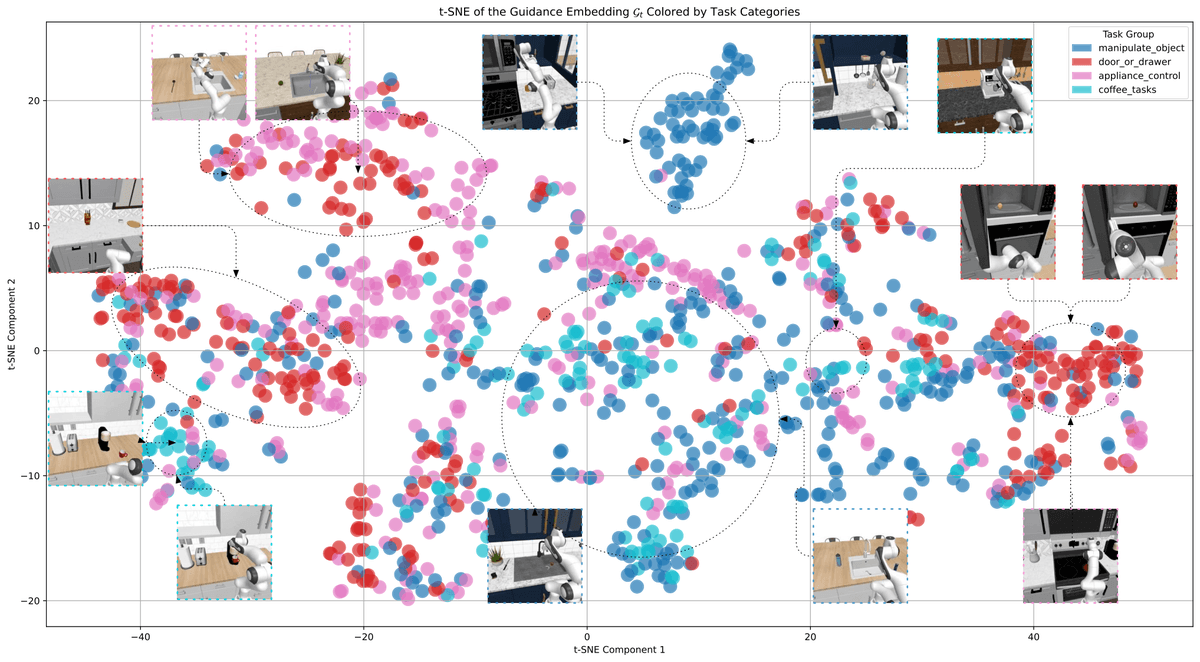
- Auxiliary Encoding Module (AEM): a small cross-attention plus feed-forward network that turns those instructions into a guidance embedding. The embedding is added element-wise to the frozen visual encoder's output, so no tensor shapes change in the base policy.
- Reflector: an LLM (Qwen2-7B) that only wakes up when the Instructor's token-level confidence drops below a threshold. It runs a chain-of-thought diagnosis, retrieves similar past (condition, action) pairs from an execution log, and re-prompts the VLM with that context.
Training cost stays low because only the guidance branch and policy head are updated, while the visual encoder stays frozen. The authors invoke PAC learning theory to argue that since the guidance branch is roughly 0.8% of the base model's parameters, fine-tuning for 5 to 10% of the original schedule is sufficient. They also skip re-querying the VLM when consecutive frames have CLIP similarity above 0.95, which speeds up training 4 to 10 times.
The numbers
On the RoboCasa benchmark of 24 long-horizon kitchen tasks, GUIDES lifted transformer policy success rates by 10 absolute percentage points (a 33.78% relative gain) after just 100 epochs of adaptation on top of a 900-epoch baseline. Diffusion policies saw a 106% relative improvement on tasks where the baseline was non-zero. When the Reflector was enabled on three of the hardest tasks, average success went from 17% baseline to 27% with GUIDES to 49% with reflection turned on.

On a real UR5 arm doing the PnPCabToCounter task, the effect on grasping precision was more dramatic. The end-effector's rate of entering the "strike zone" around the target object jumped from 4.1% to 38.8% on average across five objects, with the pill bottle going from 19% to 82%. Trajectories that had been hesitant and drifting became direct.
Where it breaks
The authors are candid that GUIDES is an enhancer, not a bootstrapper. It works as a semantic bias that steers the policy inside its already-learned latent manifold. If the base policy has never seen a useful behavior for a task, guidance embeddings cannot conjure motor primitives out of nothing. Tasks with zero baseline success in the diffusion column stayed at zero. There is also a persistent sim-to-real gap the authors attribute to sensory fidelity, which they propose addressing later with active depth or stereo vision.
An ablation drives home how much the design depends on the guidance signal itself: replacing the embedding with random values causes every run to fail, while dropping the task description from the AEM input barely dents performance. The step-wise visual observation carries most of the useful signal, which suggests the Instructor is doing real spatial grounding rather than parroting the task prompt.
Practical takeaway
The paper does not link a public code release, and the arXiv listing has no associated repository yet. But the recipe itself is straightforward to reproduce if you already have a trained BC-Transformer or Diffusion Policy: fine-tune a mid-size VLM on motion-delta-grounded captions, train a small cross-attention module to inject its output into your encoder's output tensor, and add a confidence-triggered reflection loop for hard cases. For teams sitting on validated policies who want VLM-level semantics without a full retraining budget, this is a much cheaper upgrade path than swapping to OpenVLA-class models, which the authors note require 64 A100s for roughly two weeks of training.