
UC Merced's PAS Fixes Video AI Attention Flaws Without Retraining
A training-free tweak to attention heads fixes a subtle Fourier flaw in video position encoding, boosting Video LLM accuracy without extra compute.
 Pro
Takeaways
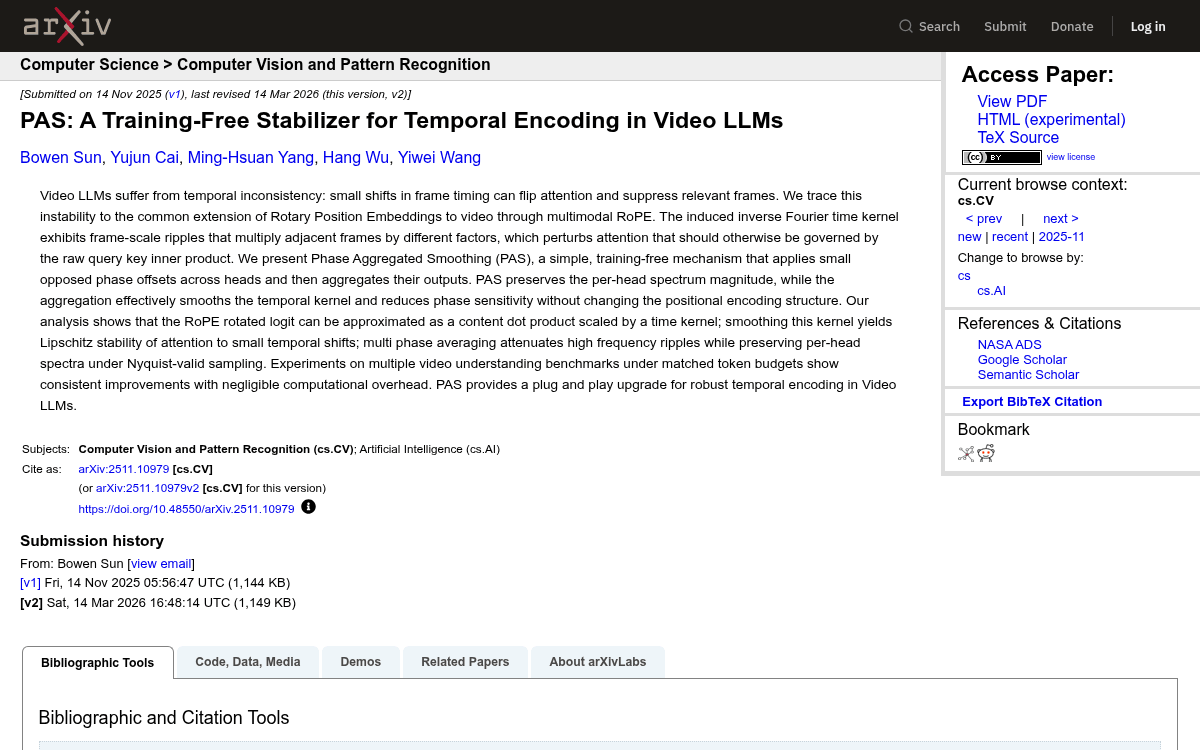
- PAS is a training-free fix for temporal jitter in Video LLMs caused by multimodal RoPE's rippled time kernel.
- It assigns small opposed phase offsets across query heads, then relies on standard multi-head aggregation to smooth the modulation.
- Tested on Qwen2.5-VL-7B across nine benchmarks, with gains up to 3.3 points on Kinetics-700 and 2.3 on MVBench.
- Throughput is statistically identical to the baseline: 76.8k vs 77.2k tokens/s on an A100.
- Largest benefits come at sparse sampling; gains vanish as frame density approaches Nyquist. Paper.
- Code and defaults (K=2 groups, offsets [0, 0.5] bin units) available at GitHub.
Video language models have a jitter problem. Nudge the frame timing by a hair, and attention can suddenly ignore the frame that actually matters. A new paper from UC Merced, the University of Queensland, Ant Group, and Google DeepMind traces this fragility to a specific mathematical quirk in how Rotary Position Embeddings (RoPE) get extended to video, and proposes a fix that runs at inference time with essentially no overhead.
The method is called Phase Aggregated Smoothing (PAS). It is training-free, adds no tokens, and drops into existing Video LLMs like Qwen2.5-VL by touching a single line in the attention path. The code is on GitHub.
Where the wobble comes from
RoPE was designed for discrete text tokens. To handle video, models use multimodal RoPE (M-RoPE), which assigns separate frequency channels to time, height, and width. Along the temporal axis, this construction amounts to assigning a finite set of temporal frequencies; each frequency line rotates query and key pairs and induces an independent, periodic contribution to the attention logit.
The authors reframe attention through a Fourier lens. Once you write out the RoPE-rotated logit, it turns out to be the ordinary content dot product multiplied by a scalar time kernel, which is the inverse Fourier transform of RoPE's line spectrum. That kernel is a sum of cosines, so it ripples at the frame scale. In practice, that means very small changes in lag can produce large fluctuations in attention; at certain lags, the modulation suppresses attention, while at others it amplifies it.
The failure mode is concrete: if a key frame happens to land in a low-gain trough of the kernel, its evidence gets crushed while less relevant frames in high-gain intervals dominate. The downstream answer flips.

Phase diversity, then averaging
PAS borrows the idea of a moving average filter. If the modulation waveform is rippled and you sample it at slightly different offsets, then averaging those samples smooths it. The clever part is where to get those offsets for free: attention heads.
The mechanism is:
- Partition the query heads into groups (the paper defaults to
K=2). - Assign each group a small temporal phase offset in the query stream only. The default is
[0, 0.5]in bin units. - Leave keys, values, tokens, and the positional structure untouched.
- Run the standard multi-head aggregation. That aggregation now acts as a controlled moving average across nearby lags.
Because a time shift only rotates phases in the frequency domain, each head individually preserves its RoPE spectrum magnitude. The smoothing emerges only when the heads are combined. The authors back this with three theorems: a Lipschitz bound showing that a smoother time kernel implies attention that changes at most linearly under tiny timing shifts; a proof that multi-phase averaging strictly reduces local temporal variation; and a Nyquist-conditional guarantee that per-head recovered spectra are invariant under these offsets.
What it costs
Almost nothing. PAS adds a per-token, per-head linear transform on the temporal half-dimensions of Q. On an NVIDIA A100 80 GB and under matched sequences and settings, the original backbone achieves (77.2±3.1)×10³ tokens/s throughput, while PAS achieves (76.8±4.0)×10³ tokens/s. The two are statistically indistinguishable within variance, indicating that enabling PAS has a negligible impact on inference speed.
Nine benchmarks, one backbone
The team evaluates on Qwen2.5-VL-7B-Instruct across four action recognition datasets (20BN-Jester, Something-Something V2, Kinetics-700, Breakfast Actions) and five general Video LLM suites (MVBench, TempCompass, PerceptionTest, EgoSchema, MMBench-Video). All comparisons use identical decoding and matched video-token budgets.
PAS is also stacked on top of two existing training-free baselines: SlowFast-LLaVA and TS-LLaVA. Highlights from the matched-token results:
- Kinetics-700 accuracy: 44.9 → 48.2 with PAS alone, 49.8 stacked on SlowFast.
- 20BN-Jester accuracy: 16.0 → 18.3, and 19.6 stacked.
- MVBench: 67.2 → 69.5, and 71.0 stacked.
- TempCompass: 71.5 → 73.3, and 73.9 stacked.
- MMBench-Video mean score: 1.71 → 1.78, and 1.81 stacked.
Breakfast Actions, which the authors deliberately sub-sample below Nyquist, shows only modest gains. That is consistent with the theory: when aliasing dominates, per-head spectra are no longer invariant to phase shifts and there is less signal for the smoothing to recover.
When to reach for it
PAS is designed for the regime that most deployed Video LLMs actually operate in: low frame rates, aggressive frame merging, and matched token budgets that force sparse temporal sampling. The ablation on sampling ratio backs this up. Across 20BN-Jester, SSv2, and Kinetics-700, PAS yields larger gains at lower sampling ratios and gradually converges to the original backbone as r increases. When r is high, the two curves are statistically indistinguishable. On Breakfast Actions (undersampled relative to the RoPE band), the improvement window is narrower and the absolute gains are smaller.
In other words, PAS is a targeted patch for phase sensitivity, not a universal accuracy booster. If you already sample densely enough that the modulation kernel is being probed smoothly, there is little left to fix. If you are running sparse, low-FPS pipelines, this is the free lunch.
Why this matters
The core contribution is not the algorithm, which is a few lines of code. It is the diagnosis. Prior work on video RoPE, including VideoRoPE and Qwen2-VL's M-RoPE, treated the temporal axis as an engineering choice. PAS argues that the induced time-domain kernel is inherently rippled at the frame scale, which is a spectrum property, not a sampling artifact, and it separates that problem from token budgets and backbone changes.
The offset choice is also robust. Sweeps across offset magnitudes from 0.1 to 1.0 bin units show wide performance plateaus in the 0.3 to 0.8 range, with the recommended default of 0.5 sitting comfortably inside the plateau on every dataset tested. For anyone shipping a Video LLM today, PAS is close to a no-risk patch: no retraining, no throughput hit, and a couple of lines that hook into the query stream after positional encoding.