
UC Berkeley's SPARK Cuts Humanoid Robot Motion Error by 83%
A new two-stage retargeting pipeline maps human motion to humanoids with skeleton calibration and progressive optimization, cutting IK error up to 83 percent.
 Pro
Takeaways
- SPARK is a two-stage human-to-humanoid retargeting pipeline from UC Berkeley and Shanghai Innovation Institute, targeting IROS 2026.
- Stage one converts human motion to a URDF skeleton and calibrates arms, legs, torso, and end effectors to the target robot.
- Stage two runs progressive kinodynamic trajectory optimization: kinematic TO, inverse dynamics, then full kinodynamic TO.
- IK error drops 65 to 83 percent versus GMR baseline on AMASS ACCAD across G1, H1, T1, PM01, Kuavo 4Pro.
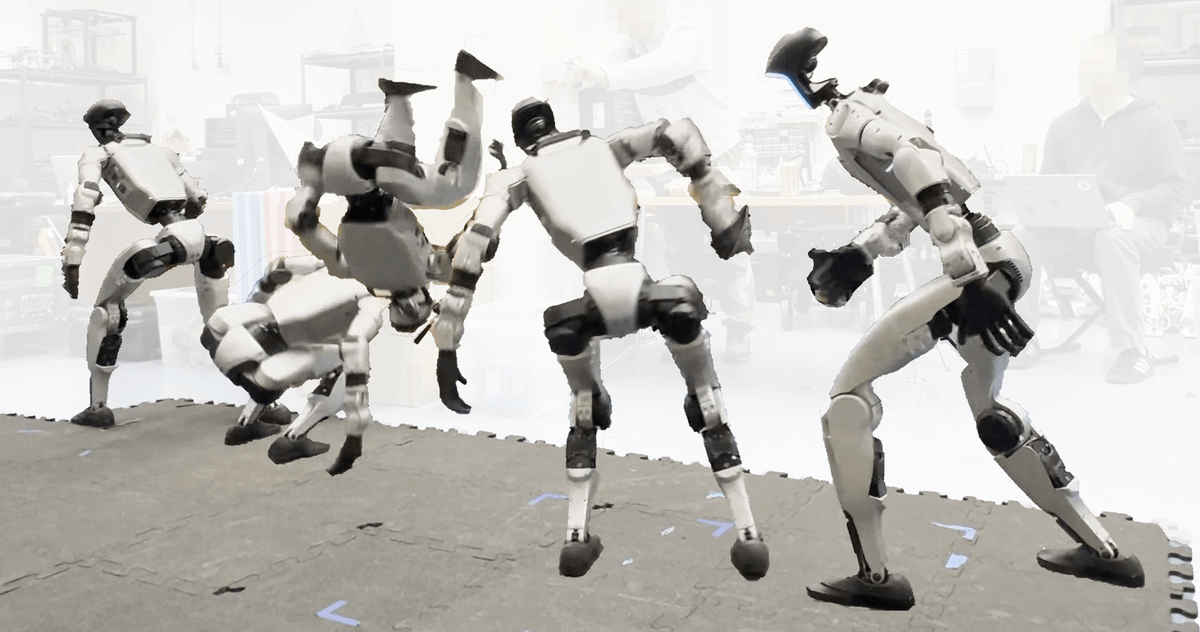
- Torque references from KDTO accelerate RL convergence on hard motions like a Unitree G1 side flip.
- Preprint on arXiv; no code released yet.
Humanoid robot teams keep hitting the same wall: there are massive libraries of human motion capture data, but the humans in those recordings do not have the same proportions, joint counts, or torque limits as a Unitree G1 or an EngineAI PM01. Pipes that naively copy human joint targets onto a robot produce motions that look plausible in simulation and then fold on real hardware. A team from UC Berkeley and the Shanghai Innovation Institute has proposed SPARK, a retargeting pipeline that fixes the geometry first, then the physics, before any reinforcement learning happens.
The headline result: on the AMASS ACCAD motion capture dataset, SPARK drops inverse kinematics error by 65 to 83 percent across five different humanoid platforms compared to GMR, the current general motion retargeting baseline. The same pipeline was used to train tracking policies that landed a side flip on a Unitree G1.
Why raw retargeting keeps breaking
Existing retargeting tools model human-robot morphology mismatch using root-link-centered task-space scalings and per-keyframe local offsets that are inconsistent with the underlying skeletal structure, often requiring substantial IK objective tuning. The paper points out a concrete failure mode: if a robot has a taller, wider shoulder but a shorter arm than the human, a single root-to-arm scaling factor cannot fix both dimensions at once, and the correct scaling changes with every joint configuration.
The second problem is that most retargeting pipelines are purely kinematic. They match positions frame by frame but never check whether the resulting trajectory obeys gravity, torque limits, or contact physics. When those references are handed to an RL policy, the policy has to learn two things at once: how to track the motion and how to silently repair the physics violations. That entanglement is what makes training a side flip so painful.

Step one: calibrate the skeleton, not the keyframes
Instead of tweaking task-space targets, SPARK converts the human motion sequence into a URDF (the standard robot description format used across ROS, MuJoCo, and Isaac Lab) and rescales that URDF to match the target robot. The calibration is broken into five groups of keyframes covering end effectors, arms, legs, main body, and root position. Arms get a scalar length scaling because human and robot arm rest poses can differ, while legs and torso links get full 3D translation matching. The torso, which has extra intermediate links, is corrected with an affine transform that combines an xz shear with independent y and z scalings.

The payoff is that once the human URDF is aligned to the robot, IK targets are already structurally consistent. The authors report they can set IK position and orientation tracking weights uniformly to one, eliminating most of the per-motion tuning that dominates other pipelines. The comparison against GMR across five platforms is stark:
| Robot | GMR error (cm) | SPARK error (cm) | Reduction |
|---|---|---|---|
| Unitree G1 | 9.37 | 1.60 | 82.9% |
| Unitree H1 | 12.53 | 4.40 | 64.9% |
| Booster T1 | 6.59 | 1.85 | 71.9% |
| EngineAI PM01 | 9.51 | 2.47 | 74.0% |
| Kuavo 4Pro | 19.50 | 4.71 | 75.8% |
Step two: warm-start the physics in three passes
Kinodynamic trajectory optimization, meaning optimization that jointly reasons about positions, velocities, accelerations, torques, and contact forces, is notoriously hard to solve in one shot. SPARK breaks it into three progressively harder problems, each warm-started from the previous one:
- Kinematic TO (KTO): Fixes contact kinematics and self-collisions using a double-integrator model. Feet stay above the ground during swing, land flat at first contact, and hold zero velocity while in contact.
- Inverse Dynamics (ID): Runs a per-timestep quadratic program that computes joint torques and 6D contact wrenches consistent with the KTO trajectory, subject to friction cone limits and torque bounds.
- Full Kinodynamic TO (KDTO): Jointly optimizes state and inputs using the full-order Lagrangian dynamics, initialized from the KTO and ID solutions.
The output is not just a dynamically consistent state trajectory but also a reference torque profile, which turns out to be surprisingly useful downstream.
Where the torque reference pays off
The team tested three scenarios on Unitree G1 using BeyondMimic-style RL tracking in Isaac Lab. For a modest edit like connecting a jump to standing start and end poses, KTO alone already helps and full KDTO adds little. For an aggressive 4x jump-height edit that changes flight time and effectively rescales gravity, KDTO produces meaningfully lower final tracking error than KTO or raw edits.

The clearest win is the side flip. A KTO-only reference makes the policy stall for around 500 training iterations while the robot is inverted, because it has to learn tracking and fix physics simultaneously. KDTO shortens that plateau, and adding an exponential torque-tracking reward that follows the KDTO torque reference (the variant called KDTO+T) converges faster still.
What it is and is not good for
SPARK is targeted at the offline data pipeline: preparing high-quality reference motions and torque supervision for downstream RL. It is not a real-time controller, and the trajectory optimization stack is heavy enough that it would not run on-robot. It also assumes you have contact labels from the source motion, which AMASS provides but many casual capture formats do not. And while the URDF calibration generalizes to any human motion format with an implicit skeleton, the pipeline still needs a clean rest pose per source dataset.
The paper is currently a preprint accepted to IROS 2026, with no public code release yet. The authors, based in Xiaobin Xiong's Legged AI Lab and Koushil Sreenath's group at Berkeley, have historically open-sourced follow-on tools like mjlab, so keep an eye out.