
UC Berkeley's RIGID Framework Plugs AI Into Evidence-Based Course Design
A new framework from Berkeley pairs learning-science research with generative AI to close the gap between evidence and everyday instructional design.
 Pro
Takeaways
- Berkeley researchers propose RIGID, a framework tying learning-sciences research to instructional design via generative AI.
- Applies Kozma's micro, meso, and macro context levels across analysis, design, implementation, and evaluation phases.
- AI acts as a coordination layer, using automatic prompt engineering to fuse research and classroom constraints.
- Institutional Centers for Teaching and Learning are positioned as key meso-level contributors.
- Outputs include syllabi, tutoring content, assessments, and open educational resources with human designers in the loop.
- Conceptual framework only, with no code, benchmarks, or empirical evaluation released.
Instructional design has a well-known evidence problem. Educators know that learning-science research should shape how courses, assessments, and tutoring materials are built, but pulling that research into a real workflow is slow, context-heavy, and mostly manual. A new paper from UC Berkeley proposes a way to make that integration systematic by using generative AI as the connective tissue between research findings and design decisions.
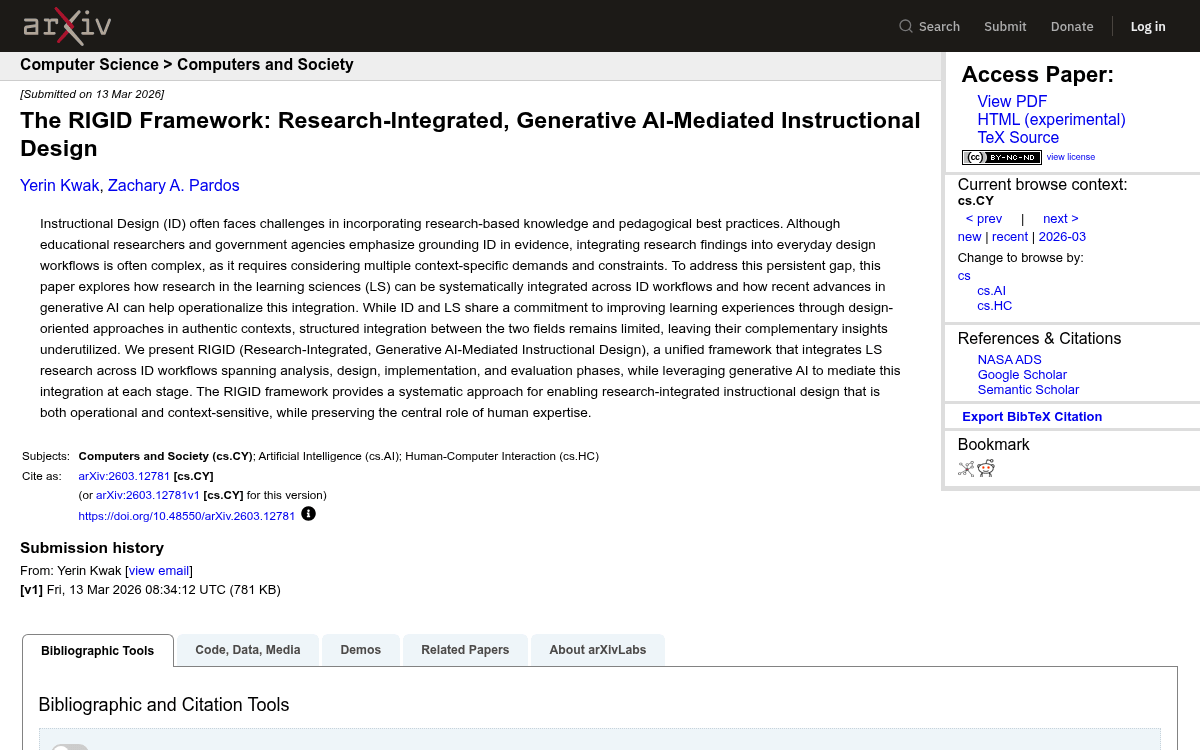
The paper, The RIGID Framework: Research-Integrated, Generative AI-Mediated Instructional Design by Yerin Kwak and Zachary A. Pardos, argues that instructional design frequently struggles to incorporate research-based knowledge and pedagogical best practices, and that although educational researchers and government agencies emphasize grounding design in evidence, translating research findings into everyday design workflows is complex because it requires juggling multiple context-specific demands and constraints. RIGID stands for Research-Integrated, Generative AI-Mediated Instructional Design, and it targets that translation gap directly.
Why the field has a translation problem
Instructional design (ID) and the learning sciences (LS) are close cousins, but they rarely share a workflow. Both fields are committed to improving learning experiences through design-oriented approaches in authentic contexts, yet structured integration between them remains limited, leaving their complementary insights underutilized. In practice that means a designer building a course might read a paper on retrieval practice or worked-examples, but has no reliable way to convert that finding into concrete lesson-level decisions given their specific learners, institution, and constraints.
The authors also point out that this is not a one-shot problem. Research–practice integration spans multiple phases of ID, from analysis and design to implementation and evaluation, and achieving lifecycle-wide integration is difficult because instructional design decisions must simultaneously consider multiple contextual factors, making their coordination a combinatorial process that imposes substantial cognitive and logistical demands on instructors. That combinatorial load is exactly the kind of thing large language models are useful for.
Three levels of context, four phases of design
RIGID borrows a structure from Kozma. It expands the scope of analysis by incorporating three contextual levels that shape pedagogical practice: micro, meso, and macro. The micro level covers classroom factors such as student characteristics, teacher expertise, learning objectives, and pedagogical constraints. The meso level encompasses institutional conditions, including organizational goals, resources, and local policies. The macro level reflects the broadest context, including educational policies and theoretical perspectives that inform what counts as effective teaching and learning.
Those three levels are then run through an ADDIE-style lifecycle. The RIGID framework integrates learning-sciences perspectives into instructional design processes across four iterative phases, with AI serving as a mediating mechanism. The phases are analysis, design, implementation, and evaluation, and each has a defined role for AI.

How AI actually plugs in
The heart of the proposal is treating the model as a coordinator, not a content generator. RIGID positions generative AI as a coordination layer that operationalizes research-based constraints while enabling scalable exploration of the design space. By leveraging prompts and coordinating the micro-, meso-, and macro-level considerations identified during the Analysis phase, generative AI can generate multiple design alternatives within research-informed boundaries, allowing designers to systematically compare and evaluate alternative configurations.
Concretely, the analysis phase uses AI to fuse contextual insights into structured prompts. AI supports analysis by transforming insights from the micro, meso, and macro levels, together with a system prompt that provides high-level task-agnostic guidance for the model, into structured prompts that inform subsequent design decisions. Recent advances in automatic prompt engineering, which automatically generate, evaluate, and select prompts, allow AI to produce multiple prompt variants and identify those that perform best.
A typical flow across analysis and design looks like this:
- Instructor supplies micro-level facts: learners, objectives, constraints.
- Learning-sciences literature and institutional data supply meso- and macro-level context.
- The model distills these into optimized prompts using automatic prompt engineering.
- The model prototypes materials and can simulate learners against them.
- Designers compare alternatives and iterate.
Micro-level insights from instructional design, together with meso- and macro-level insights from the learning sciences, are distilled into prompt components for the AI, which then optimizes prompts, prototypes materials, and simulates learners to create contextually grounded and pedagogically aligned instructional resources. The evaluation phase then feeds outcomes back into analysis. Evaluation becomes not only a judgment of effectiveness but also a process of generating insights that can refine instructional practices and inform the development of learning theories, and those insights subsequently feed the next analysis phase, enabling iterative refinement.
Who could use it and where it will bite
The framework is meant to be practical for instructors, instructional designers, and institutional research units. The authors specifically call out one likely home for the meso layer. At the meso level, Centers for Teaching and Learning or similar institutional research units can serve as key contributors, since they often function as institutional laboratories that identify campus-specific research questions, analyze data, design and refine programs, and disseminate actionable knowledge about teaching and learning. Practical outputs from a RIGID pipeline include syllabi, textbook drafts, tutoring system content, assessments, and open educational resources.
The obvious catch is model reliability. Despite rapid advancements, generative AI continues to exhibit hallucinations, confidently producing false or misleading information, which remains a critical concern in educational contexts. Recent work has shown that self-consistency, self-reflection, and similar methods can significantly reduce hallucination rates, but error rates remain higher than desirable for many educational uses. That is a real ceiling on how much of the design work can be handed off to the model versus checked by a human expert.
It is also worth being upfront about what this paper is not. RIGID is a conceptual framework, not a shipped product. There is no released codebase, no benchmark suite, and no empirical evaluation of a reference implementation in the paper itself. The contribution is the architecture: a clear mapping between three contextual levels of learning-sciences research, the four phases of instructional design, and the specific role AI plays at each stage. For teams already stitching together LLMs, retrieval, and prompt pipelines for course design, it offers a structured target to build against rather than another ad hoc chatbot workflow.