
UBC's ToMAgent Beats Larger Models by Thinking About Your Feelings First
A new training method teaches small language models to reason about their conversation partner's mental state, boosting goal completion by up to 18.9%.
 Pro
Takeaways
- ToMAgent trains LLMs to generate partner mental states before each dialogue turn using look-ahead simulation.
- Improves goal completion by up to 18.9% (3B) and 6.9% (7B) on Sotopia benchmark.
- 7B version is competitive with GPT-5-nano and beats it on relationship preservation scores.
- Mental states cover five dimensions: beliefs, desires, intentions, emotions, knowledge.
- Adds only ~47 tokens and ~4.5 seconds per turn versus the base model.
- Code, data, and models available at arxiv.org/abs/2509.22887 and on GitHub.
Most chatbots barrel through conversations without pausing to consider what the person on the other side actually wants. A team from UBC and the Vector Institute has built a training recipe that changes that, and the numbers suggest it matters more than expected. Their agent, called ToMAgent (ToMA), writes down guesses about the partner's mental state before speaking, and it beats much larger models at achieving social goals in dialogue.
The setup targets a gap that has quietly widened as LLMs get deployed as tutors, customer service reps, and negotiation assistants. Prior work in interactive social environments like Sotopia has largely trained models to generate utterances that lead to successful conversations, overlooking explicit mental state modeling. Optimizing for what to say, without modeling why the other person might say what they say, leaves a lot of performance on the table.
Thinking before speaking
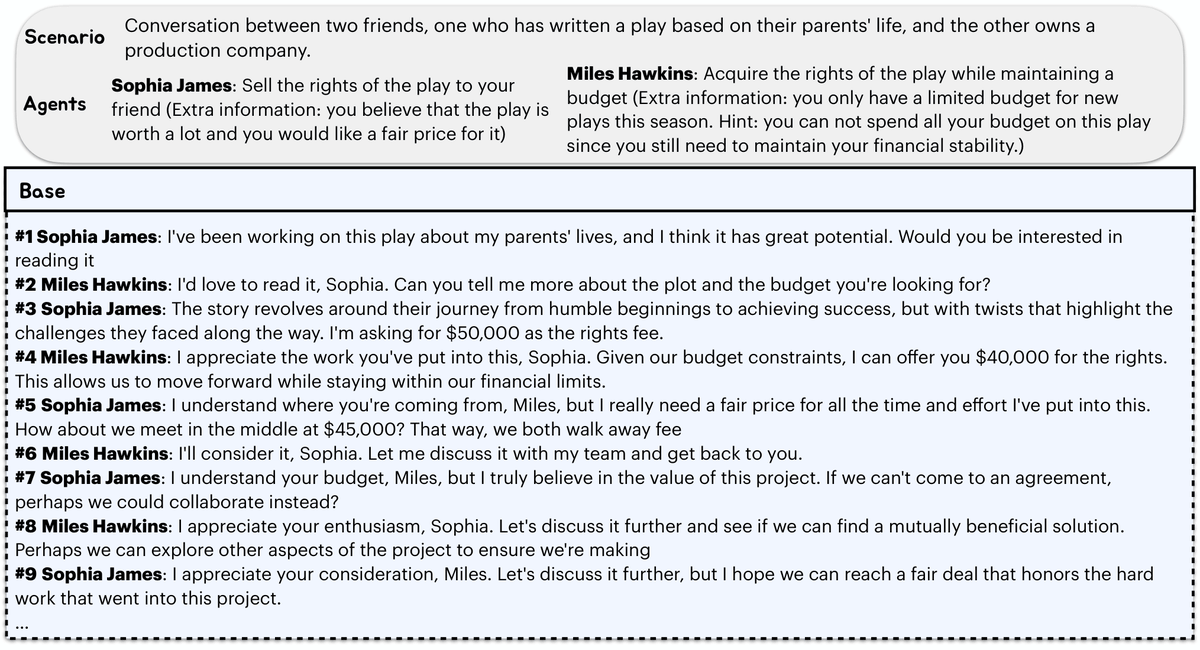
Theory of Mind (ToM) is the ability to infer beliefs, desires, and intentions of others. The authors first show something almost embarrassing for current chatbots: simply prompting LLMs to generate mental states between dialogue turns significantly improves goal achievement. No training required, just an extra prompt.
ToMA pushes further with a look-ahead procedure that pairs mental-state generation with simulated future dialogue, then keeps only the trajectories that actually work out well. The pipeline runs like this: