
UBC's Echo-CoPilot Beats o4-mini by 15.7% Reading Heart Ultrasounds
A new research paper proposes a three-agent system that grounds echocardiography interpretation in clinical guideline graphs, cutting hallucinations near decision cutoffs.
 Pro
Takeaways
- Researchers from UBC and Rutgers propose Echo-CoPilot, an agentic framework for echocardiography interpretation.
- Three parallel ReAct agents (structural, pathological, quantitative) invoke shared echo tools like EchoPrime and MedSAM2.
- EchoKG knowledge graph encodes ASE/EACVI guidelines as requires/avoid edges plus clinical thresholds.
- A self-contrast LLM builds a discrepancy checklist and re-queries the graph instead of majority voting.
- Reaches 50.8% on MIMICEchoQA, beating Qwen2-VL-7B-biomed (49.0%) and o4-mini (43.9%).
- Code is public on GitHub; evaluation still limited to one benchmark cohort.
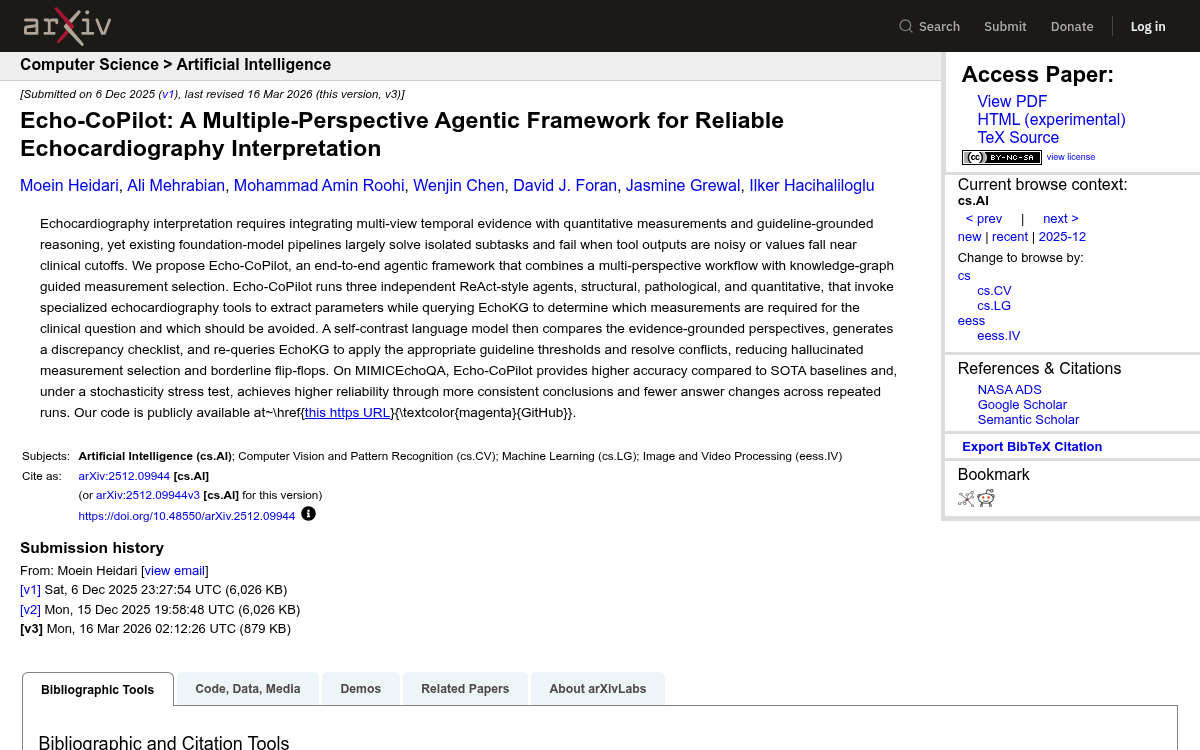
Reading a heart ultrasound is not a single-shot classification problem. A cardiologist watches multiple video views, extracts numeric measurements, then compares them against guideline thresholds that shift depending on what the referring physician actually asked. A group of researchers from the University of British Columbia and Rutgers Cancer Institute has now published a paper arguing that a single vision language model cannot do this reliably, and proposes an agentic framework called Echo-CoPilot that splits the job across three specialist reasoners plus a clinical knowledge graph.
Where current echo models break down
Echocardiography interpretation requires fusing multi-view video, quantitative measurements, and guideline-grounded reasoning, yet foundation-model pipelines act as black boxes and become unreliable near clinical cutoffs. The authors point out that most existing systems handle isolated subtasks (view classification, segmentation, ejection fraction estimation) but stumble when tool outputs are noisy or a measurement lands within a few percent of a guideline threshold, which is where borderline diagnoses flip.
The evaluation target is MIMICEchoQA, a benchmark introduced by a separate Stanford-led team. MIMICEchoQA is a benchmark dataset for evaluating echocardiogram-based visual question answering (VQA). It consists of 622 curated examples, each containing a transthoracic echocardiogram video and corresponding closed-ended Q/A pairs derived from clinical reports. The benchmark covers key tasks including disease classification, measurement retrieval, and threshold-based decision making using MIMIC-IV-ECHO data.
Three agents, one shared toolbox

Instead of asking one model to do everything, Echo-CoPilot spins up three parallel ReAct-style agents that look at the same study through different lenses. ReAct is a prompting pattern where the model alternates between reasoning steps and calling external tools. Echo-CoPilot instantiates three parallel ReAct agents, Structural, Pathological, and Quantitative, that independently reason over the exam using a shared tool cache that reuses tool output to improve efficiency.
Each agent calls specialized echo tools rather than trying to see pixels directly. EchoKG knowledge graph encodes ASE/EACVI guidelines as requires/avoid edges and clinical thresholds, so the agent selects the right measurements for each question. ASE and EACVI are the American and European cardiovascular imaging societies, so the graph essentially encodes the rulebook cardiologists already follow.
The underlying vision models are borrowed from prior work. The GitHub repo credits the authors of EchoPrime, PanEcho, and MedSAM2 for the segmentation and feature extraction tools that the agents invoke.
The self-contrast step
After each agent produces its own trajectory, a second stage reconciles them. A contrast LLM builds a discrepancy checklist and resolves borderline conflicts instead of naive majority voting. The self-contrast language model then compares the evidence-grounded perspectives, generates a discrepancy checklist, and re-queries EchoKG to apply the appropriate guideline thresholds and resolve conflicts, reducing hallucinated measurement selection and borderline flip-flops.
In practical terms, the pipeline looks like this:
- Query EchoKG to figure out which measurements the clinical question actually requires, and which should be avoided.
- Run the structural, pathological, and quantitative agents in parallel with a shared tool cache.
- Feed all three trajectories into a contrast LLM that flags disagreements.
- Re-query EchoKG for the relevant guideline thresholds and produce a final, auditable answer.
What the numbers show
On the 622-example MIMICEchoQA benchmark, the framework posts modest but consistent gains over strong baselines. Echo-CoPilot establishes a new state-of-the-art, achieving 50.8% accuracy. Absolute improvement over the best biomedical baseline (Qwen2-VL-7B-biomed, 49.0%) is +1.8 points (relative +3.7%), and over the strongest general VLM (o4-mini, 43.9%) is +6.9 points (relative +15.7%).
| Model | Accuracy on MIMICEchoQA |
|---|---|
| Echo-CoPilot | 50.8% |
| Qwen2-VL-7B-biomed | 49.0% |
| o4-mini | 43.9% |
The absolute number is worth putting in context: MIMICEchoQA is hard, and even the best model is still wrong about half the time. The more interesting result is the stochasticity stress test. Under a stochasticity stress test, Echo-CoPilot achieves higher reliability through more consistent conclusions and fewer answer changes across repeated runs. That matters for medical use, where a model that flips between mild and severe on repeated runs is worse than a slightly less accurate one that stays consistent.
How the reasoning changes behavior
The paper includes qualitative traces showing how the agents handle missing data. The agent begins by clarifying which information is missing, then selectively invokes required tools. When direct measurements (e.g., wall thickness) are unavailable, the agent pivots to surrogate signals, such as binary dilation flags, and explicitly states that its conclusion is based on these model outputs rather than on a non-existent numeric value. The resulting answers are short, but the reasoning chain shows that the agent consistently cross-checks tool outputs before committing to a decision.
For tasks such as mitral regurgitation severity, the agent utilizes sequential disease prediction, quantitative measurement (e.g., regurgitant jet area, vena contracta), and cross-references established clinical thresholds (e.g., VC ≥ 0.7 cm for severe). That is the exact chain a cardiology fellow would be taught to follow, which is the point.
Availability and caveats
The full implementation is open source at the Echo-CoPilot GitHub repository, including the EchoKG structure and integration with the third-party echo tools. The authors are candid about the limits of the evaluation. While the scarcity of public video-based benchmarks currently limits evaluation to a single large-scale cohort, this work establishes a rigorous paradigm for auditable medical agents. Future efforts will focus on curating diverse, multi-center benchmarks to test generalization and advancing toward prospective clinical validation.
For anyone building clinical AI, the takeaway is less about the 1.8-point accuracy bump and more about the architectural pattern: split reasoning across specialist agents, ground tool selection in an explicit guideline graph, and reconcile with a contrast step rather than a vote. It is a template that translates cleanly to other imaging modalities where guidelines already exist on paper but are hard for a single VLM to internalize.