
UBC's DSeq-JEPA Beats Meta's I-JEPA by Predicting Images in Importance Order
A new self-supervised vision method predicts image regions in order of importance instead of all at once, beating I-JEPA across seven benchmarks.
 Pro
Takeaways
- DSeq-JEPA replaces I-JEPA's parallel masked prediction with a saliency-ranked sequential objective, published on arXiv.
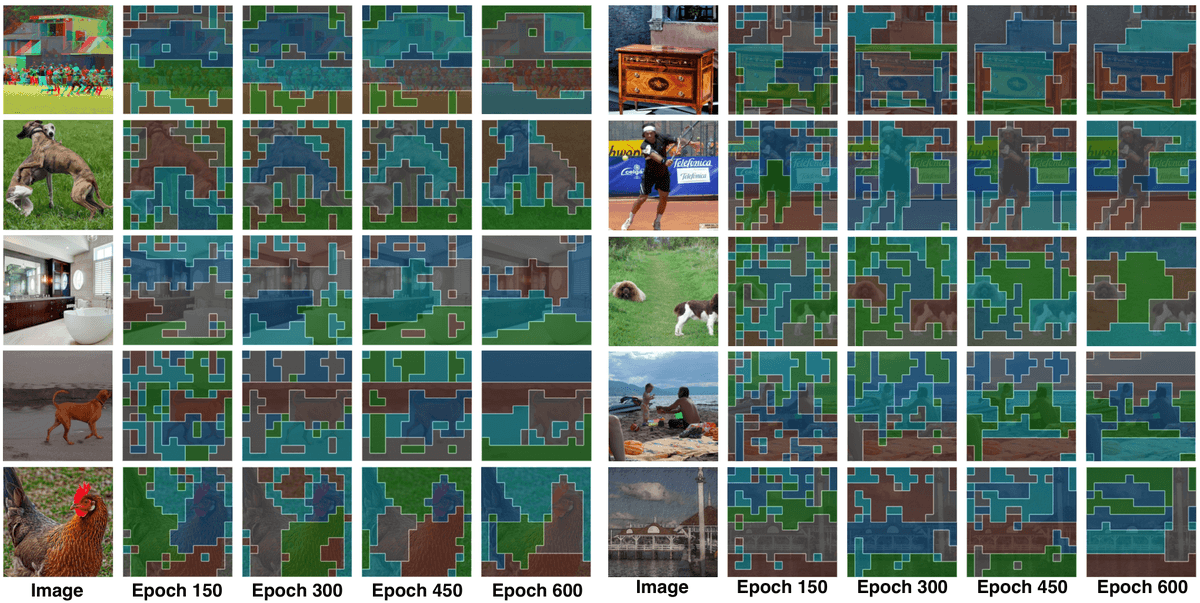
- The target encoder's own attention produces a saliency map that orders regions from most to least discriminative.
- Predictions are made autoregressively in latent space, each step conditioned on prior predicted regions, forming a curriculum.
- ImageNet ViT-B/16 linear probing improves from 72.4% (I-JEPA) to 73.5%, with larger gains on CUB and Stanford Cars.
- Consistent transfer gains reported on MS-COCO, ADE20K, iNaturalist21, and CLEVR spatial reasoning tasks.
- Official code available at github.com/SkyShunsuke/DSeq-JEPA.
Self-supervised vision models have spent the last few years arguing about where to predict, what to predict, and in what space to predict it. A new paper from researchers at UBC, University of Fukui, and IHU Strasbourg proposes a different question: in what order should a model predict? Their answer, DSeq-JEPA, is a self-supervised vision architecture that predicts masked image regions sequentially from most to least visually important, and it consistently beats I-JEPA on classification, detection, segmentation, and reasoning benchmarks.
The parallel-prediction blind spot
Meta's Image-based Joint-Embedding Predictive Architecture (I-JEPA) is one of the more influential recent takes on self-supervised vision. I-JEPA learns representations by predicting latent embeddings of masked target regions from visible context, which sidesteps the pixel-level reconstruction that pushes masked autoencoders toward low-level texture features.
The catch is uniform treatment of every masked region. I-JEPA treats all regions uniformly and independently, lacking an explicit notion of where or in what order predictions should be made. A patch containing the beak of a bird gets the same weight as a patch of background sky, and the model tries to fill them all in one shot. Human vision does not work that way. We fixate on the informative regions first and use those cues to interpret the rest.

Rank first, then predict in order
DSeq-JEPA bridges predictive and autoregressive self-supervised learning, integrating JEPA-style latent prediction with GPT-style sequential reasoning. Concretely, the training loop does two things I-JEPA does not:
- It imposes a curriculum by sequentially predicting regions in discriminative order derived from a saliency ranking.
- It introduces region ordering via transformer-derived saliency maps, sampling and predicting regions in curriculum-like semantic progression, so earlier predictions condition later ones.
The saliency map itself is not a separate model. It comes from the target encoder's own attention, which acts as a cheap proxy for visual importance. After ranking the candidate masked regions, the predictor produces embeddings in that order, with each step conditioned on the visible context plus the already-predicted regions. The formulation looks a lot like an autoregressive decoder, but operating in latent embedding space rather than over pixels or tokens.

What the numbers say
The team evaluated on the standard SSL gauntlet. On ImageNet linear probing with ViT-B/16, I-JEPA scores 72.4% while DSeq-JEPA reaches 73.5%, a gain of 1.1 points. Fine-grained categorization, where subtle discriminative parts actually matter, shows larger relative improvements: CUB moves from 65.3% to 66.2%, and Stanford Cars from 65.9% to 67.3%.
Beyond classification, DSeq-JEPA consistently improves transfer performance on image classification (ImageNet), fine-grained visual categorization (iNaturalist21, CUB-200-2011, Stanford Cars), dense prediction tasks on MS-COCO and ADE20K, and low-level reasoning on CLEVR/Count and CLEVR/Dist. That last set is interesting because CLEVR tests spatial and counting ability rather than semantic recognition, suggesting the ordered curriculum helps geometry as well as categories.
One diagnostic from the paper is worth flagging: prediction loss grows monotonically as the model works down the ranked list. Predicting the top-1 or top-2 salient regions is relatively easy, while top-4 and top-5 regions carry higher loss values, evidence that the model really is exploiting a difficulty gradient during training.

Where this is useful, and where it is not
The clearest wins are in tasks that depend on part-level discrimination, so fine-grained recognition, dense prediction, and any downstream task where localized cues carry the label. The consistent ImageNet gain also suggests the pre-trained backbone is a straightforward drop-in replacement for I-JEPA weights, which matters if you already have an I-JEPA pipeline.
A few honest limitations:
- Sequential prediction adds compute compared to I-JEPA's single parallel step, since each region conditions on prior ones.
- The method is evaluated on ImageNet-scale ViT-B/16 backbones. Web-scale pre-training on billion-image corpora is not shown.
- The saliency proxy inherits whatever biases the target encoder's attention has early in training, which could reinforce shortcuts on certain data distributions.
Code and availability
The official implementation is on GitHub under the SkyShunsuke account, alongside a related Fine-tuning-JEPA repo that already provides a simple I-JEPA pre-training and fine-tuning harness on the officially provided IN-1k pre-trained I-JEPA model (in1k_vith14_ep300). Anyone running I-JEPA today should be able to swap in the discriminative sequential objective without rearchitecting the encoder or predictor networks.
The broader takeaway is that the JEPA family is starting to absorb ideas from autoregressive language modeling, but in latent space and driven by visual importance rather than raster order. If that hybrid holds up at larger scale, ordered latent prediction may end up looking like the natural bridge between GPT-style pre-training and world-model-style representation learning.