
TUM's TANGO Shrinks Robot Arm Planning Memory 6x With Tensor Compression
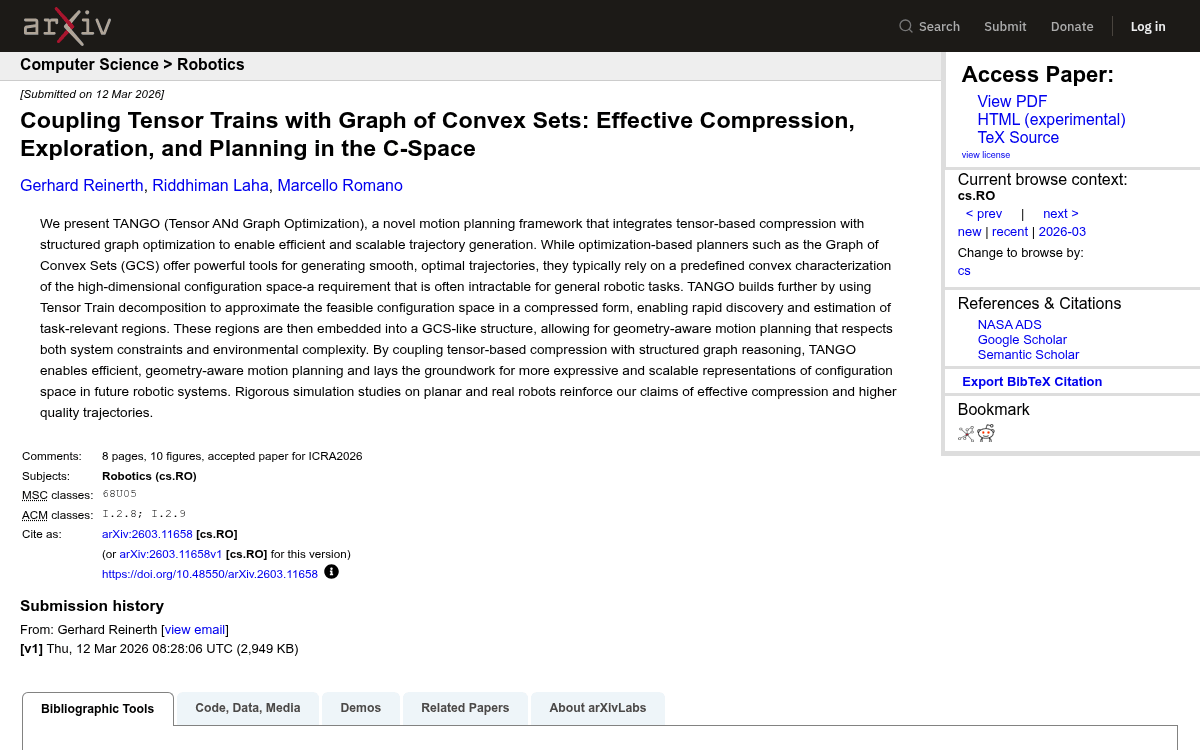
TANGO couples Tensor Train compression with Graph of Convex Sets, cutting memory 6x and generating smoother robot trajectories than RRT with far fewer waypoints.
 Pro
Takeaways
- TANGO combines Tensor Train compression with Graph of Convex Sets for scalable robot motion planning (paper).
- TT-Cross approximates feasible configuration space as a probability density, avoiding uniform sampling.
- IRIS grows safe convex regions around good samples; overlapping regions become graph edges.
- Reshaping tensors cut memory from 43,600 to 7,110 parameters and runtime from 27.79s to 5.53s.
- Beats RRT on Franka Panda with fewer waypoints (3-4) and better manipulability scores.
- Uses Riemannian manipulability metric instead of Yoshikawa for better singularity sensitivity.
Motion planning for robot arms sounds simple until you try to do it well. Any planner has to search a configuration space (or C-space), the set of all joint angle combinations the robot could take. For a 7-joint arm, that space is 7-dimensional, riddled with self-collisions, singularities where the arm loses dexterity, and obstacles that map into weirdly shaped forbidden regions. Sampling this space uniformly wastes most of your compute on configurations you would never want to use.
A team from the Technical University of Munich has proposed TANGO (Tensor ANd Graph Optimization), a planner that compresses the feasible C-space with a tensor decomposition and then plans through it using a convex optimization framework. The result is a planner that produces smoother trajectories with fewer waypoints than the standard baseline, while shrinking the memory needed to represent the space by roughly 6x.
Why convex planning stalls in high dimensions
The paper builds on a technique called Graph of Convex Sets (GCS), which formulates shortest-path planning as a convex optimization over a graph whose nodes are convex regions of free space and whose edges connect overlapping regions. GCS is powerful because convex programs have global optima and specialized solvers. The catch is that you first need a convex characterization of the high-dimensional configuration space, which is often intractable for general robotic tasks.
Existing convex decomposition approaches have known failure modes. Iterative methods, optimization-driven cuts, and face clustering all return only approximately convex partitions of the original geometry. Using the convex hulls of these components in motion planning can inflate feasible regions and accidentally intersect obstacles, breaking safety guarantees. TANGO sidesteps this by never trying to decompose the whole space. Instead it learns where the good configurations live and grows convex regions only there.
Compressing the C-space with tensor trains
The core trick is Tensor Train (TT) decomposition, a way of representing a very high-dimensional array as a chain of small 3D tensor cores. Under equal ranks and dimensions, the parameter count scales linearly with dimensionality and quadratically with rank, which is what makes an otherwise exponentially large object storable.

To build the tensor, TANGO discretizes each joint into bins and evaluates a task-specific cost at each configuration. That cost is turned into a probability density using p(q) = exp(-γ C(q)), so preferable configurations get high likelihood and singular ones get low likelihood. TT-Cross, a greedy sampling algorithm, then approximates that PDF without ever materializing the full tensor. Taking the elementwise complement gives an inverse PDF that concentrates on infeasible or low-quality configurations, giving the planner both good samples and obstacle candidates for free.
From samples to a convex graph
Given samples from both distributions, TANGO runs the following pipeline:
- Cluster the obstacle-like samples into convex obstacle regions using RNN-DBSCAN.
- Run IRIS (Iterative Regional Inflation by Semi-definite programming) around the good samples. IRIS starts from a seed in free space and iteratively inflates a convex polytope by alternating between pushing separating hyperplanes outward and expanding an inscribed ellipsoid, converging to a locally maximal collision-free region.
- Prune redundant safe sets that are already contained inside larger ones.
- Build the GCS by adding an edge whenever two safe convex sets intersect.
- Solve the shortest-path problem over the GCS to get a smooth trajectory from start to goal.
The team also explored which cost function to feed into the PDF. The classic Yoshikawa manipulability index measures the volume of the velocity ellipsoid from the Jacobian, but it can remain unchanged even when the ellipsoid deforms significantly, missing critical manipulability changes. They instead adopt a Riemannian metric that measures the squared distance between the manipulability ellipsoid and a reference hypersphere, which is sensitive to shape and orientation, not just volume.
Numbers on real robots
The experiments cover a 3-DoF planar arm and a 7-DoF Franka Emika Panda with three joints locked to give a 4-DoF planning problem. For the Panda, each joint was discretized into 128 bins, then reshaped from a 128^4 tensor into a 14-dimensional tensor of size 4 per axis for compression via TT-Cross.

That reshape is where the real speedup comes from. Mean parameter count dropped from about 4.36 x 10^4 to 7.11 x 10^3, and mean execution time dropped from 27.79 seconds to 5.53 seconds over 15 trials. Against a standard RRT baseline on 100 randomized start-goal pairs, TANGO produced structured plans typically needing only 3-4 waypoints before refinement, with a higher minimum PDF-score along each trajectory, meaning it kept the robot in more dexterous poses throughout the motion.
Where it helps and where it does not
TANGO is a good fit when you need repeatable, smooth trajectories for a fixed arm under task-quality constraints like manipulability, and when you can afford a one-time preprocessing pass. The convex sets and their graph are computed once per environment and then reused across queries.
The limitations are honest. The authors deliberately worked in a 4-DoF setting rather than the full 7-DoF Panda because the safe convex polytopes get geometrically more complex in higher dimensions. Task-space obstacles are not handled directly in this paper, though the authors sketch how a second tensor train built from signed distance functions could be combined with the current one. There is no public code release accompanying the paper yet, so anyone wanting to reproduce the pipeline will need to stitch together TT-Cross, IRIS, and a GCS solver themselves.
The broader idea worth borrowing is the framing: treat feasibility itself as a probability density, compress it with a tensor train so sampling is cheap, and only then hand the interesting regions to a convex optimizer. It is a clean way to make convex planning tools usable on spaces where a full convex decomposition would never terminate.