
TUM's RUSSAgent Teaches a Robot to Scan Any Organ autonomously
A reinforcement-learning fine-tuned language model plans ultrasound scans by reading handbooks and calling tools, replacing hard-coded robotic pipelines.
 Pro
Takeaways
- LLM agent reads ultrasound scanning handbooks and calls robot tools, replacing organ-specific hand-crafted pipelines.
- Qwen3-4B fine-tuned with SFT plus PPO using a dense per-tool-call reward for arguments.
- Held-out guideline success rose from 53.8% to 92.3% after RL fine-tuning.
- Real-world scans of gallbladder, spine, and kidney on volunteers with a KUKA LBR iiwa robot.
- Five tools cover trajectory planning, execution, contact adjustment, voice guidance, and refinement.
- Code released as RUSSAgent; paper on arXiv.
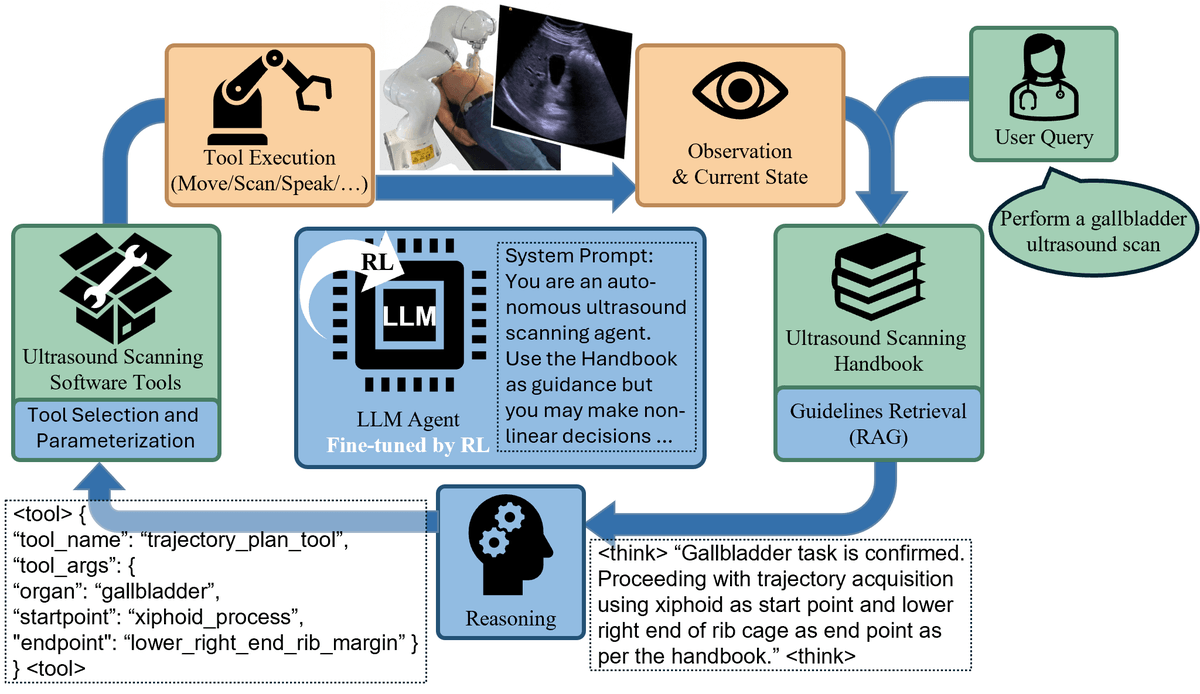
Autonomous robotic ultrasound has mostly lived in a world of hand-crafted pipelines: one bespoke protocol for the spine, another for the carotid, another for the aorta. A new framework from the Technical University of Munich and collaborators wants to collapse those into a single system where a language model reads the same scanning handbooks a human sonographer would, then calls perception and control tools to run the exam. The paper, titled From Scanning Guidelines to Action, ships with open-source code as RUSSAgent.
Why fixed pipelines keep breaking
Ultrasound is cheap, portable, and radiation-free, but it lives or dies by the operator. Free-hand scanning varies with expertise and causes repetitive-strain injuries. Robots promise reproducibility, but the expertise is often hard-coded through fixed procedures and task-specific models, yielding pipelines that resist adaptation to new scanning targets. Swap the target organ and you often have to rebuild half the stack: new segmentation model, new trajectory rules, new force controller.
Prior LLM-based attempts, like USPilot, plugged a language model in as a planner but treated its reasoning as a black box. The authors here argue that the intermediate reasoning is precisely what needs to be trained and inspected if the system is going to be trusted in a clinic.
Inside the agent loop
The setup treats the LLM as a high-level planner sitting on top of a fixed toolbox and a database of scanning guidelines. At each step, retrieval-augmented generation pulls the relevant handbook instructions, and the agent reasons over the current observations and emits a think reasoning trace followed by a tool token with a structured JSON tool call. Tool outputs get appended to history, letting the agent loop, repeat, or branch based on what it sees rather than marching down a fixed script.
Five tools cover the full scanning workflow:
- Trajectory Planning: fuses multi-view RGBD captures into a body-surface reconstruction, registers a skeletal atlas, and turns landmark-referenced start and end points into a 3D probe path.
- Robot Execution: moves a KUKA LBR iiwa arm along a trajectory or to a target pose at a chosen speed.
- Contact Adjustment: uses ultrasound confidence maps (a random-walk-based measure of how much of the image is trustworthy signal versus shadow) to nudge the probe into better contact.
- Voice Guidance: issues verbal instructions to the patient, such as the breath-hold cues needed to slide the gallbladder out from under the rib cage.
- Trajectory Refinement: after the initial pass, runs an organ-specific segmentation model and replans if the target is not well centered.

Training the reasoning, not just the answers
Big models are too slow for the loop, so the authors distill down to a small one. Qwen3-4B-Instruct is fine-tuned on training guidelines while a larger Qwen3-30B-A3B-Instruct generates reference agent traces made of think blocks and tool JSON commands. Supervised fine-tuning teaches the format, then Proximal Policy Optimization sharpens the behavior. LoRA is used with rank 16 for SFT and rank 8 for RL.
The reward design does most of the heavy lifting. Rather than only checking whether the final scan succeeded, it grades each tool call densely. A wrong tool name gets a flat penalty. A correct tool name earns a base reward plus an argument score that mixes three things: whether the required argument keys are present, whether their values match (exact for discrete fields, tolerance-based for numerics), and a small penalty for spurious extra keys. That last term keeps the model from spraying junk parameters into a JSON call the robot has to execute.
What the numbers show
The team wrote 20 scanning guidelines, split 10 for training and 10 held out. On the held-out set:
| Metric | Base Qwen3-4B | After RL fine-tuning |
|---|---|---|
| Step-wise tool accuracy | 0.6512 | 0.8973 |
| Overall scan success rate | 0.5384 | 0.9230 |
Qualitatively, the base model tends to emit thin, uninformative reasoning traces and drop required arguments. The fine-tuned version produces more coherent rationales and correctly parameterizes tools, including the breath-hold instruction needed before a gallbladder sweep.

Real robot, real volunteers
The system was then run end-to-end on three human volunteers using a KUKA LBR iiwa with a Siemens ACUSON Juniper ultrasound and a 5C1 probe, plus an Azure Kinect on the end effector for surface capture. Experiments across gallbladder, spine, and kidney scanning show the agent following diverse guidelines and completing autonomous scans within a unified pipeline. Every spine and kidney run succeeded; one gallbladder case failed, which the authors attribute to the tight timing between breath-hold instructions and probe motion.
Where this actually fits
The framework suits teams building a robotic imaging stack that want a single planner to generalize across organs without rewriting protocol logic each time. The tools themselves are still classical, so the robot's low-level safety envelope is unchanged; only the orchestration is learned. A few honest limitations to flag:
- The evaluation covers 20 guidelines and three anatomies with a small volunteer cohort, not a clinical trial.
- Failure modes cluster around time-critical patient interaction, exactly where language-model latency and instruction phrasing matter most.
- The perception tools depend on off-the-shelf body and skeleton models plus organ-specific segmenters, so accuracy on atypical body habitus is inherited from those components.
Beyond ultrasound, the recipe is portable: a small LLM, a curated tool set, guideline retrieval, and a dense per-call reward that separately scores tool choice, argument presence, argument correctness, and unwanted extras. That reward decomposition is arguably the most reusable idea in the paper for anyone training agentic tool-callers in domains where a wrong JSON key is a safety event rather than a typo. Code and a demo video are available for teams that want to reproduce it.