
TU Munich's Training-Free Framework Boosts Video AI Accuracy by 37 Points
A new training-free method uses a model's own uncertainty to guide attention, letting off-the-shelf MLLMs match specialized fine-tuned systems on hard visual tasks.
 Pro
Takeaways
- New training-free framework uses MLLM's own output entropy to localize relevant crops, frames, and time windows
- Boosts InternVL2.5-8B on V* Bench from 71.7 to 91.1 without any fine-tuning
- On Charades-STA temporal grounding, LLaVA-OV's mIoU jumps from 10.4 to 46.8
- Beats fine-tuned specialists like VTimeLLM and TimeChat using off-the-shelf models
- Main cost is extra forward passes; efficiency tricks recover most throughput
- Code released at github.com/ExplainableML/ug-framework, paper on arXiv
Multimodal LLMs are strong at describing pictures but weak at finding needles in haystacks. Ask one to spot a small object in a 4K photo or pinpoint the exact seconds where a goal is scored in a 40-minute video, and performance often collapses. A team from TU Munich and collaborators has released a training-free framework that fixes much of this weakness by exploiting a signal the model already produces: its own uncertainty.
The core observation is refreshingly simple. When an MLLM is shown the correct visual evidence for a query, its predictive confidence increases and uncertainty naturally decreases. Turn that around and you get a localization tool: score candidate crops, frames, or windows by how confident the model becomes, then answer using whichever one drove uncertainty lowest.
The blind spots this fixes
The paper targets three tasks where standard MLLMs struggle badly. Small-object recognition fails because low-resolution visual encoders lose critical details, long-video understanding suffers because restricted context lengths force suboptimal sampling, and most MLLMs lack strong temporal grounding since they are not trained with explicit temporal signals. Existing fixes usually involve curating task-specific datasets, fine-tuning, or bolting on external detectors, which is expensive and doesn't generalize.
The authors validated the uncertainty idea with a clean experiment on V* Bench. They chopped high-resolution images into crops, fed each one to LLaVA-OneVision-7B, and measured the entropy of its output. Crops containing the target object exhibited substantially lower entropy than crops showing only background, with regions overlapping the target producing the lowest entropy.

Score, then answer
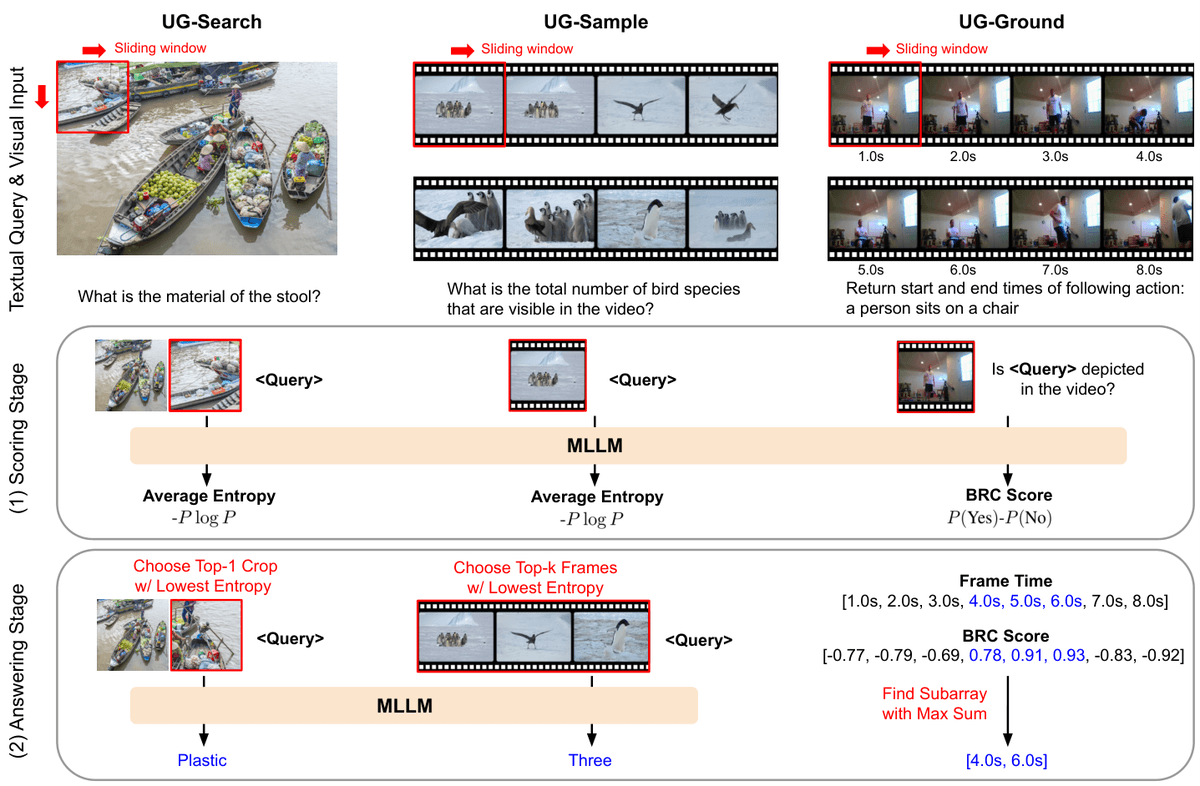
The Uncertainty-Guided (UG) framework uses a two-stage "score-then-answer" pipeline with two scoring metrics:
- Average Entropy - Shannon entropy averaged across generated tokens. Used for open-ended queries.
- Binary Response Confidence (BRC) - the difference between the probabilities of the "yes" and "no" tokens in the first generated distribution. Used when the question is a yes/no check.
These plug into three task-specific variants:
- UG-Search for high-resolution images. A sliding window generates candidate crops, each is scored by average entropy, and the lowest-entropy crop is used to answer. The original image's key-value states are cached and reused across scoring passes to cut redundant compute.
- UG-Sample for long video QA. Every frame in a pool of 256 uniformly sampled candidates is scored, and the top-8 lowest-entropy frames are concatenated in temporal order for final inference.
- UG-Ground for temporal grounding. A sliding window sweeps the video, each window gets a BRC score for "is this event happening here?", and temporal grounding is reduced to finding the subarray with the maximum sum which can be solved efficiently in linear time using Kadane's Algorithm.
Numbers that punch above their weight
The gains are large enough to close the gap with fine-tuned specialist systems. On V* Bench, InternVL2.5-8B jumps from 71.7 to 91.1 (+19.4). On HR-Bench 8K, it rises from 58.0 to 73.6. Qwen2.5-VL-7B picks up 6.1 points on Video-MME and 7.8 on LongVideoBench with UG-Sample.
Temporal grounding shows the most dramatic swing. LLaVA-OV's mIoU on Charades-STA rises from 10.4 to 46.8, and InternVL2.5-8B leaps from 9.5 to 47.4. These training-free numbers beat instruction-tuned specialists like VTimeLLM, TimeChat, and TimeMarker that were explicitly trained on temporal reasoning data.
The method also scales cleanly with model size. Both the original baseline models and their UG-enhanced variants improve steadily as model size increases, and the benefits of UG remain stable and consistent across the entire scaling curve, tested from 1B to 38B on the InternVL-2.5 family.

The catch: extra forward passes
Nothing is free. Each candidate crop or window requires a scoring pass, so wall-clock latency climbs. The paper offers three ways to soften this:
- Decouple the scorer from the answerer. A 4B scorer reaches 89.0% on V* Bench within 2.1 points of self-scoring with the 8B model while maintaining a 1.3x throughput advantage.
- Pre-filter with a cheap vision model. SigLIP as a pre-filter for UG-Sample recovers most of the accuracy gain with 1.6x higher throughput. Generic detectors like YOLOv8 work poorly because they are query-agnostic.
- Widen the temporal stride. On Video-MME, going from stride 1 to stride 9 boosts throughput 5x while still beating the baseline.
The framework is also embarrassingly parallel: crops and frames are independent, so a properly batched implementation should collapse most of the sequential overhead. The current release runs scoring sequentially because several open-source MLLMs behave unreliably with batch sizes above one.
When it helps and when it doesn't
UG shines when the answer depends on a small, sparse region of a large visual input: reading a sign in a crowded street photo, finding the goal moment in a soccer match, timing a specific action in a workout video. It offers less on tasks where uniform sampling already captures the answer, which is why short-video benchmarks like NextQA see only modest gains.
There's one interesting failure mode. On MLVU's Action Count category, UG-Sample underperforms because UG-Sample globally prioritizes the most salient frames and may under-sample less-prominent target actions distributed across the video. The fix is a hybrid, UG-Sample+AKS, that combines entropy scoring with segment-wise sampling to guarantee temporal coverage.
Code is available on the official GitHub repository, and the framework works out of the box with LLaVA-OneVision, Qwen2.5-VL, InternVL-2.5, LLaVA-Video, and InternVideo-2.5. No fine-tuning, no architectural changes, no task-specific data curation. Just a smarter way to interrogate the model you already have.