
TU Munich's ReMem-VLA Gives Robots Memory, Jumping from 8% to 94% Success
A new robot control model gives vision-language-action policies both short-term and long-term memory using dual-level recurrent queries.
 Pro
Takeaways
- ReMem-VLA adds dual-level recurrent memory queries to a frozen Qwen3-VL-2B backbone for robot control.
- Frame-level queries handle short-term memory, chunk-level queries retain context across the whole episode.
- Hits 94.5% average on MemoryBench vs 8.25% for π0.5 and 1.5% for MemoryVLA.
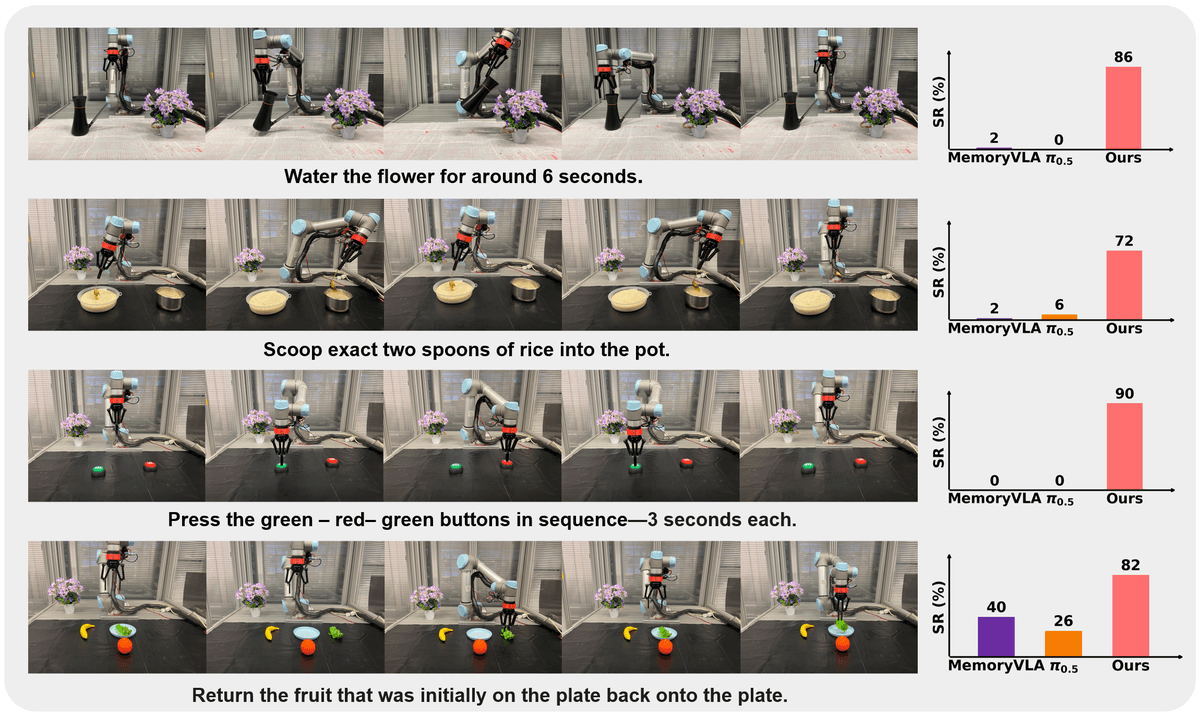
- Real-world UR5 tasks reach 82.5% success versus 11% and 8% for baselines.
- Past Observation Prediction auxiliary loss boosts visual memory task from 34% to 82%.
- Recurrence path is gradient-free EMA; only what to store is learned, not how to propagate it.
Most vision-language-action (VLA) models controlling robots today have a peculiar amnesia problem: they decide what to do next based only on what they see right now, ignoring everything that came before. A team from TU Munich, Huawei, University of Freiburg, and Nanjing University has released ReMem-VLA, a recurrent memory architecture that gives robots the ability to remember spatial layouts, action counts, elapsed time, and past visual scenes across an entire task episode. On memory-heavy benchmarks, it jumps from single-digit success rates to over 90%.
The Markov trap
Vision-language-action models for closed-loop robot control are typically cast under the Markov assumption, making them prone to errors on tasks requiring historical context. That is a fancy way of saying the robot only looks at the current camera frame plus the language instruction, then predicts an action. If you ask it to place a cup back where it started, it has no idea where that was.
Prior work tried two workarounds, and both broke down. Retrieval-based methods pull from a memory bank but can be misled by distractors, while horizon-extension methods extend the frame window but their fixed horizon still limits long-term retention. Even earlier RNN-based attempts like RoboFlamingo did not evaluate on memory-heavy tasks, and the authors show that naive recurrence collapses because truncated backpropagation through time only assigns credit across a handful of steps, so gradients never teach the model what to keep over hundreds of frames.

Two clocks, two memories
ReMem-VLA's central idea is to run memory at two different speeds. It uses frame-level recurrent memory for short-term retention such as maintaining a fixed pose over several seconds, and chunk-level recurrent memory for long-term memory such as tracking overall task progress. Both are just sets of learnable query tokens attached to a frozen Qwen3-VL-2B backbone.
Each query set is updated by exponential moving average (EMA) between timesteps. Frame-level queries refresh every step, giving fine-grained recency. Chunk-level queries only update at chunk boundaries (every k frames, where k matches the 30-step action chunk), so their exponential decay is much slower and old context sticks around longer. Crucially, the recurrence path itself has no trainable parameters. The authors argue this is what makes the whole thing work, because gradients can't be expected to flow through hundreds of frames anyway, so the model only learns what to write into memory, not how memory propagates.

Four kinds of learnable tokens flow through a 12-layer bidirectional transformer connector between the VLM and the prediction heads: action queries feeding a diffusion action head, hindsight queries feeding an image reconstruction head, and the two levels of memory queries. The image head implements Past Observation Prediction, an auxiliary loss that asks the model to reconstruct a past RGB frame. It is a targeted fix for visual memory that pure recurrence handles poorly.
Training a recurrent policy without cheating
Batching recurrent policies is annoying because episodes have different lengths and you can't leak state between them. ReMem-VLA uses slot-based streaming training: a fixed pool of concurrent slots each tracks one live episode, contributing one frame per training step. Recurrent state accumulates naturally within a slot and is hard-reset at episode boundaries. BPTT truncation is set to just 1, because the gradient-free EMA path handles long-range propagation for you.
The numbers
The team evaluates on an extended version of MemoryBench plus real-world UR5 arm tasks. The simulation results are lopsided.
| Method | Put Block Back | Rearrange | Reopen Drawer | Long Horizon | Avg |
|---|---|---|---|---|---|
| OpenVLA-OFT | 0 | 0 | 3 | 0 | 0.75 |
| π0.5 | 6 | 4 | 20 | 3 | 8.25 |
| MemoryVLA | 0 | 1 | 5 | 0 | 1.5 |
| ReMem-VLA | 93 | 99 | 100 | 86 | 94.5 |
In real-world experiments across four purpose-built tasks (watering a flower for six seconds, scooping exactly two spoons of rice, pressing three buttons in sequence, returning a fruit to its original plate), ReMem-VLA hit an average 82.5% success rate against 11% for π0.5 and 8% for MemoryVLA. The Return Fruit task, which specifically probes visual memory, jumped from 34% to 82% once Past Observation Prediction was added, especially when predicting the very first frame of the episode.

Where it helps and where it falls short
Ablations show both memory levels matter. Frame-level alone hits 87.75% average but stumbles on the 600-frame Long Horizon task. Chunk-level alone drops to 84.5% because it can't handle short-term dependencies like holding a button. Combined, they reach 94.5%. Making the recurrence trainable (unfreezing the VLM, or swapping EMA for a GRU or MLP) almost completely destroys memory capability. The sweet spot for the EMA coefficient is β = 0.5 with 128 total query tokens.
This is genuinely useful for anyone building manipulation policies that need to reason about task progress, count actions, or return objects to remembered positions. Long-horizon assembly, sequential cooking-style tasks, and any policy where the current frame is ambiguous are natural fits. The main caveats: on a single RTX 4090 the model runs at 10 Hz (bumpable to ~20 Hz with action reuse), and the authors explicitly note it has not been pretrained on large-scale robot datasets like Open-X-Embodiment or DROID, which may cap its generalization. It also only handles within-episode memory, not lifelong memory across sessions.
The paper does not link to a public code release or model checkpoint. For teams already using π0.5 or OpenVLA-OFT, the more portable takeaway may be the recipe itself: dual-scale EMA queries on a frozen backbone, slot-based streaming training with truncation of 1, and a past-image reconstruction auxiliary loss. That combination could plausibly be bolted onto existing VLA stacks without disturbing their pretrained weights.