
TU Munich's ConceptPose Beats Trained Pose Models by 62% Without Any Training
A new approach ditches training entirely, using language-driven concept maps from vision language models to beat trained pose estimators by 62%.
 Pro
Takeaways
- ConceptPose does 6D object pose estimation with zero training, no CAD models, and no learned matcher.
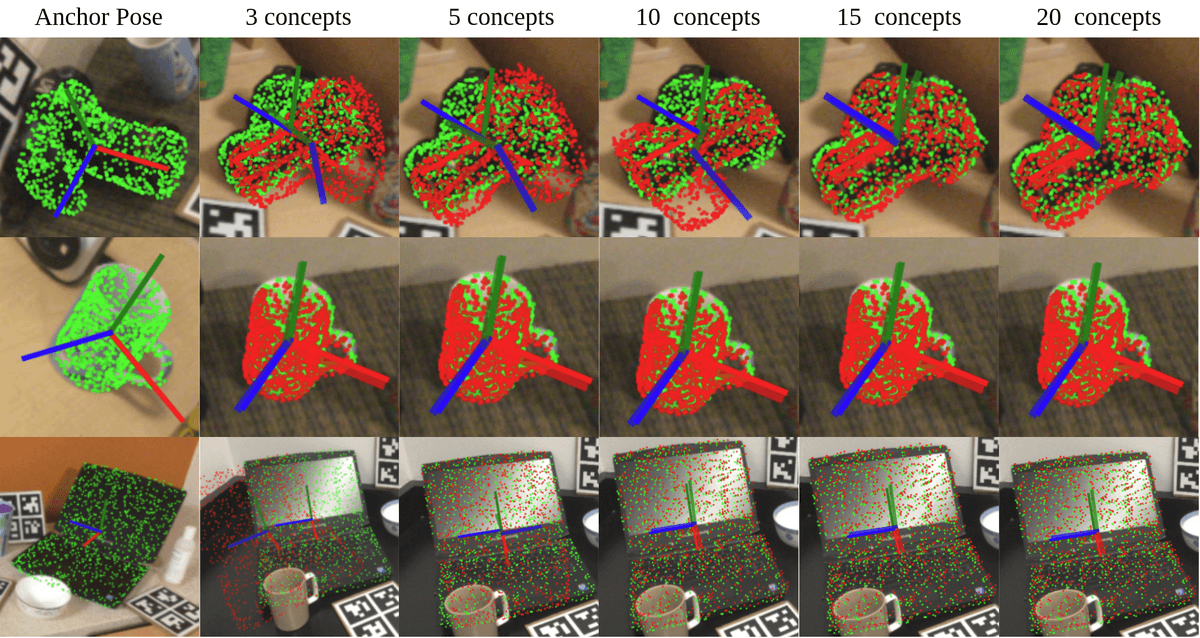
- It prompts an LLM (Gemini 2.5 Pro) for concept labels, then uses SigLIP2 + GradCAM to localize them in RGB-D.
- Beats the strongest baseline by 62% average ADD(-S) across REAL275, TYOL, YCB-V, and LINEMOD.
- Also outperforms FoundationPose in few-shot tracking (90.1 vs 87.4 ADD-AUC) without any training.
- Runs at ~7 seconds per image pair on a consumer RTX 4060 Ti; not yet real-time.
- Details, ablations, and qualitative results on the project page.
Object pose estimation, the task of figuring out where a physical object sits in 3D space and how it is oriented, has long been dominated by pipelines that need dataset-specific training, CAD models, and ground-truth pose annotations. A new paper from researchers at TU Munich and INSAIT challenges that assumption. ConceptPose estimates 6DoF pose without any pose training whatsoever, by asking a language model what an object looks like, then having a vision language model point to those parts in the image.
The method is both training-free and model-free: no CAD mesh, no learned correspondence head, no fine-tuning on pose datasets. It still outperforms the strongest baseline by a relative 62% in average ADD(-S) score, including methods that lean on extensive dataset-specific training.
Why pose estimation has been so painful
Classical 6D pose pipelines fall into a few camps, all with drawbacks. Instance-level approaches learn to estimate poses for specific objects, achieving high accuracy on known instances but failing to generalize. Category-level methods relax this constraint but remain tied to predefined classes with curated data. Recent foundation-model approaches like FoundationPose, Oryon, and Horyon lean on VFM backbones (e.g., DINO) to extract robust 2D features, which then feed a trainable correspondence pipeline. That extra trained head is what keeps them locked to specific datasets and makes swapping in a newer backbone painful.
The authors argue there is a more human way to do this. When you see an unfamiliar object from a new angle, you don't run a neural correspondence network; you look for the same distinctive parts (the handle, the spout, the base) and match them across views. Language is the natural medium for describing those parts, and modern VLMs already know how to ground language in pixels.