
TU Delft's Robot Skips Training Data by Building Digital Twins First
A Delft team skips vision-language-action training entirely, reconstructing a physics-ready digital twin from a single RGB-D view and letting simulation pick the winning move.
 Pro
Takeaways
- TU Delft team proposes zero-shot open-world manipulation via digital twins, skipping VLA action training entirely. Paper
- Two-stage mesh alignment uses DINOv2 similarity for coarse pose, then RANSAC and ICP for fine refinement.
- Hunyuan3D 2.0 generates object meshes; GPT-4o predicts materials for physics parameters in Isaac Sim.
- 96 real-robot trials on Kinova Gen3 Lite; six of nine tasks hit 75%+ success without demonstrations.
- Alignment success on mugs jumped from 27% to 91% versus direct RANSAC+ICP baseline.
- Main limitations: rigid objects only, visual ambiguity in the VLM checker, not real-time. Project page
Most recent progress in robot manipulation has come from Vision-Language-Action (VLA) models that map camera pixels and text prompts directly to motor commands. They work, but they are hungry for data. A new paper from TU Delft argues that this appetite is the wrong bottleneck to keep feeding. Instead of learning what to do, their system learns what the world is, then figures out what to do inside a simulator.
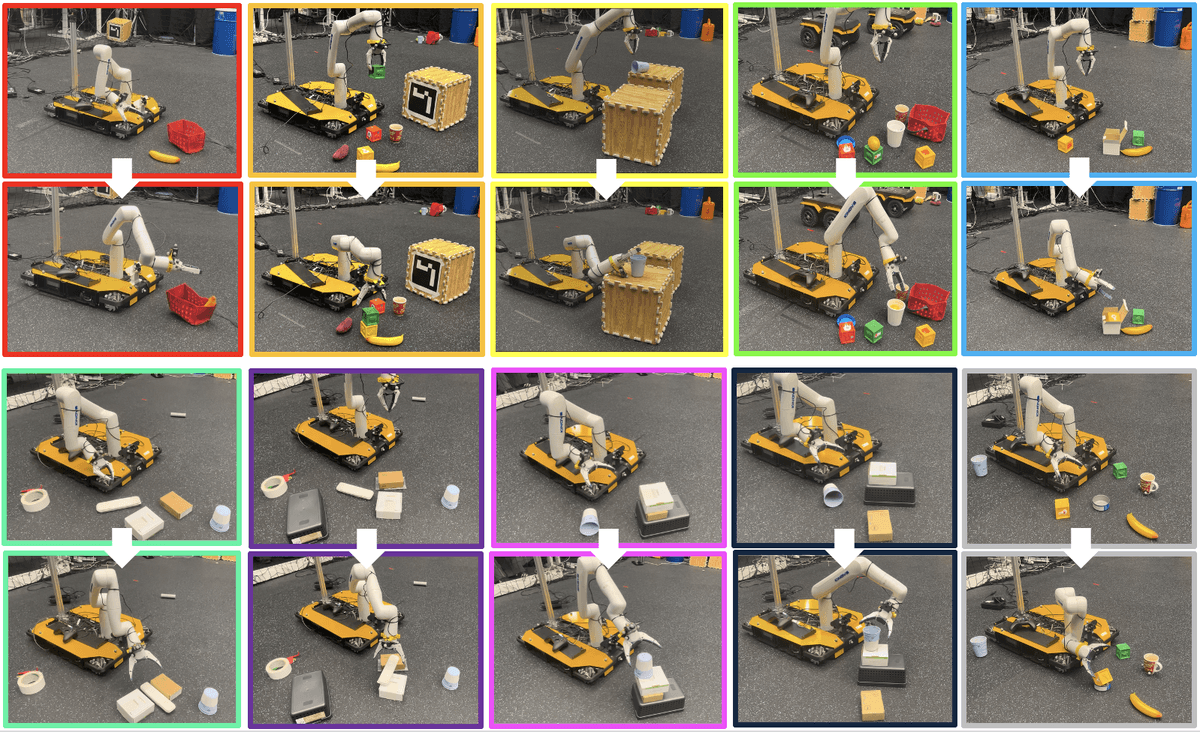
The framework, from Xiaotong Li, Gang Chen, and Javier Alonso-Mora at Delft's Cognitive Robotics group, performs zero-shot open-world manipulation by building a physically grounded digital twin of whatever the robot is looking at, sampling candidate actions inside NVIDIA Isaac Sim, and letting a vision-language model pick the winner before anything moves in the real world. Project demos include putting a banana into a basket, stacking cubes, and placing a cup upside-down on a wooden box, all without a single task-specific demonstration.
Why VLAs hit a wall
VLA models typically pair a pretrained vision-language backbone with an action head that produces executable control commands. The authors point out an uncomfortable fact: action data is a different modality from language and vision, and a backbone pretrained mostly on 2D tokens does not naturally handle continuous control. Collecting diverse, high-quality robot action trajectories remains expensive and difficult to standardize across embodiments and sensing configurations.
World models offer an alternative. Rather than imitating demonstrations, they predict the consequences of actions. The catch is that most current world models are video-diffusion style, and while such 2D models produce visually compelling predictions, they lack explicit 3D structure and physical consistency. That makes them poor at reasoning about contact and geometry, which is exactly what manipulation demands.
A four-stage pipeline

Given a single RGB-D image and a natural-language instruction, the system runs four stages:
- Open-set segmentation: GPT-4o parses the instruction to identify manipulated and interactive objects, then Grounded-SAM produces the 2D masks.
- Open-set grasping: AnyGrasp predicts grasp pose candidates from the RGB-D image, filtered to the target using the segmentation mask, with a GPT-4o post-grasp check that retries if the gripper came up empty.
- Digital twin construction: A textured mesh is generated with Hunyuan3D 2.0, then aligned to the real object via a two-stage pose alignment.
- Strategy sampling: Candidate goal poses are simulated in Isaac Sim, rendered, and scored by GPT-4o plus a Gaussian Process classifier.
Partial-to-partial alignment, the sneaky-hard part
The hardest step is turning a canonical unit-scale mesh from Hunyuan3D into something that lines up with a partial, gripper-occluded RGB-D view. Classical point cloud registration fails here because there is no complete geometry to register against.

The workaround is clever. A set of hypothesized poses is rendered from the generated mesh, DINOv2 features are extracted, and cosine similarity against the real observation picks the best coarse pose. That render is then depth-back-projected into a partial point cloud, turning the impossible partial-to-complete problem into a tractable partial-to-partial one that RANSAC and ICP can finish off. Scale is recovered by comparing 3D bounding boxes of the two partial clouds. GPT-4o also predicts each object's material so Isaac Sim can assign reasonable friction and mass.
How action selection actually works
Once the twin is built, the sample policy needs to be efficient. Blindly sampling 6-DoF goal poses would be wasteful, so the system constrains translations to a GPT-4o-plus-Grounded-SAM segmented interaction area, then sweeps reachable rotations. Each simulated outcome is rendered from a fixed front-tilted viewpoint and shown to GPT-4o, which returns a binary success label. Those weak labels train a Gaussian Process classifier over SE(3) that outputs calibrated success probabilities, and the top-ranked candidate runs on the real robot.
Numbers from 96 real-robot trials
The team ran nine tasks on a 7-DoF Kinova Gen3 Lite with two RealSense D405 cameras, totaling 96 attempts. Six of the nine tasks hit at least 75% success:
| Task | Success rate |
|---|---|
| Put the yellow cube into the white box | 91.7% (11/12) |
| Put the banana into the basket | 83.3% (10/12) |
| Put the long cutlery box into the gap between two boxes | 83.3% (10/12) |
| Put the lemon into the white cup | 75.0% (9/12) |
| Stack the green cube onto the yellow cube | 50.0% (6/12) |
| Put the blue cup upside on the wooden box | 33.3% (2/6) |
On the alignment ablation, the two-stage pipeline crushed direct RANSAC+ICP on scenes where classical methods stall on local minima, jumping from 27.27% to 90.91% success on mugs and from 11.11% to 88.89% on grasped mugs.
Where it breaks
The failure analysis is refreshingly honest. The two lowest-scoring tasks both involved a cup either standing upright or upside-down on a wooden box, and the result checker floundered because those two orientations looked ambiguous from the rendered viewpoint. Other losses came from the sim-to-real gap: Isaac Sim's rigid-body parameters cannot capture hollow plastic cubes, and small camera calibration errors hurt tight-tolerance tasks.
Speed is the bigger caveat. The simulation-based strategy sampling remains computationally demanding, which currently prevents real-time deployment. This is a planner that thinks before it acts, not a reactive policy.
What this changes
The paper shows you can get respectable open-world manipulation performance on novel rigid objects without collecting a single teleoperated trajectory, provided you are willing to stitch together strong off-the-shelf models: GPT-4o for semantics, Grounded-SAM for masks, AnyGrasp for grasps, Hunyuan3D 2.0 for meshes, DINOv2 for feature matching, and Isaac Sim for physics. The framework is embodiment-agnostic because the action space is just end-effector poses.
Scope is limited to rigid objects for now, since deformables and articulated joints would need elasticity and joint modeling in the twin. Code has not shipped with the preprint, but the pipeline is documented in enough detail that reproducing the alignment module looks feasible. For anyone weighing whether to invest more in scaling VLA data collection or in building better simulators and 3D generators, this work suggests the second path is closer to working than it looked.