
TU Delft's MPC-RL Hybrid Cuts Self-Driving Intersection Crashes by 21%
A hierarchical controller pairs a learned speed policy with a model predictive planner, cutting collisions 21% and transferring zero-shot to highway merging.
Takeaways
- TU Delft team couples PPO speed policy with MPC trajectory optimizer at every control step.
- Cuts collision rate 21% and boosts success rate 6.5% versus standalone MPC across 3,000 episodes.
- Zero-shot transfers to highway merging; end-to-end PPO fails 100% of merge attempts.
- Runs at 38.36 ms per step, under 1% overhead versus pure MPC on 10 Hz control.
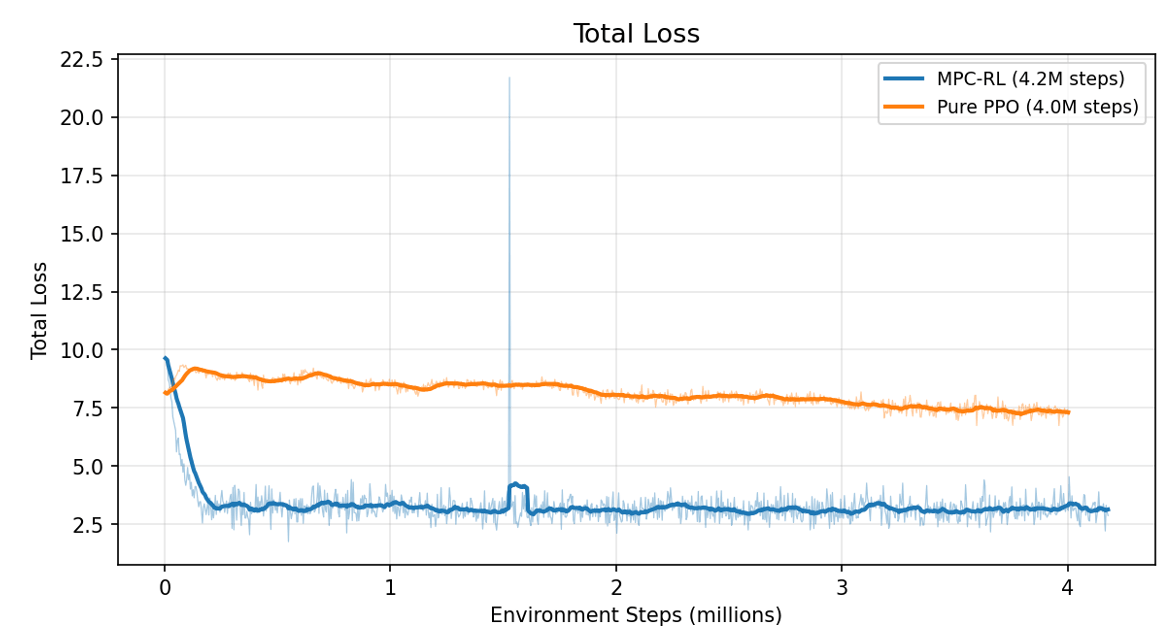
- MPC-RL loss stabilizes in 200k steps versus 2.5M for end-to-end PPO.
- Tested in Highway-Env; code to be released open source.
Self-driving cars still struggle at unsignalized intersections. The classic engineering fix, model predictive control (MPC), keeps trajectories feasible and safe but leans on hand-crafted rules that make cars overly cautious. Deep reinforcement learning goes the other way, learning fluid interactive behavior while offering no safety guarantees and generalizing poorly. A team from TU Delft has now published a coupled MPC-RL framework that keeps both pieces active at every control step, and the numbers suggest the marriage works.
Why intersections break existing controllers
Driving at unsignalized junctions demands a careful balance between assertive and cooperative behaviors. Too timid and the car blocks traffic; too aggressive and it crashes. Prior hybrid attempts typically alternated authority between MPC and RL, or let one supervise the other. Among the few studies that adopt a more integrated architecture, evaluation has been limited to simplified scenarios with only one or two surrounding vehicles, and generalizability to structurally different environments has not been investigated. Many of those training setups also disabled the MPC's collision avoidance during learning and re-enabled it at deployment, creating a train-test mismatch.