
TU Delft's EAAE Cuts Drone Battery Drain by 21% in Cluttered Spaces
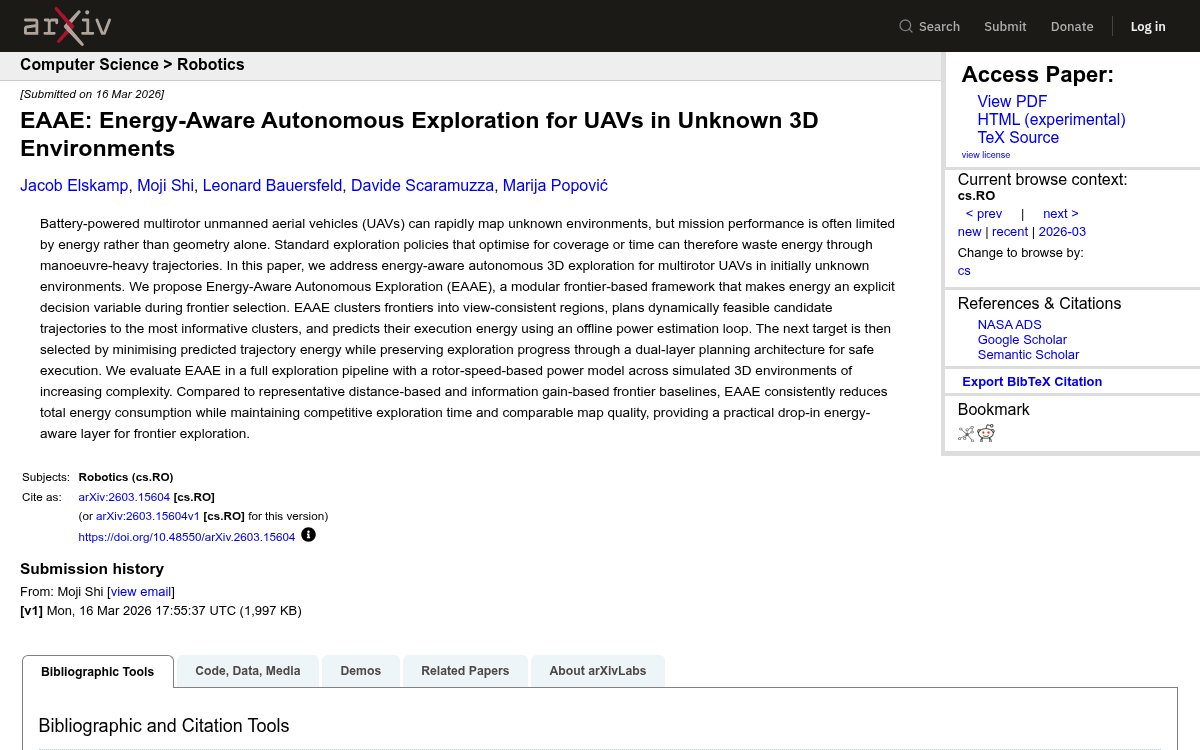
A new frontier-exploration framework for drones treats battery energy as a first-class planning variable, cutting mission energy by up to 21 percent.
 Pro
Takeaways
- EAAE is a frontier-based UAV exploration framework that treats battery energy as an explicit decision variable.
- Candidate trajectories are simulated offline in Agilicious to predict rotor-level energy before goal selection.
- Cut total mission energy by up to 21.1% versus Nearest Frontier in cluttered scenes.
- Exploration time and map entropy stay competitive with distance- and information-gain baselines.
- Global trajectory generation is the runtime bottleneck at 1.9-3.3 seconds per cycle, not energy estimation.
- Evaluation is simulation-only; real-world flights, wind, and multi-UAV extensions are future work. Paper.
Battery life, not compute, is what usually ends a drone mission. A small multirotor can map an unknown warehouse or disaster site in minutes, but if its exploration policy chases the nearest unmapped voxel without thinking about acceleration, altitude changes, or sharp turns, it burns through the battery long before the map is complete. A new paper from TU Delft and the University of Zurich proposes making predicted energy the actual quantity the planner minimizes.
The framework, called Energy-Aware Autonomous Exploration (EAAE), plugs into a standard frontier-based exploration stack and replaces the usual distance or information-gain heuristic with a rotor-level energy estimate for each candidate trajectory. Against distance- and information-gain-based baselines, it consistently reduces total energy consumption while maintaining competitive exploration time and comparable map quality.
Why distance lies about energy
Frontier-based exploration, introduced by Yamauchi in 1998, is still the dominant approach: the drone maintains an occupancy map, finds the boundary voxels between known-free and unknown space, and picks one to fly to next. Most systems rank those frontiers by Euclidean distance, cluster size, or a hand-tuned utility mixing information gain with travel time.
Multirotor energy consumption has almost nothing to do with straight-line distance. It depends on maneuvering behavior, accelerations, heading changes, and altitude transitions, so trajectories with similar geometric length can induce substantially different energy expenditures. A closer frontier hidden behind a pillar that requires an aggressive S-curve can cost more Joules than a farther one reachable by a smooth straight shot.
How EAAE picks the next goal
The pipeline runs an iterative five-step loop on top of an OctoMap-style voxel grid updated from a forward-facing depth camera:
- Detect frontier voxels (free voxels touching at least one unknown neighbor).
- Cluster them using divisive k-means, splitting recursively until each cluster fits inside a single camera field-of-view cone.
- Filter for reachability and rank remaining clusters by information gain, defined simply as the number of frontier voxels in the cluster.
- For the top candidates, generate dynamically feasible global trajectories with a risk-aware kinodynamic planner.
- Simulate each trajectory offline and pick the one with the lowest predicted energy.

The energy prediction is where the work earns its name. Rather than fitting an empirical model to flight states or assuming energy scales with path length, EAAE runs each candidate trajectory through the Agilicious physics simulator, records the rotor angular velocities produced by a geometric controller, and integrates a rotor power model from Bauersfeld and Scaramuzza's earlier work. Total predicted energy is computed by integrating instantaneous power across all four rotors over the trajectory, using a cubic-plus-sixth-order polynomial in rotor angular velocity.
At execution time, a dual-layer architecture takes over: the global kinodynamic plan is tracked by EGO-Planner as a local reactive layer for obstacle avoidance, which decouples the expensive energy reasoning from the tight control loop.
The numbers
The authors tested EAAE in Gazebo across two environments, a 20x20m open room called Simple and a 22x22m cluttered scene called Pillars, against two baselines: Nearest Frontier (greedy closest-centroid) and Classic Frontier (largest cluster first). Five runs per method.
| Scene | Method | Time (s) | Energy (kJ) | Entropy (bits/cell) |
|---|---|---|---|---|
| Simple | EAAE | 160.0 | 21.2 | 0.725 |
| Simple | Nearest | 182.8 | 30.3 | 0.735 |
| Simple | Classic | 178.3 | 22.2 | 0.719 |
| Pillars | EAAE | 353.0 | 45.0 | 0.754 |
| Pillars | Nearest | 321.7 | 57.0 | 0.784 |
| Pillars | Classic | 366.6 | 51.4 | 0.767 |
EAAE consumed 21.2 kJ in Simple and 45.0 kJ in Pillars, cutting total energy by 12.5% versus Classic Frontier and 21.1% versus Nearest in the cluttered scene. The gap widens in cluttered environments, which tracks with intuition: that is where geometric proxies most badly misestimate the real cost of a maneuver.
Nearest Frontier often finishes cluttered scenes fastest but at substantially higher average power, while EAAE holds lower power throughout, indicating its selected trajectories are simply less demanding to execute. Map quality, measured as OctoMap entropy, stays comparable across methods, and in Pillars EAAE actually produces the most confident map.
The catch
Predicting energy by simulating full trajectories is not free. Global candidate trajectory generation dominates the runtime at 3331.6 ms in Simple and 1887.0 ms in Pillars, while clustering and offline energy estimation stay on the order of tens of milliseconds. The energy evaluation itself is cheap, but scoring a candidate requires generating a feasible trajectory to it first. In dense scenes with many candidate clusters, this becomes the bottleneck.
The evaluation is also simulation-only. The authors flag real-world validation, wind disturbances, payload changes, and multi-UAV coordination as open work. Code has not been released with the paper.
Why it matters
The practical appeal of EAAE is that it acts as a drop-in decision layer rather than a redesign of the exploration stack. If you already run a frontier pipeline with OctoMap, a kinodynamic global planner, and a reactive local planner, you can swap the frontier ranking rule and inherit the energy savings. For inspection, search-and-rescue, or any endurance-limited mission where a 20 percent battery gain translates directly into more area covered, that is a meaningful lever, and it makes explicit what most existing planners only hint at through time or distance proxies.