
TU Delft's CLRNet Cuts Self-Driving Sensor Calibration Errors by 50%
A new deep learning network jointly calibrates camera, lidar, and 4D radar in one shot, cutting translation and rotation errors by more than half.
 Pro
Takeaways
- CLRNet jointly calibrates camera, lidar, and 4D radar end-to-end from a single synchronized frame, no targets required.
- Cuts median translation and rotation errors by at least 50% versus prior state of the art on View-of-Delft and Dual-Radar.
- Key ideas: equirectangular projection, shared tri-modal feature space, loop closure loss, extra radar channels (RCS, Doppler, time).
- Rigid-platform variant CLRNet+4 hits 0.9 cm, 0.1° camera-radar and 0.3 cm, 0.03° camera-lidar median error.
- Runs at 50 fps on a GTX 1080 Ti; cross-dataset generalization remains an open problem.
- Code releasing at github.com/tudelft-iv; paper on arXiv.
Fusing camera, lidar, and radar is the standard recipe for robust 3D perception in self-driving stacks, but that fusion collapses if you do not know exactly where each sensor sits relative to the others. Getting those six numbers (three for rotation, three for translation) right is called extrinsic calibration, and it has quietly remained one of the messier problems in autonomy, especially once radar enters the mix. A team from TU Delft, HUN-REN SZTAKI, and Pázmány Péter Catholic University just published CLRNet, a deep network that jointly calibrates all three modalities from a single synchronized frame and beats the previous state of the art by more than 50% on both translation and rotation error.
Why radar keeps breaking calibration pipelines
Traditional calibration relies on checkerboards or other target objects placed carefully in a rig. That works offline, but it does not survive vibration, articulation, or a sensor getting knocked out of alignment during operation. Targetless methods try to solve this by extracting features directly from the scene, which is where deep learning has taken over for camera-to-lidar pairs.
Radar is the odd one out. Several accurate methods exist for camera-to-lidar calibration, but accurate targetless radar calibration remains unsolved because of how sparse the data is. Even modern 4D radar (three spatial dimensions plus Doppler velocity) returns only a few hundred to a few thousand points per frame, and it shares almost no visual features with a camera image. Most prior work in this area either estimated only the yaw angle, ignored translation, required moving objects in the scene, or assumed specific sensor motion patterns.
Letting lidar translate for radar
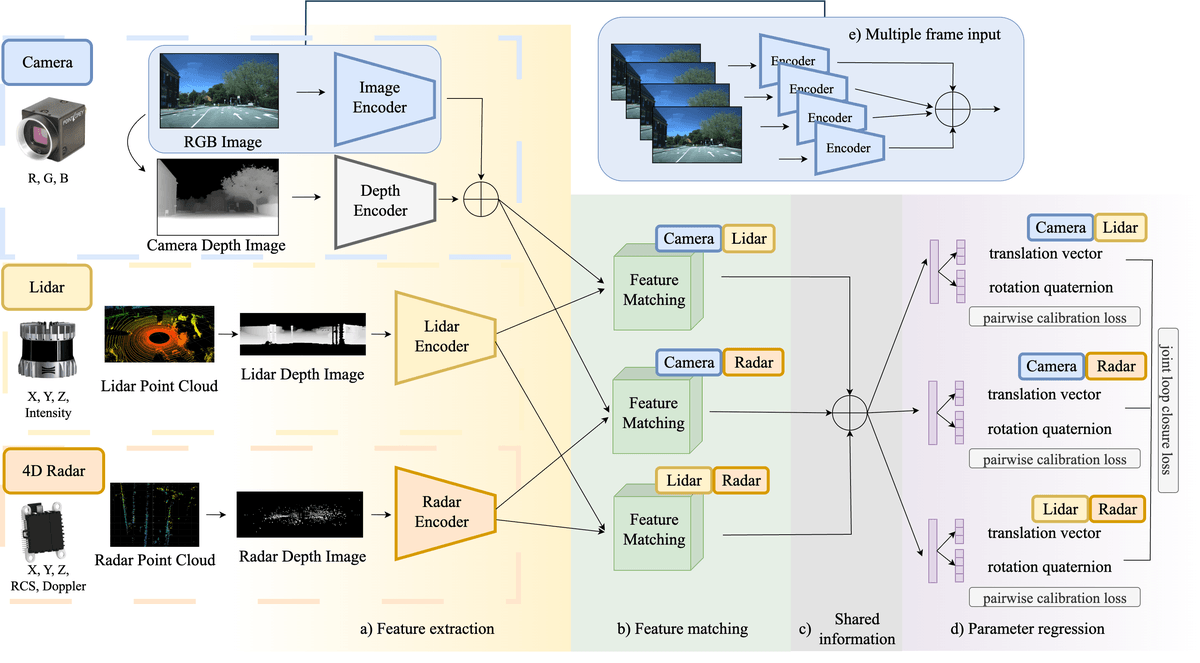
CLRNet performs joint targetless calibration on multi-sensor systems containing camera, lidar, and radar, end-to-end. By considering the three sensors jointly, the authors exploit the advantages of established camera-to-lidar techniques together with the fact that both lidar and radar provide range measurements that can be matched in the depth image domain. That yields improved camera-radar alignment through a shared feature space carrying information from all three modalities, plus a joint loop closure term in the loss function.
In plain terms, rather than aligning sparse radar points to a camera image directly, the network uses lidar as a middleman that speaks both languages. The three sensors get their own encoder branches, pairwise feature matching layers compute correspondences between every pair, and a shared feature vector concatenating information from all three modalities feeds regression heads that output the final translation vectors and rotation quaternions.
Four ideas that made it work
- Equirectangular projection instead of pinhole. Standard depth-image projection throws away points that fall outside the camera frustum after miscalibration. CLRNet projects lidar and radar point clouds into a 360-degree spherical image, preserving every measurement, which matters most for sparse radar.
- Extra radar channels. Beyond depth, the radar depth image carries radar cross-section, ego-motion-compensated Doppler velocity, and time.
- Camera depth prediction using DepthAnythingV2, concatenated with the RGB feature map to give the network a geometric prior from the image alone.
- Loop closure loss. Because camera-to-lidar, lidar-to-radar, and radar-to-camera transformations should compose to identity, the loss penalizes any residual when you walk the loop.
Numbers that make the point
The team evaluated on the View-of-Delft and Dual-Radar datasets, cutting median translational and rotational calibration errors by at least 50% against existing state-of-the-art methods. A few specifics from their four test scenarios on View-of-Delft:
- Single-frame, small miscalibration (±20 cm, ±1°): median 7.8 cm and 0.4° for camera-radar, 3.7 cm and 0.1° for camera-lidar.
- Large miscalibration (±100 cm, ±20°) with iterative refinement: camera-radar median drops to 10.0 cm, 0.4°.
- Rigid platform with the four-frame variant (CLRNet+4): 0.9 cm, 0.1° for camera-radar and 0.3 cm, 0.03° for camera-lidar.
- Full-range recovery (±200 cm, ±180°): still 1.4 cm, 0.2° camera-radar with CLRNet+4.
The closest recent baseline, 4DRC-OC, sat at roughly 18.6 cm and 0.8° in the equivalent single-frame test. LCCNet, the widely used camera-lidar baseline, came in about 40% worse than CLRNet on the camera-lidar pair.

When to actually use it
The authors are direct about the use case. This targets situations where you need single-frame recovery, either because your platform is not rigid (two-wheelers, robotic arms, drones with articulated payloads) or because a nominally rigid rig has drifted from vibration or a knock. On rigid setups with a factory calibration that occasionally needs verification, you can accumulate frames and take the median for even tighter results. Runtime is 20 ms per frame on a GTX 1080 Ti excluding the camera depth prediction step, which is fast enough for online use.
Where it still struggles
Cross-dataset transfer is the honest weakness. When trained on View-of-Delft and tested on Dual-Radar (or vice versa), errors blow up to well over a meter for every method tested. The authors attribute this to a 15-to-30x difference in radar point cloud density between the two datasets, different camera intrinsics and mounting, and day-versus-night distribution shifts. In practice you cannot ship a pretrained model and expect it to work on a new radar chip without at least some fine-tuning data.
The traditional motion-based baseline iKalibr could not even complete calibration on View-of-Delft because the vehicle motion was not excited enough, a fair reminder that learning-based approaches are the more practical option for typical driving data.
Availability
The authors state the code will be released at github.com/tudelft-iv for non-commercial scientific use once the paper is accepted. Both benchmark datasets (View-of-Delft and Dual-Radar) are already public, so reproducing the numbers should be tractable. If you are building a radar-inclusive perception stack and have been living with hand-tuned or checkerboard-derived extrinsics, this is worth a look.