
TU Delft Reveals the Hidden Cost of Decentralized AI in Power Grids
A new benchmark quantifies exactly how much reward multi-agent reinforcement learning loses when redundancy in engineering systems forces agents to coordinate.
 Pro
Takeaways
- New benchmark measures the optimality gap when MADRL replaces centralized POMDP solvers for infrastructure maintenance planning.
- Uses k-out-of-n systems with n=4 components so SARSOP can produce near-optimal reference policies.
- Nine algorithms tested across CTCE, CTDE, and DTDE paradigms including DDQN, MAPPO, VDN, QMIX, IPPO.
- Performance near-optimal in series systems but degrades sharply as redundancy increases toward parallel configurations.
- Value factorization methods (VDN, QMIX) proven analytically to be suboptimal in parallel configurations.
- Code, environments, baselines, and trained models released at github.com/prateekbhustali/price-of-decentralization.
Managing physical infrastructure like power grids, bridges, or wind farms is a sequential decision problem under uncertainty: which components to inspect, which to repair, and when. Formally, it maps onto a partially observable Markov decision process (POMDP), but exact solutions blow up combinatorially as the number of components grows. Multi-agent deep reinforcement learning (MADRL) is the popular workaround, giving each component its own agent. A new study from TU Delft, TU Munich, and Penn State asks a sharp question: what does decentralization actually cost you in optimality?
The authors call it the price of decentralization, and they've built a benchmark specifically designed to measure it. Their paper and code are public, with implementations at github.com/prateekbhustali/price-of-decentralization.
Why existing MADRL benchmarks lie to you
Prior work like IMP-MARL benchmarked MADRL on infrastructure problems with up to 100 components, but their evaluation relies on heuristic baselines that offer no guarantees on optimality. The problem: heuristics are inconsistent. Their effectiveness varies with problem setting, which means a MADRL algorithm can look great against a weak heuristic and terrible against a strong one, with no way to know which is closer to truth.
The authors' fix is to shrink the problem enough that a real optimal baseline becomes computable. They build environments around the classic k-out-of-n:G system, a common archetype of deteriorating engineering systems, that operates as long as at least k out of its n components remain functional. With n=4 components, SARSOP, a point-based POMDP solver with performance guarantees, can produce near-optimal reference policies. Varying k from 4 (series, every component matters) to 1 (parallel, maximum redundancy) lets them dial redundancy up and down cleanly.
Nine algorithms, three paradigms, one honest scoreboard
The benchmark covers the three standard MADRL training regimes, distinguished by what information agents see during learning versus deployment:
- CTCE (centralized training, centralized execution): a single agent sees everything. Includes joint DDQN, joint actor-critic (JAC), and DCMAC.
- CTDE (centralized training, decentralized execution): agents share info during training but act on local observations at deployment. Includes MAPPO-PS, IACC-PS, VDN-PS, QMIX-PS.
- DTDE (decentralized throughout): fully independent agents. Includes IAC-PS and IPPO-PS.
Each algorithm is trained across 10 random seeds and evaluated with 100,000 Monte Carlo rollouts on the infinite-horizon discounted cost.
Redundancy is where things break
The headline result: MADRL algorithms achieve near-optimal performance in series-like settings, whereas increasing redundancy amplifies coordination challenges and can lead to optimality losses. In the 4-out-of-4 series system, most decentralized agents land within a couple of percent of SARSOP. In the 1-out-of-4 parallel system, gaps widen substantially.
The intuition is that series systems have a simple additive coordination structure (every component must work, so every agent's job is roughly independent). Parallel systems create a hard credit-assignment problem: only one or two of four components need maintenance, and picking which is a joint decision that per-agent value functions struggle to represent.

Value factorization has a provable ceiling
VDN and QMIX, the value-factorization workhorses of cooperative MARL, take a specific hit. The authors prove analytically that in a simplified two-agent reliability matrix game, linear (VDN) and monotonic (QMIX) decomposition can represent the optimum in series configurations but cannot represent it in parallel ones. The monotonicity constraint forces a fixed action ordering across all joint actions, which conflicts with the parallel structure where only one agent should repair.
Emergent periodic maintenance
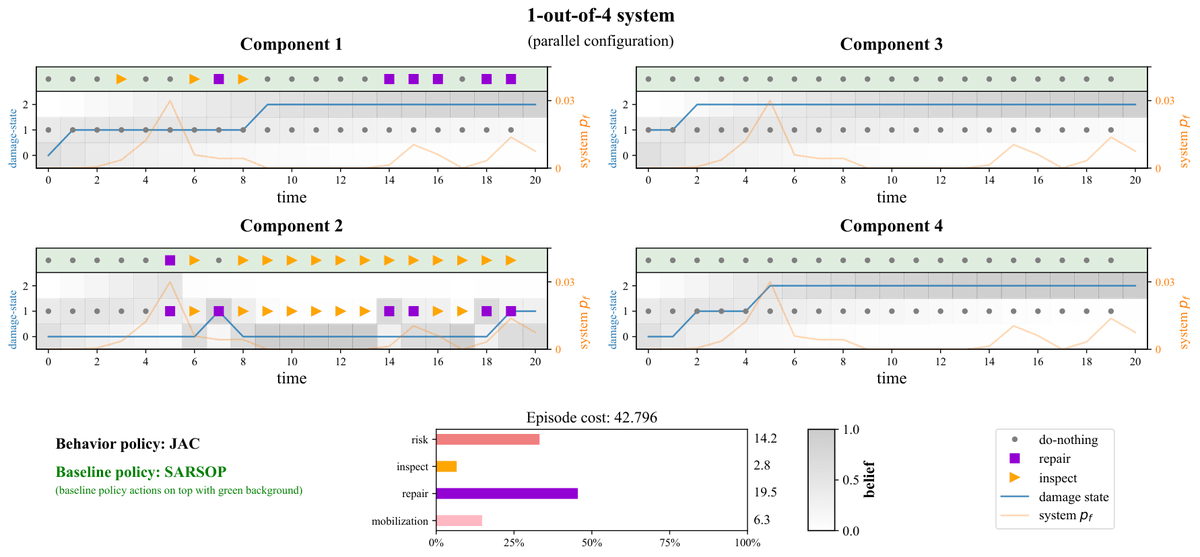
One of the more surprising findings involves what decentralized agents do when they can't fully coordinate. In the 1-out-of-4 system, IACC-PS agents converge to a striking pattern: agent 1 repairs every 5 or 7 timesteps, agent 2 repairs every 5 timesteps, and agents 3 and 4 sit idle. Although agents do not observe the global time step, they appear to infer the temporal structure implicitly. With no inspection actions, belief updates are fully deterministic under the stationary deterioration model.
By avoiding inspections, agents remove stochasticity from their belief updates, effectively turning the problem into a deterministic schedule they can learn without a clock. It's a clever workaround for the non-stationarity pathology, and it emerges purely from optimization pressure.
What this means in practice
For anyone deploying MADRL on real infrastructure problems:
- Series-structured systems are safe territory. Nearly all methods approach optimal; pick based on training cost.
- Redundant systems need scrutiny. Decentralized approximations still beat optimized heuristics, but there's a real gap to optimal that current methods can't close.
- Value factorization has structural limits. VDN and QMIX work well in series but degrade in parallel systems for reasons that aren't hyperparameter tuning issues.
- Heuristic-only benchmarks can mislead. Where possible, compute a proper POMDP baseline; the authors' repo ships SARSOP baselines alongside DRL implementations.
The broader lesson is that scalability in MADRL is not free. Decentralization solves the exponential blowup in joint action spaces but introduces coordination pathologies whose severity depends on the reward structure of the problem. Knowing which regime your system lives in matters more than picking the fanciest algorithm.