
TU Darmstadt's WHOLE-MoMa Teaches Robots Bimanual Tasks Without Human Data
A two-stage pipeline uses a rough whole-body controller to seed data, then offline RL stitches better behaviors together, no teleoperation needed.
 Pro
Takeaways
- WHOLE-MoMa learns whole-body mobile manipulation without teleoperation, using a sub-optimal controller as a data prior.
- A rough WBC generates 3k randomized trajectories per task, offline RL then stitches better behaviors via reward.
- Extends IQL with Q-chunking so critics can evaluate action chunks from diffusion policies directly.
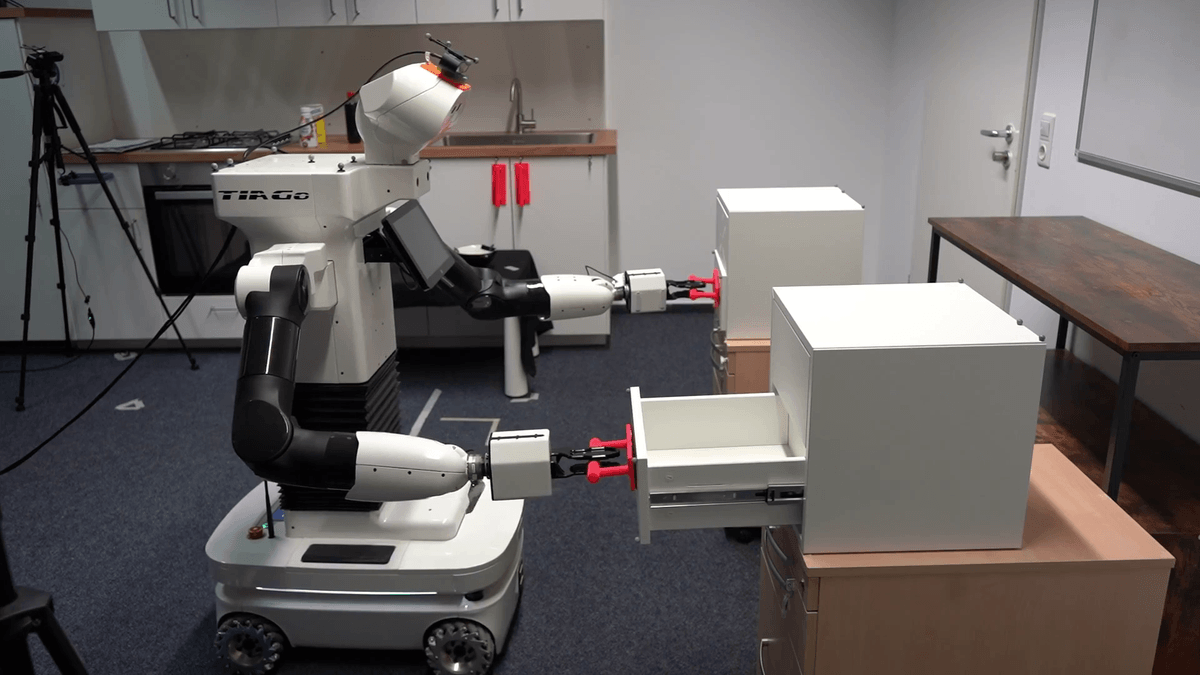
- Simulation: 98% door, 80% bimanual drawer, 78% cupboard-open-and-place on a TIAGo++.
- Sim-to-real transfer with no fine-tuning: 80% drawer and 68% cupboard on the physical robot.
- Async chunk inference plus EMA smoothing keeps diffusion policy running at 40 Hz control rate.
Getting a mobile robot to open a cupboard door with one arm while simultaneously placing a cup inside with the other sounds mundane, but it is one of the hardest problems in robotics. The base has to roll, both arms have to coordinate, and every subgoal (reach, grasp, articulate, place) has to flow into the next without snapping the handle or getting stuck. A new method called WHOLE-MoMa from TU Darmstadt's PEARL Lab shows you can learn these behaviors end-to-end without any human teleoperation data, and transfer the resulting policy directly to a real robot.
Why whole-body manipulation is stuck
Two schools of thought dominate control of a mobile manipulator, and both have serious problems. Classical whole-body controllers (WBCs) solve control problems via hierarchical optimization, resolving priorities instantaneously at each timestep, which makes them reactive and computationally cheap but purely myopic. They cannot reason about how the current joint configuration will trash a later phase of the same interaction. A pose that is great for grabbing a handle can be terrible for actually pulling the drawer open.
The learning-based alternative usually means expensive whole-body teleoperation or suffering from the curse of dimensionality in the larger state-action space. Teleop requires specialized rigs, a lot of human hours, and still leaves the policy brittle when it drifts out of the demonstration distribution.
A bad controller is still a great prior
The authors observe that a sloppy, hand-tuned WBC does not need to be good; it just needs to be structured. Even a sub-optimal controller focuses data collection on a physically feasible, task-relevant slice of the state-action space, which is exactly the region where offline reinforcement learning can actually learn something useful. The pipeline has two stages: