
TU Darmstadt's UniFField Lets Robots Map Unknown Rooms Without Retraining
A new voxel-based feature field brings RGB, CLIP semantics, and geometry into one representation that also reports how much to trust each prediction.
 Pro
Takeaways
- UniFField unifies RGB, CLIP semantics, and TSDF geometry into one voxel-based feature field with per-modality uncertainty.
- The model generalizes zero-shot to unseen scenes without per-scene optimization.
- Beats scene-specific NeRF at 25 to 50 reference frames; F-score 0.519 on ScanNet geometry.
- Learned uncertainties correlate with prediction errors (Spearman rho up to 0.56 for TSDF).
- Deployed on a TIAGo mobile manipulator for active object search using language queries.
- Frame integration takes 0.04s but full feature-map rendering takes 7.7s, limiting real-time use.
Most 3D scene representations robots rely on today have two annoying properties: they need to be retrained from scratch for every new room, and they confidently return predictions with no sense of how wrong they might be. A team from TU Darmstadt is proposing a fix with UniFField, a neural feature field that packs color, CLIP-style semantics, and geometry into a single voxel-based representation, works zero-shot on unseen scenes, and produces a calibrated uncertainty estimate for each modality.
The scene-specific trap
Feature fields lift 2D features from foundation models like CLIP or DINO into 3D so robots can do language-guided manipulation and navigation. The catch is that most 3D neural feature fields are scene-specific, trained using a fixed set of 2D images and their respective features captured for a single scene. NeRF and Gaussian Splatting variants also struggle to incrementally add observations as a robot explores, which is exactly what you want for a mobile platform wandering through an unknown environment.
The second problem is trust. A robot navigating a partially observed room needs to know when a feature prediction is based on solid evidence versus when it is essentially a hallucination from a briefly-glimpsed patch. 2D vision encoders like CLIP or DINO can still be very noisy in their predictions, especially in partially observable settings, and that noise propagates directly into whatever the robot decides to do next.
One volume, three modalities, three uncertainties
UniFField structures a scene as a 3D voxel grid where each voxel carries a unified feature vector. A 2D CNN extracts dense image features from each RGB frame, and every pixel's feature is back-projected along its viewing ray, assigning that feature to all voxels intersected by the ray. This creates an image feature volume averaged over all accumulated observations. Depth channels feed a standard TSDF fusion pass to give the network explicit spatial guidance.
The clever bit is what else gets stacked into the input. Alongside the color and TSDF volumes, the authors add two "metadata" channels per voxel: how many observations landed in it, and how much those observations varied. These signals prime the network to reason about its own confidence before it even runs the 3D CNN that produces the final unified feature volume.

Three MLP decoders sit on top of the volume, one each for visual, semantic, and geometric properties. Each decoder has two heads that predict the mean and log-variance of a Gaussian, so every prediction comes with an uncertainty estimate. Training uses a heteroscedastic loss that lets the model choose to widen its variance on hard samples rather than take the full L2 hit, which is the standard trick for learning aleatoric uncertainty end-to-end.
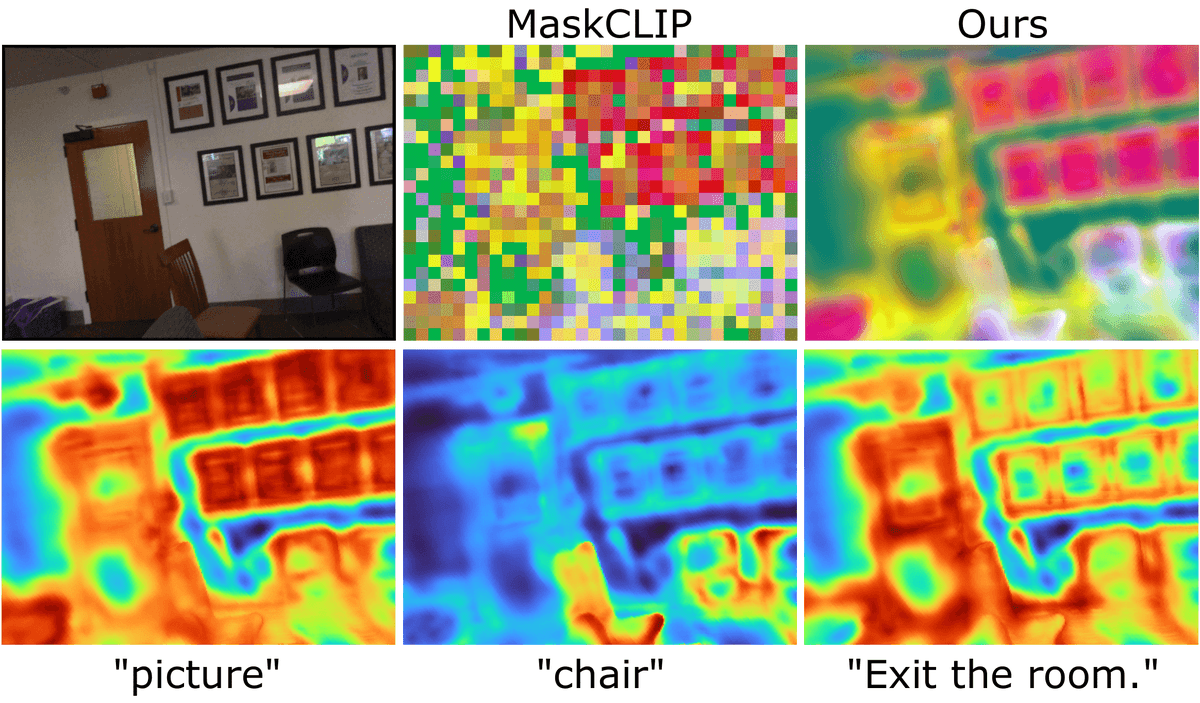
For semantics, UniFField distills MaskCLIP, a variant of CLIP that produces dense patch-level features instead of a single image embedding. Aligning the field's semantic head with MaskCLIP means you can query the 3D volume with arbitrary language at inference time.
How it holds up on ScanNet
The model was pretrained on ScanNet and evaluated zero-shot on unseen scenes. A few numbers worth noting:
- With only 25 to 50 reference frames, UniFField beats a scene-specific NeRF on PSNR and SSIM. NeRF only pulls ahead when given 1,658 frames to fit.
- On geometric reconstruction it lands between Atlas and FineRecon, achieving a 0.519 F-score versus 0.476 for Atlas and 0.578 for FineRecon, without any per-scene optimization.
- Semantic features track MaskCLIP closely, with a cosine distance of 0.325 and MAE of 0.021 across 100 test scenes.

The uncertainty story is where it gets interesting. The learned uncertainties correlate strongly with actual prediction errors, hitting Spearman rho values around 0.47 for color, 0.22 for CLIP features, and 0.56 for TSDF. They also outperform Monte Carlo dropout ensembles in 2D, though 3D spatial errors that arise due to unobserved areas can sometimes be better identified with dropout ensemble-based uncertainty in comparison to the predicted uncertainty. The learned estimates capture aleatoric noise well; unexplored regions are still better flagged by ensemble methods.
Driving a real robot with uncertainty
To show the representation is more than a benchmark exercise, the team wired it into a TIAGo mobile manipulator with a head-mounted ZED2i stereo camera. The policy runs in three phases: an initial sweep to seed the volume, an exploration phase that repeatedly heads toward the region of highest visual uncertainty, then an exploitation phase that localizes objects matching a language query.
A key detail: they weight the language-similarity score by the inverse of spatial uncertainty. Because spatial uncertainty appears in areas of high depth contrast and complex geometry, downweighting those regions produces cleaner target localizations than raw CLIP similarity alone. Videos of the policy are on the project page.
What it is good for, and what it is not
Timing-wise, the model is not real-time. Creating a feature volume takes 0.04s per frame while extracting the TSDF and rendering a 640x480 feature map takes 1.26s and 7.70s respectively. That is fine for a robot that pauses to think between waypoints, but not for closed-loop control. The authors also acknowledge that combining multiple uncertainties multiplicatively is finicky, with effectiveness varying by query.
The practical sweet spot is any task where a robot needs to build up a 3D understanding of an unfamiliar space and reason about which parts of that understanding to trust: language-conditioned object search, active mapping, next-best-view planning, and uncertainty-aware manipulation. The generalizable prior means you skip the hours of per-scene optimization that NeRF-based pipelines still demand.
There is no public code repo linked in the paper yet, only the demo site, but the method builds on well-known components (Atlas-style back-projection, FineRecon-style depth guidance, MaskCLIP distillation, heteroscedastic loss) that should make it reproducible for anyone who wants to try.