
TU Braunschweig's RadField3D Lets Neural Networks Replace Slow Radiation Simulations
An open-source Geant4 simulator plus a PyTorch-ready binary format aim to let neural networks replace slow Monte-Carlo dose calculations.
 Pro
Takeaways
- RadField3D is an open-source Geant4 Monte-Carlo simulator producing voxelized 3D radiation fields for medical dosimetry (GitHub).
- RadFiled3D is the companion binary file format with C++/Python APIs and PyTorch integration, pip-installable (repo).
- Particle tracks are auto-split into Beam, Patient and Scatter components, key for staff dose estimation.
- Validated at PTB against ISO 4037-1 measurements using H-100 quality and two phantoms at three distances.
- Voxel layers support scalars, vectors, and N-D histograms with per-voxel statistical uncertainty tracked.
- Already powering follow-up work training neural surrogates for interactive scatter-field estimation (paper).
Radiation-protection dosimetry has a speed problem. The gold standard for calculating how X-rays scatter through a patient and toward the medical staff around them is Monte-Carlo simulation, which is accurate but far too slow for interactive use. A team from TU Braunschweig and Germany's national metrology institute (PTB) has released a pair of tools designed to unblock that bottleneck for machine learning research: RadField3D, a Geant4-based simulator that produces voxelized 3D radiation fields, and RadFiled3D, a binary file format with a Python and PyTorch API for feeding those fields into neural networks.
Why Monte-Carlo is the wrong tool for real time
Monte-Carlo radiation transport works by tracing millions of individual particle histories through matter, sampling physical interactions at each step. It is the reference method for computing dose distributions, but as the authors point out, existing radiation transport simulations lack the speed required for real-time dose calculations, which is also a limitation for virtual reality training software used to reduce radiation exposure during interventions by increasing awareness among medical staff, and these systems currently lack dosimetrically reliable data for real-time visualisation.
There is an obvious deep-learning shaped hole here: train a network on precomputed Monte-Carlo outputs, then use the network as a fast surrogate at inference time. The problem is that nobody had a clean, standardized way to generate and store the training data. That is what this paper is really about.
How the simulator is put together
The simulation framework is built on top of the Geant4 framework, with optimizations aimed at improving transport data collection while interfering only minimally with the standard particle transport process. For medical X-ray physics, the authors combined the QGSP_BIC_HP physics list with the G4EmStandardPhysics_Option4 option, which is a common choice for accurate low-energy photon and electron interactions.
The interesting twist is how particles get accounted for. RadField3D registers a G4UserSteppingAction that tallies all segments of the simulated particle trajectories, and on each step automatically categorizes particle segments into three separate components: Beam, Patient and Scatter. That decomposition matters because staff dose in interventional radiology is dominated by scatter off the patient, not the direct beam.

Fields are stored as voxel grids. Voxels of 2 cm x 2 cm x 2 cm form a grid of 50 x 50 x 50 per layer, and each voxel can hold not just a scalar dose value but full energy histograms and directional vectors.
A file format built for training loops
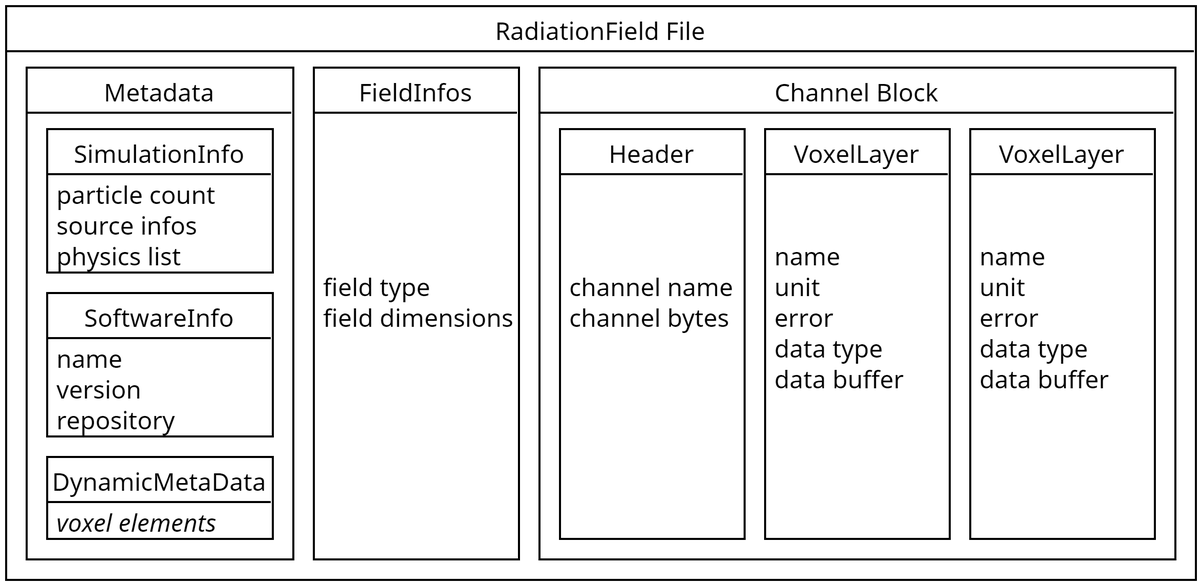
RadFiled3D is the piece that actually matters for ML practitioners. The library provides an API for a structured, binary file format that can store all relevant information from a three dimensional radiation field calculated by algorithms like Monte-Carlo radiation transport simulations, which is useful when processing a huge amount of radiation field files like when training a neural network, and it ships with a Python interface and a PyTorch integration.
The internal layout is hierarchical:
- Fields are partitioned into channels (VoxelGridBuffer or PolarSegmentsBuffer), all channels share the same size and resolution, and a channel is again partitioned into layers.
- Each layer holds voxel data typed as float, double, uint32, uint64, glm::vec2/3/4, or an N-D histogram (list of floats).
- Each layer carries a unit string and a per-voxel statistical uncertainty.
Installation is the standard pip install route: thanks to the Python API and PyTorch integration, RadFiled3D is suited for machine learning use and can be directly installed from PyPI using pip. The heavier simulator is a CMake C++ build.
Validating against real measurements
Simulators for medical dose are only useful if they match reality. The authors validated RadField3D against a series of measurements conducted in accordance with ISO 4037-1, performed at three distinct distances around two different phantoms using the H-100 radiation quality to maximize detector response in the scattered radiation field at PTB's calibration X-ray facility. The team also implemented a statistical error estimator: an incremental variance evaluation applied to all energy bins of all measured photon fluences, so downstream ML code can weight or filter voxels by uncertainty.
Is it already being used?
Yes, by the same group. A follow-up paper trains lightweight neural networks on RadField3D-generated data. The authors present three variants of a lightweight, fully connected artificial neural network suited for interactive estimation of three-dimensional, spatially resolved volumes of scattered radiation fields, trained on three synthetically generated datasets of increasing complexity produced with RadField3D, using the torso of a male Alderson RANDO phantom as the primary scatter object. The training code lives at Centrasis/radfield3d-nn.
Where it fits, and where it does not
This is a research substrate, not a clinical planning system. It is useful if you want to:
- Train neural surrogates that approximate Monte-Carlo dose maps in milliseconds for VR training, occupational dosimetry, or interventional guidance.
- Benchmark simulation-acceleration methods against a validated ground truth with published uncertainty per voxel.
- Study how to compress or represent 3D fields with mixed scalar, vector and histogram data.
The current scope is narrow by design. The application simulates a concentric x-ray beam that can be rotated on a sphere with a certain radius around the center of the irradiated scene, which fits interventional radiology and calibration geometries but is not a general treatment planning engine. It targets photons in the medical energy range with a fixed voxel geometry, so anything involving heavy ions, complex time-varying sources, or sub-centimeter resolution will need extension. And, of course, the surrogate networks built on top of it inherit all the usual generalization risks of learned physics approximators, which is why the ground-truth generator and its uncertainty tracking matter in the first place.