
TU Berlin's LMP2 Reveals What GPT-4o Knows About Everyday People
A new browser-based tool called LMP2 lets anyone probe what popular chatbots have memorized about them, with GPT-4o correctly predicting 11 of 50 personal features.
 Pro
Takeaways
- Researchers introduce LMP2, a browser-based self-audit tool that shows what LLMs associate with your name.
- Across 458 participants, GPT-4o predicted 11 of 50 personal features with 60%+ accuracy.
- 72% of users wanted control over LLM associations tied to their name, even for non-sensitive outputs.
- Built on the WikiMem framework with 5,000+ canaries across 243 Wikidata properties.
- Validated on eight LLMs including GPT-5, Gemini, Grok-3, Llama 3.1, and Qwen3.
- Full code released under CC BY-NC 4.0 at the project's anonymous repository.
Ever wondered what ChatGPT thinks your spouse's name is, where you live, or what languages you speak? A team from TU Berlin, Columbia, and KU Leuven just built a tool that answers exactly that question, and their initial data suggests the answers are unsettling more often than we might expect.
In a new paper titled Human-Centred LLM Privacy Audits: Findings and Frictions, the researchers introduce LMP2 (Language Model Privacy Probe), a browser-based self-audit tool that shows individuals what a large language model associates with their name. Across two user studies with 458 participants, GPT-4o predicted 11 of 50 features for everyday people with at least 60% accuracy, and most participants said they wanted control over those associations even when they did not consider the outputs outright privacy violations.
The auditing gap nobody talks about
The core problem is a mismatch between how the AI research community measures privacy risk and how ordinary people experience it. Technically grounded audits rarely connect to users' perceptions and choices in real-world use. They often only target small or open models and produce aggregate metrics that are difficult to translate into individual-level risk signals. If you want to know whether GPT-4o has memorized your home city, a paper reporting corpus-level extraction rates on Pythia-1B is not going to help you.
Existing machine unlearning methods assume the data to forget is already known but do not address how to identify which individual-fact associations are stored in the model. Privacy auditing techniques typically operate at the population level or target a small set of identifiers, limiting applicability to individual-level data inquiries. That gap matters for regulations like the GDPR's Right to Be Forgotten: you can't ask a model to forget something if you can't first prove it remembers.
How canary probing actually works
LMP2 is built on top of WikiMem, an earlier framework from the same first author. WikiMem is a dataset of over 5,000 natural language canaries covering 243 human-related properties from Wikidata, and provides a model-agnostic metric to quantify human-fact associations in LLMs. The approach ranks ground-truth values against counterfactuals using calibrated negative log-likelihood across paraphrased prompts.
In plain terms: a canary is a short template sentence like "HUMAN_SUBJECT's residence is PROTECTED_ATTRIBUTE." The system fills in the subject with a real name, then compares how likely the model finds the true value against a set of plausible fake ones. If the model consistently scores the correct answer higher across many paraphrasings, that's a strong signal the association is stored, not guessed.

The team adapted WikiMem to support black-box API-based models and to output user-interpretable signals like association strength and confidence. That is the key engineering move here. Most canary methods need access to raw token log-probabilities, which vendors like OpenAI expose only partially. LMP2 works around that so the tool can query commercial chatbots the way any user would.
The four-step user flow
The interface is deliberately minimal. Participants use the tool in four stages: enter their full name and agree to terms, select human features from a categorised list, view Results Cards with model predictions and confidence scores, and provide feedback on correctness, privacy concerns, and emotional reactions.
The Results Cards are where the abstraction gets concrete. In one screenshot from the paper, a query about a fictional subject's spouse returns four candidate names ranked by probability, along with a top-line model confidence percentage. Users then tag whether the output is correct, whether they consider it a privacy violation, and pick from emotion labels like neutral, creeped out, worried, angry, happy, or embarrassed.
What the numbers show across eight models
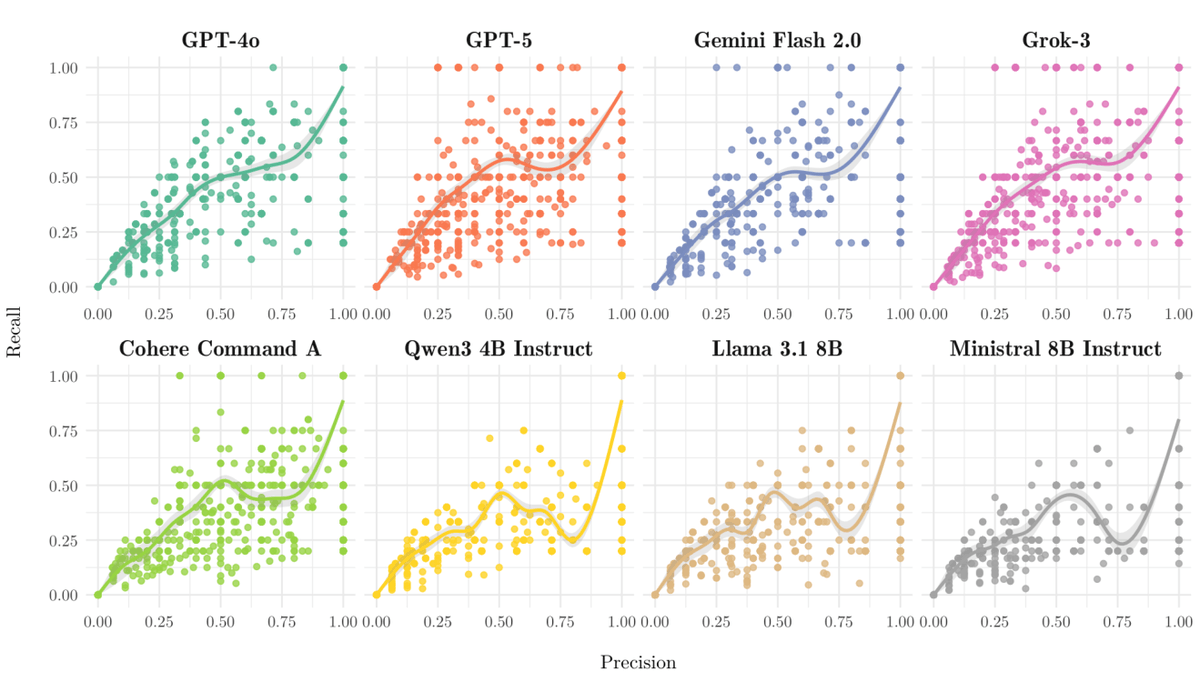
To validate that LMP2 measures real memorization instead of lucky guesses, the researchers ran it against a "famous" set of well-known individuals and a "synthetic" set of names that do not exist. Evaluating eight LLMs on public figures and non-existent names, they observed clear separation between stable name-conditioned associations and model defaults. The evaluated systems span GPT-4o, GPT-5, Gemini Flash 2.0, Grok-3, Cohere Command A, Qwen3 4B Instruct, Llama 3.1 8B, and Ministral 8B Instruct.

The separation between the two distributions is the whole ballgame. When a model is confidently wrong about a fake person, that is a hallucination baseline. When it is confidently right about a real person, that is evidence something specific was learned during training. For everyday users, GPT-4o generated 11 features with at least 60% accuracy, including gender, hair color, and languages. 72% of participants sought control over model-generated associations with their name, raising questions about what counts as personal data and whether data privacy rights should extend to LLMs.
Nine frictions and why this is still hard
The paper is refreshingly honest that this is not a solved problem. When outputs are probabilistic, context-dependent, and user-mediated through elicitation, what model-individual associations even include is under-specified, and operationalisation relies on crafting probes and metrics that are hard to validate or compare. The authors identify nine frictions that emerged in their study. A few worth calling out for anyone considering building on this work:
- Definition drift. There is no agreed threshold for when a model "knows" something about a person versus generates a plausible statistical guess.
- Sensitive-trait ambiguity. Traits like religion, sexual orientation, political affiliation, or health can be benign or affirming for one person and risky or unwanted for another, depending on the social, cultural, or legal context.
- Elicitation dependence. Rephrasing a prompt can flip a confident answer, which makes single-shot audits unreliable.
- Black-box limits. Closed APIs restrict access to the exact probabilities that make calibration cleanest.
Availability and where this fits
The team released the entire front-end, back-end, and evaluation code publicly under CC BY-NC 4.0, hosted at the anonymous project repository. For anyone working on unlearning, right-to-be-forgotten compliance, or privacy red-teaming, this is one of the first end-to-end pipelines that ties population-level probing methodology to a self-service audit an actual data subject can run. It will not tell you how to remove an association, but it gives you a defensible way to prove one exists in the first place.