
TU Berlin's CMPPP Detector Finally Tells Self-Driving Cars What Isn't There
A new detector built on spatial statistics gives autonomous systems a calibrated probability that a region truly contains no obstacles.
 Pro
Takeaways
- New detector CMPPP models bounding boxes as a marked Poisson point process for calibrated empty-space probabilities.
- Loss derived from a Radon-Nikodym derivative gives an L1 box term plus cross-entropy for free.
- ECE on Cityscapes drops from 0.22 (semantic segmentation) to 0.003, about 100x better calibrated.
- Faster R-CNN and CenterNet log ECE of 0.9915 on the same void-confidence task, essentially uncalibrated.
- mAP trails Faster R-CNN by 5-10 points but matches its runtime and improves with ensembling.
- Code released at github.com/CMPPP-CV/cmpppnet, tested on Cityscapes, VisDrone, and TiROD.
Object detectors are great at pointing at things. They are terrible at telling you what is not there. A YOLO or Faster R-CNN model will happily draw boxes around every car and pedestrian it sees, but it has no principled answer to the question a self-driving car actually needs to ask: what is the probability that the strip of asphalt three meters ahead is genuinely empty? A new paper from researchers at TU Berlin and Heinrich-Heine-University Düsseldorf reframes object detection as a problem in spatial statistics to fix exactly that gap.
The work, Towards Reliable Detection of Empty Space, introduces the Conditional Marked Poisson Point Process (CMPPP) detector. The authors position it as the first object detection approach that is fully probabilistically founded and capable of assigning calibrated void/occupation probabilities to arbitrary regions in space. Code is available on GitHub.
The silence problem in modern detectors
Standard detectors output an objectness score for boxes they draw, and semantic segmentation networks output per-pixel class probabilities. Both look like probabilities, but neither is designed to answer questions about empty regions. Object detectors do not provide explicit uncertainty assessment for areas outside their own predictions, meaning the model never makes a probability assessment of whether an area without detected objects is truly free of obstacles. Absence of a bounding box is treated as certainty of emptiness, which is exactly the failure mode you do not want in a trajectory planner.
The naive workaround, multiplying per-pixel "road" probabilities from a semantic segmentation model across a test region, collapses because pixels are assumed conditionally independent. A pixel classifier's void confidence for a doubled area behaves roughly like the original confidence squared, giving exponential scaling with region size and making cross-scale re-calibration essentially impossible. Even after temperature or Platt scaling, the calibration error for standard detectors remains dismal.
Bounding boxes as a marked point process
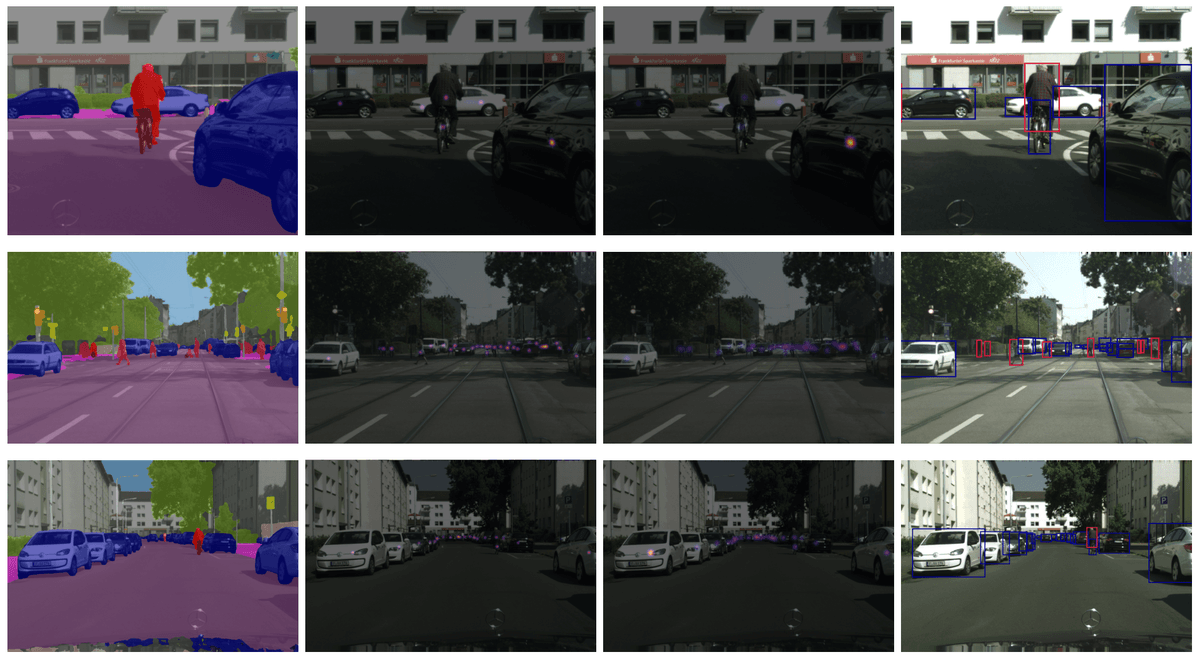
The trick is to stop thinking of detection as pixel classification and start thinking of it as spatial statistics. In a marked point process, random events occur at points in space, and each point carries a "mark" describing its properties. Ecologists use them to model tree locations plus tree species and size. Astronomers use them for galaxy clusters. The authors treat each object as a center point in the image plane, with the mark encoding width, height, and class label.
The intensity function λ(ξ|I) tells you the expected density of object centers at location ξ given input image I. Once you integrate that intensity over any test region, the Poisson distribution gives you a real, calibrated probability that zero objects sit in that region. That is the number a planner actually wants.

How the training works
Because the space of point configurations is infinite-dimensional, you cannot just write down a density with respect to Lebesgue measure and take its log. The authors get around this using a Radon-Nikodym derivative with respect to a homogeneous Poisson process as a reference measure. The resulting negative log-likelihood decomposes into three familiar-looking terms:
- An integral of the intensity over the image, minus the intensity summed at each ground-truth center, acting as a "distributed objectness" loss.
- An L1 regression term for width and height, which falls out naturally if you model the box dimensions with a Laplace distribution.
- A cross-entropy classification term from a softmax over classes.
The neural network is a standard semantic segmentation architecture with 1 + 2 + |C| output channels for the intensity logit, box dimensions, and class logits respectively. The authors evaluate DeepLabv3+ with a ResNet-50 backbone, an FCN with HRNet backbone, and SegFormer-B5. A neat side effect of the derivation: the model has zero training hyperparameters and only a single inference hyperparameter, the crop patch size used to suppress duplicate peaks in the intensity map (an ablation shows it is robust from roughly 24 to 42 pixels).
The calibration numbers
Calibration is measured with Expected Calibration Error (ECE), the gap between predicted confidence and observed frequency. The team samples random test boxes of fixed area s from each image and asks each model to predict the probability the box is empty.
The gap between CMPPP and the baselines is not subtle. On Cityscapes with DeepLabv3+ and box area s=1000, semantic segmentation logs an ECE of 0.2245 while the PPP variant hits 0.0029, roughly two orders of magnitude better. For Faster R-CNN and CenterNet, treating superpixel objectness as a void confidence yields ECE values of 0.9915 at the same box size, essentially useless. Even after Platt scaling the baselines to that specific box size, CMPPP stays at least an order of magnitude better calibrated.
What you give up on raw accuracy
This is not a free lunch on detection accuracy. On Cityscapes person and vehicle classes, DeepLabv3+ CMPPP hits 49.43 mAP, HRNet 55.49, and SegFormer 51.04. Faster R-CNN and CenterNet reach 59.32 and 57.08 respectively. The authors are upfront that their model has not gone through years of architectural tuning, and a 5-seed ensemble already lifts DeepLabv3+ mAP to 54.29 without hurting calibration. Runtime is competitive as well: the DeepLabv3+ CMPPP model runs at 16.2 FPS versus 29.4 FPS for a comparable Faster R-CNN, while the HRNet variant matches a ResNeSt50 Faster R-CNN at around 15 FPS.
Where this matters
The obvious application is any system that has to plan through space it cannot fully perceive:
- Autonomous driving. A planner can query any candidate trajectory rectangle and get a calibrated collision-risk number instead of trusting the absence of a box.
- Indoor robotics. The team validates on TiROD, a frog-perspective indoor lab and garden dataset with 13 semantic classes.
- Drone landing. On VisDrone, the same framework provides calibrated probabilities for whether a candidate landing rectangle is clear.
The known weaknesses are honest and specific. The square patch assumption during peak extraction struggles with very large foreground objects whose intensity is spread over a wide area, suggesting depth-aware patch sizing. And the Poisson model treats events as non-interacting, so it does not encode the physical constraint that two cars cannot occupy the same pixel. Neither of those is fatal, and both are natural extensions.
The broader shift here is worth noting. Modern detection pipelines have been shaped by heuristics like anchor boxes, non-maximum suppression, and objectness scores. CMPPP replaces that stack with a single likelihood derived from spatial statistics, and in doing so recovers something practical: a number you can actually trust when the model tells you a region is empty.