
Tsinghua Study Finds Shared AI Tutors Beat Individual Ones for Student Collaboration
A classroom study finds that whether groups share one AI mentor or get one each drastically changes how students collaborate, regulate, and lean on teachers.
 Pro
Takeaways
- Tsinghua-led classroom study of shared vs individual GenAI mentors with 38 eighth-graders and identical GPT-5.0 backend.
- Shared AI groups showed 23.6% analysis-oriented cognition vs 12.8% in individual-AI groups (p = .049).
- Individual-AI groups had 61% off-task turns vs 36% in shared-AI groups (p = .043).
- Student-teacher interaction was near zero with shared AI, but 3.9% with individual AI (p = .005).
- Analyses used lag sequential analysis, ordered network analysis, and first-order Markov transition modeling on multi-layer discourse coding.
- Authors argue AI access structure is a pedagogical design variable, not just a technical choice; no code or dataset released.
A new Tsinghua-led study puts a sharp empirical point on something a lot of teachers have suspected: giving each student their own generative AI tutor is not the same pedagogical event as giving a group one shared AI to work with, even when the underlying model and prompts are identical. The team ran a controlled classroom experiment with two eighth-grade classes and found that the access configuration alone reshaped how kids talked to each other, how often the teacher had to intervene, and how much time drifted off task.
The setup nobody had actually measured
Most research on generative AI in classrooms has focused on prompt quality, feedback style, or model capabilities. Prior work has largely examined AI's functional affordances but seldom considered access configuration itself as a structural factor shaping participation and coordination in group-based collaborative learning settings. That gap matters because computer-supported collaborative learning research has long shown that how a tool is distributed inside a group changes the interaction patterns around it.
The authors ran a clean comparison. Two Grade 8 classes (N = 38, ages 13-14) participated, organized into small groups of three to four members. The classes were comparable in prior achievement, used the same teacher, the same creative problem-solving task on designing a Smart Garden, and the same GPT-5.0-based mentor system. The only variable was configuration:
- Condition A (shared): one AI instance per group, on a centrally positioned device
- Condition B (individual): each student got their own AI on a personal laptop or tablet
Same model, very different classrooms
The researchers coded every turn of interaction across eight dimensions (student orientation, cognition, behavior, affect, shared regulation, AI function, teacher regulation, teacher behavior) and then ran lag sequential analysis, ordered network analysis, and first-order Markov transition models to look at how those turns chained together. Lag sequential analysis flags statistically reliable next-move transitions, and ordered network analysis maps which cognitive states tend to co-occur inside a sliding conversation window.

The gaps between conditions were large and statistically meaningful. Condition B, with individual AI agents, generated substantially more student-AI turns, while Condition A produced a higher proportion of student-student exchanges. Student-teacher interaction was nearly absent in Condition A but occurred more frequently in Condition B (p = .005).
Off-task behavior followed the same split. Condition B had a significantly higher proportion of non-task-related turns (61.36% vs 35.66%, p = .043), while Condition A produced a significantly greater proportion of implementation and analysis turns (23.63% vs 12.81%, p = .049). Giving every student their own AI, in other words, correlated with more chatter, more drift, and more calls for the teacher.
Two regulatory regimes
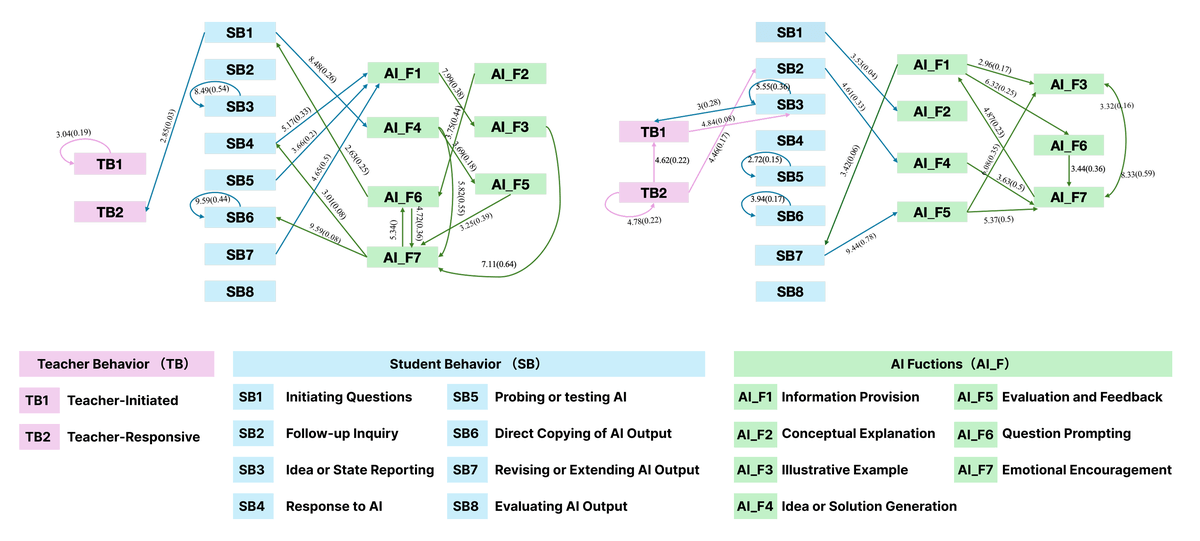
The sequence analyses show why. In the shared-AI groups, students repeatedly directed responses, probes, and revisions back to a common AI output, which acted as an anchor the whole group referenced. Multiple student moves converged on shared AI functions, and AI prompts redistributed attention back to the group.
In the individual-AI groups, the pattern was dyadic and iterative. Chains such as information provision to revising AI output to evaluation formed multi-step loops inside single student-AI pairings, producing localized sequential exchanges rather than group convergence. When groups did finally align, it was often reactive: students working to reconcile inconsistencies across the different AI responses their classmates had received, rather than co-constructing meaning from a shared reference.
What this means in practice
The headline finding is that AI configuration is a pedagogical design choice, not a procurement decision. A few concrete takeaways for anyone deploying LLM tutors in classroom or team settings:
- Shared AI supports convergence. Better for tasks that need collective sense-making, aligned goals, and a stable group climate.
- Individual AI supports divergence. Better for parallel ideation and exploration, but expect fragmented follow-through.
- Teacher workload does not go down with personalization. It shifts. Individualized AI may increase coordination demands by multiplying epistemic entry points, requiring teachers to manage heterogeneity across parallel reasoning paths rather than a shared misunderstanding.
- Hybrid staging is worth exploring. The authors suggest phased transitions from shared to individualized AI to balance anchoring with exploratory breadth.
Caveats before you generalize
This is a small, single-site study: 38 students in one Chinese public middle school, one instructional context, and a relatively short intervention window. The team did not directly measure teacher workload or student cognitive load, and the coding scheme infers regulation from observable talk rather than from what is actually happening in students' heads. There is also no released code, model, or dataset - this is an empirical HCI paper, not a system release, so the contribution is a methodological framework (the multi-layer coding plus LSA/ONA/Markov pipeline) and a set of findings, not a tool you can pull from GitHub.
Still, the process-level evidence here is unusually rigorous for the AI-in-classroom literature, and it lands on a claim worth internalizing before rolling ChatGPT-style assistants out to every desk: how the AI is distributed inside a group can matter as much as what the AI actually says.