
Tsinghua's Spatial-TTT Beats GPT-5 on 3D Reasoning With a 2B Model
Tsinghua and Tencent Hunyuan researchers built a 2B model that beats GPT-5 on spatial video reasoning by updating weights during inference.
 Pro
Takeaways
- Spatial-TTT is a 2B model that updates its own weights during inference to remember 3D scenes across long video streams.
- Beats GPT-5, Gemini-3-Pro, and Qwen3-VL-8B on VSI-Bench with a score of 64.4 average.
- Hybrid architecture interleaves TTT layers with self-attention anchors at a 3:1 ratio, preserving pretrained Qwen3-VL knowledge.
- Uses depthwise 3D convolutions on Q/K/V so fast weights learn spatiotemporal context rather than isolated tokens.
- Achieves 40%+ memory and FLOPs reduction versus Qwen3-VL-2B at 1024 frames thanks to linear-complexity attention.
- Code, weights, and dataset available at THU-SI/Spatial-TTT and on Hugging Face.
A team from Tsinghua University, Tencent Hunyuan, and NTU has released Spatial-TTT, a compact 2B multimodal model that continuously rewrites part of its own weights as it watches video, letting it reason about 3D scenes across thousands of frames. On the standard VSI-Bench spatial reasoning suite, it outperforms GPT-5, Gemini-3-Pro, and Grok-4 while using a fraction of their compute.
The core idea borrows from a growing research thread called test-time training (TTT), where a small subset of parameters, called fast weights, are updated on the fly during inference. Instead of using fixed parameters for inference, Spatial-TTT maintains adaptive fast weights that are updated online, acting as a compact non-linear memory to accumulate 3D evidence from unbounded video streams. Think of it as giving the model a scratchpad it can actively rewrite as new frames come in, rather than stuffing everything into an ever-growing context window.
Why long spatial video breaks current models
Spatial reasoning from video is a stress test that modern multimodal LLMs quietly fail. Recent advances in Multimodal Large Language Models have demonstrated impressive results in 2D visual understanding, however, their performance degrades significantly on tasks requiring spatial understanding, primarily due to the inherent lack of 3D geometric priors, as these models are predominantly trained on 2D semantic-level image-text pairs without the supervision of spatial structure.
The workarounds so far have been ugly. Existing spatial-aware approaches remain confined to single images or short video clips (i.e., 16 or 32 images) and cannot scale to the long-horizon video streams encountered in practical scenarios, where spatial cues are scattered across thousands of frames and must be progressively aggregated as the observer navigates through the environment. Naively extending the input sequence leads to prohibitive computational costs due to quadratic attention complexity, while aggressive temporal subsampling inevitably discards fine-grained spatial details critical for accurate 3D reasoning.
In other words: you either blow up your GPU with a huge context, or you throw away the frames that contain the answer.

A hybrid architecture that keeps the pretrained brain intact
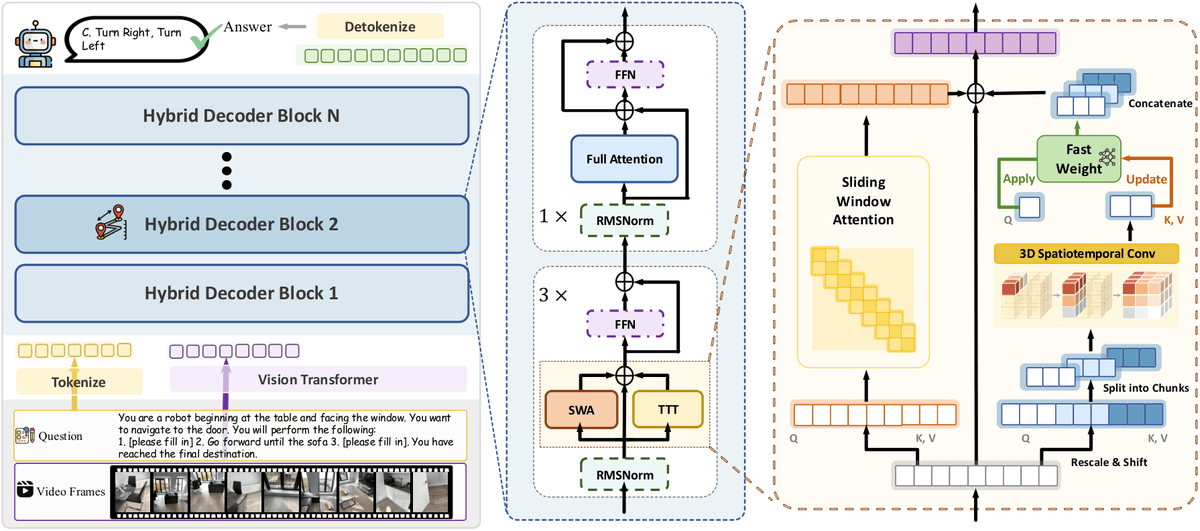
Spatial-TTT is initialized from Qwen3-VL-2B-Instruct and modified in three places. The team didn't want to nuke the pretrained model's semantics by replacing every attention layer, so they built a hybrid.
- The model employs a hybrid TTT architecture that interleaves TTT layers with self-attention layers at a 3:1 ratio. In a transformer with L decoder layers, 75% use TTT while the remaining 25% retain standard self-attention as anchor layers.
- The self-attention anchor layers preserve full-context reasoning and cross-modal alignment inherited from Qwen3-VL.
- The TTT layers do the heavy lifting for long video, compressing history into fast weights that grow sublinearly with input length.
Inside each TTT layer, two branches run in parallel and share Q/K/V projections: a sliding-window attention branch that handles local frame-to-frame continuity, and the TTT branch that performs large-chunk fast-weight updates. Conventional implementations use small chunks (e.g., 16 or 64 tokens) for frequent fast-weight updates. This works poorly for streaming visual observations: small chunks lead to low GPU utilization due to poor parallelism, and chunk boundaries artificially break the spatial structure of video frames. Spatial-TTT uses a chunk size of 2648 tokens, roughly aligned to multiple video frames.
Teaching fast weights to think in 3D
The most interesting architectural piece is what the authors call the spatial-predictive mechanism. Standard TTT computes queries, keys, and values via point-wise linear projections, which treat each visual token as if it existed in isolation. That is a bad prior for video where neighboring tokens describe the same slice of 3D space.
Their fix: before the TTT update, reshape visual tokens into a spatiotemporal grid and pass Q, K, V through a lightweight depthwise 3D convolution with a 3x3x3 kernel. The kernel is Dirac-initialized so training starts as an identity, then learns to blend local neighborhoods. Powered by the spatial-predictive mechanism, fast weights no longer learn prediction between isolated tokens, but rather predictive mapping between spatial-temporal contexts. Updates use the Muon optimizer with L2-normalized weights for stability.
Dense scene walkthroughs beat sparse QA
Architecture is only half the story. TTT is essentially learning-to-learn: the outer training loop has to teach the fast weights how to update themselves so that useful spatial information survives across chunks. Traditional spatial QA datasets are terrible signals for this. A typical spatial QA task queries relations between two objects in a small region of the scene (often answerable from only a few frames), and the target answers are often short (e.g., a multiple-choice option or an integer). Such target answers only supervise a small subset of the underlying 3D scene states, providing weak and low-coverage gradient signals for learning fast-weight update dynamics.
To fix this, the team built a dense scene-description dataset from SceneVerse annotations. Roughly 16K examples pair a scene video with a long, structured walkthrough covering scene type, object counts, and pairwise spatial relations. Training then proceeds in two stages:
- Pretrain on the 16K dense walkthroughs, with the sliding window annealed from 5600 down to the chunk size of 2648, gradually forcing TTT layers to take over cross-chunk memory.
- Fine-tune on ~3M spatial VQA samples (VSI-590K, VLM-3R, InternSpatial, ViCA, plus 0.5M self-collected ScanNet data) with 64 to 128 frames per sequence.
Benchmark numbers that a 2B model shouldn't hit
On VSI-Bench, a benchmark of ~5000 QA pairs over 288 real-world indoor videos from ScanNet, ScanNet++, and ARKitScenes, Spatial-TTT-2B posts an average of 64.4 versus 57.9 for Qwen3-VL-8B, 60.6 for VST-7B-SFT, and 56.0 for Gemini-3-Pro. It leads on Relative Direction (73.0), Appearance Order (77.0), and Absolute Distance (47.8), suggesting the fast-weight memory really is retaining geometric structure across frames.
The MindCube-Tiny results are more dramatic. Spatial-TTT achieves 76.2 ACC score on MindCube-Tiny, outperforming all baseline models. Relative to the strongest proprietary baseline (Gemini-3-pro; 63.9% average) and the strongest open-source spatial model (MindCube-3B; 51.7% average), Spatial-TTT improves by 12.3 and 24.5 percentage points, respectively.
The streaming benchmarks are where the design pays off. VSI-SUPER-Count asks models to count objects across egocentric videos up to two hours long. Qwen3-VL-2B scores 0 at every length past 10 minutes because it runs out of memory. Cambrian-S-7B does the same. Spatial-TTT-2B holds 31.8, 45.6, 36.2, and 38.4 across the 10 to 120 minute buckets.
The compute story
Because TTT gives linear-complexity attention, the efficiency curve is friendly at long context. Measured at 352x480 resolution:
| Frames | Qwen3-VL-2B mem / TFLOPs | Spatial-MLLM-4B | Spatial-TTT-2B mem / TFLOPs |
|---|---|---|---|
| 128 | 6.2 GB / 75.9 | 25.9 GB / 1698.8 | 6.2 GB / 74.3 |
| 256 | 8.3 GB / 179.9 | 41.8 GB / 6002.1 | 7.0 GB / 156.2 |
| 512 | 12.6 GB / 473.9 | OOM | 8.4 GB / 341.9 |
| 1024 | 21.2 GB / 1403.1 | OOM | 11.9 GB / 799.4 |
At 1024 frames Spatial-TTT uses roughly 44% less memory and 43% fewer FLOPs than the Qwen3-VL-2B baseline it was built from, and the gap widens as videos grow longer.
Where it fits and where it doesn't
The sweet spot is any application that needs persistent spatial memory over long egocentric or navigation-style video: embodied robots, AR headsets that need to remember the layout of a room, drone survey analysis, and autonomous driving perception stacks that need to track scene structure over minutes rather than seconds.
It is not a general-purpose VLM upgrade. The training data is heavily indoor-scene focused (ScanNet, ARKitScenes, SceneVerse), so outdoor and non-navigation scenarios are unproven. Ablations show the model is sensitive to its design choices: dropping the hybrid architecture and using pure TTT collapses the VSI-Bench average from 64.4 to 53.9, and removing dense scene supervision drops it to 61.3. Route Plan (47.4) also remains the weakest task, hinting that complex multi-step spatial planning still isn't solved.
Weights and code
The team released everything on the official GitHub repository, with model checkpoints and the dense scene-description dataset on the Hugging Face collection. The arXiv paper covers the algorithm pseudocode and full training recipe. Given that the base model is Qwen3-VL-2B, adapting the approach to larger backbones is a natural next step, and the linear scaling means the compute story only gets more attractive at scale.