
Tsinghua's RoboStereo Teaches Robots to Rehearse in 3D, Boosting Success by 97%
A dual-tower diffusion transformer imagines physically consistent robot rollouts, then uses them to refine policies without touching real hardware.
 Pro
Takeaways
- RoboStereo is a dual-tower 4D world model that jointly generates RGB video and XYZ pointmaps with bidirectional cross-attention.
- Both towers are initialized from Cosmos 2.5 and trained on 20k Bridge V2 kitchen manipulation videos.
- A unified framework adds test-time verification (TTPA), imitation via LPIPS rewards (IEPL), and demo-free exploration (OEPL).
- On MimicGen tasks the combined framework lifts OpenVLA-OFT from 27.7% to 54.0% mean success (>97% relative gain).
- Real-robot desktop-clearing tests doubled success rates from 30% to 65% with only 30 demos.
- Generation runs at 1.50 FPS on H200s, outperforming WoW, IRASim, and RoboMaster in speed and physics adherence.
Training robots in the real world is slow, expensive, and occasionally dangerous. A gripper that misjudges a peg by two millimeters can jam the mechanism, and every failed attempt eats real time on real hardware. World models, which learn to predict what a scene will look like after a robot acts, offer a way out by letting policies rehearse in imagination. The catch is that most video-based world models hallucinate physics: objects teleport, scales drift, and hands pass through surfaces. A new paper from Tsinghua University and X Square Robot introduces RoboStereo, a 4D world model that pairs an RGB video generator with a 3D geometry generator so tightly that they keep each other honest, and then uses those imagined rollouts to improve Vision-Language-Action (VLA) policies by more than 97% on fine-grained manipulation tasks.
Why current world models keep breaking physics
Standard video diffusion models learn statistical regularities from pixels alone, so they produce visually plausible frames without any explicit notion of where objects actually are in 3D space. This frequently leads to geometric hallucinations, including object teleportation or structural morphing, which impede long-horizon manipulation planning. For a robot planner that trusts these predictions, that is a fatal flaw: an imagined success might correspond to a real-world collision.
The other gap is on the optimization side. Prior work has explored using world models for training or for inference-time checking, but not both together. RoboStereo tries to close both gaps in one system.
Two towers that argue with each other
The core architecture is a symmetric dual-tower Diffusion Transformer. One tower generates RGB frames; the other generates XYZ pointmaps, which are 3-channel images where each pixel encodes a world-space 3D coordinate. Both towers utilize the Cosmos 2.5 backbone, sharing identical latent dimensions to enable homogeneous Video Autoencoder encoding without additional alignment layers.
The interesting bit is how they communicate. Each DiT features paired cross-attention layers that facilitate bidirectional information flow: the video branch queries geometric constraints from the pointmap tower, while the pointmap branch retrieves semantic context from the video tower. If the RGB branch wants to move a cup, the pointmap branch pushes back with the actual 3D constraints of the scene. If the pointmap branch is unsure about an edge, it borrows semantic cues from the pixels. A 4D Gaussian Splatting head then renders the paired output into photorealistic frames from arbitrary viewpoints.

Actions are injected through a dual-path timestep embedding. A 7-dimensional action vector (gripper translation, rotation, and width) goes through two MLPs: one fuses with the diffusion timestep to form a base conditioning latent, and the other predicts modulation offsets that are added to the AdaLN scale, shift, and residual coefficients. This gives frame-level control over the trajectory instead of a single global condition.
Training in two stages
The team constructs a 4D dataset from Bridge V2, comprising approximately 20,000 third-person videos capturing robotic arms performing diverse kitchen tasks at 320x256 resolution and 5 FPS. Depth is estimated with DepthAnything V3 and back-projected into XYZ pointmaps that stay pixel-aligned with the RGB frames.
- Stage 1 (independent): Each tower is initialized from Cosmos 2.5 and fine-tuned on its own modality with a rectified flow objective.
- Stage 2 (joint): FFN layers are frozen to preserve pretrained features, and only self-attention and cross-attention modules are trained, using paired latents with independent noise but a shared timestep so both branches denoise in sync.
The final loss weights the video branch heavily (0.85) and the pointmap branch lightly (0.15), which is enough for the geometry stream to keep the video branch grounded without dominating it.
Three ways to use imagined rollouts
Where the paper gets ambitious is in stitching together a full policy optimization stack on top of the world model. All three components share the same imagined-rollout backbone.
- Test-Time Policy Augmentation (TTPA). Before executing an action chunk, the policy hands it to RoboStereo, which simulates the outcome. A video understanding model scores whether the imagined result matches the goal. If confidence is below a threshold, the policy replans instead of moving.
- Imitative-Evolutionary Policy Learning (IEPL). RoboStereo rolls out both expert and policy actions from the same initial state and renders them from identical viewpoints. The reward is the negative LPIPS perceptual distance between the two imagined videos, giving a dense, differentiable imitation signal. GRPO then updates the policy using group-normalized advantages.
- Open-Exploration Policy Learning (OEPL). When there are no expert demonstrations, a video discriminator scores overlapping clips of the imagined trajectory and weights later clips more heavily, so the policy is rewarded for finishing the task rather than starting well and drifting.

The numbers
On the WorldArena benchmark, RoboStereo is compared against eight embodied world models including GigaWorld-0, Genie Envisioner, Cosmos 2.5, RoboMaster, WoW, and IRASim. It ranks first or second on most of the 16 metrics and takes the top spot across every metric in Physics Adherence and 3D Accuracy. Depth accuracy hits 0.881 versus 0.862 for the next best (IRASim), and instruction following reaches 0.723 versus 0.640.
Policy optimization is evaluated on three MimicGen tasks: Coffee_D0, StackThree_D0, and Square_D0, with OpenVLA-OFT as the base policy fine-tuned on 300 expert demos per task. All methods share an identical budget of 128 trajectories.
| Method | Coffee | StackThree | Square | Mean |
|---|---|---|---|---|
| Base policy | 32.6 | 30.2 | 20.2 | 27.7 |
| DPO (offline) | 32.6 | 38.2 | 23.3 | 31.4 |
| GRPO (online, binary reward) | 29.8 | 35.1 | 22.7 | 29.2 |
| TTPA | 46.7 | 46.9 | 36.2 | 43.3 |
| IEPL | 47.8 | 44.1 | 37.4 | 43.1 |
| OEPL | 53.4 | 50.8 | 39.3 | 47.8 |
| Combined | 59.8 | 55.7 | 46.5 | 54.0 |
Under the same budget, plain online GRPO with binary success rewards actually hurts the base policy slightly, which matches the intuition that sparse rewards on 128 rollouts are too thin to move a large VLA. IEPL's dense perceptual reward and OEPL's temporally weighted discriminator give the optimizer something to grip on.
Real hardware, not just simulation
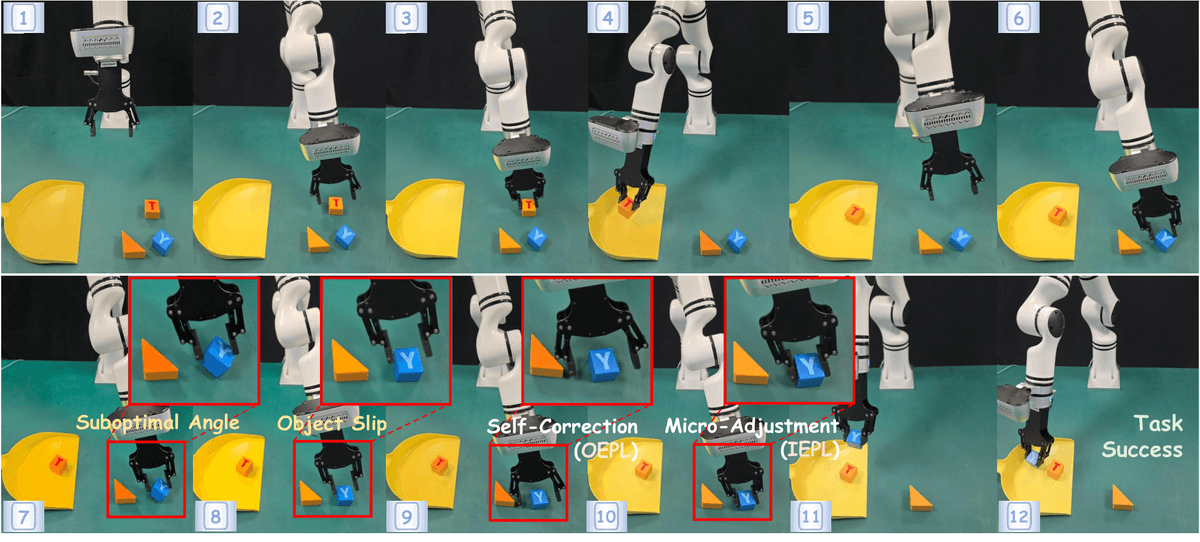
The authors also tested this on a Realman robotic arm doing a desktop-clearing task with a distractor prism. With only 30 real demonstrations for domain alignment, the imitation-learning baseline reached a 30% success rate (6/20 trials), while jointly optimizing with IEPL and OEPL doubled that to 65% (13/20). The failure modes fixed by the imagined-rollout training are the interesting ones: when a grasp slipped, the base policy blindly continued transporting an empty gripper, while the optimized policy detected the slip and re-grasped autonomously.
Practical caveats
A few things to keep in mind before assuming this drops into any robot stack:
- Compute is nontrivial. Training used 16 NVIDIA H200 GPUs, and generation runs at about 0.7 seconds per frame, or roughly 1.50 FPS for the video tower alone. That is faster than the compared world models (WoW at 0.05 FPS, IRASim at 0.53 FPS) but still not real-time reactive control.
- Domain-specific fine-tuning is required. The world model was fine-tuned on Bridge V2 and then again on MimicGen data before optimization, and the real-robot experiment used 30 in-domain demos. This is a world-model-in-the-loop training accelerator, not a zero-shot planner.
- Wrist cameras were omitted in the simulation experiments, following prior protocols. Contact-rich tasks that rely on wrist views may need extended handling.
- The paper does not currently link a public code release or model weights. The arXiv HTML version and PDF describe architecture, algorithms, and hyperparameters in enough detail for reimplementation, but there is no announced repository yet.
The broader point RoboStereo makes is that world models become useful as training infrastructure precisely when their geometry stops lying. Once the imagined video is consistent enough that perceptual distances mean something, LPIPS becomes a dense reward and GRPO starts to work with tiny rollout budgets. That reframes video generation quality as a bottleneck for robot learning, not just for entertainment.