
Tsinghua's Prompt-SID Beats Supervised Denoising Without Ever Seeing Clean Images
Prompt-SID uses a latent diffusion model to generate structural prompts that guide self-supervised denoising, beating supervised baselines without needing clean training images
 Pro
Takeaways
- Prompt-SID is a self-supervised image denoiser that beats supervised baselines on 8 of 12 benchmark settings without any clean training images.
- A lightweight latent diffusion model (RG-Diff) generates a structural "prompt" vector from the original-scale noisy image, which guides the transformer denoiser.
- A scale replay mechanism bridges the resolution gap between downsampled training inputs and full-resolution inference, a key unsolved problem in prior work.
- On the SIDD real-world benchmark, it achieves 51.02 dB PSNR, outperforming all prior self-supervised methods including B2U and NBR2NBR.
- Validated on fluorescence microscopy (two-photon calcium imaging), where clean ground truth is rarely available, surpassing supervised baselines at 1 Hz and 30 Hz.
- Code is available at github.com/huaqlili/Prompt-SID; paper at arXiv 2502.06432.
Prompt-SID, a new self-supervised image denoising framework from Tsinghua University, was accepted at AAAI 2025 with a surprisingly bold result: it outperforms fully supervised methods on several benchmarks without ever seeing a clean ground-truth image during training. The trick is using a latent diffusion model not to generate the final output, but to generate a compact structural "prompt" that tells the denoiser what the image should look like before noise corrupted it.
The problem with not having clean data
Training a denoiser the traditional way requires paired images: one noisy, one clean. Many studies have concentrated on constructing supervised models utilizing paired datasets for image denoising, which proves to be expensive and time-consuming. This is especially painful in domains like biomedical imaging, where acquiring clean reference scans can be physically impossible or require damaging levels of radiation exposure.
Self-supervised methods sidestep this by learning from a single noisy image alone. But they come with their own tradeoff. Current self-supervised and unsupervised approaches typically rely on blind-spot networks or sub-image pairs sampling, resulting in pixel information loss and destruction of detailed structural information, thereby significantly constraining the efficacy of such methods.
To understand why, it helps to know what these two approaches actually do:
- Blind-spot networks (BSN): The model is deliberately prevented from seeing the center pixel of its receptive field during training, forcing it to predict that pixel from context. This avoids the trivial solution of copying input to output, but it means the network never directly processes every pixel. BSNs often sacrifice local detail and introduce pixel discontinuities due to spatial independence assumptions.
- Sub-image sampling (e.g., Neighbor2Neighbor): The noisy image is split into two downsampled sub-images that serve as noisy input/target pairs. This avoids needing clean data, but the downsampling throws away half the pixels and destroys fine structural details in the process.
Both approaches essentially trade pixel completeness for the ability to train without labels. Prompt-SID is designed to recover that lost information.
The core idea: a diffusion-generated structural prompt
Prompt-SID primarily addresses the semantic degradation and structural damage caused by the sampling processes of previous self-supervised methods. The key insight is to use the original full-resolution noisy image as a source of structural information, encode that structure into a compact vector, and inject it into the denoiser as a conditioning signal, or "prompt."

The system has two main components working in tandem:
- RG-Diff (Representation Generation Diffusion): A lightweight diffusion model that operates entirely in a compressed 1D vector space, not on full images. A pixel structure encoder (PSE) first compresses both the downsampled sub-image and the original-scale noisy image into structural vectors. RG-Diff then uses the sub-image vector as a condition to reconstruct the original-scale structural vector via reverse diffusion. Because it works in a tiny latent space, it runs fast and avoids the hallucination problems of full image-level diffusion.
- SPIformer (Structural Prompt Integrative Transformer): A Vision Transformer-based denoiser that receives the structural vector from RG-Diff through a Structural Attention Module (SAM). SAM fuses the structural prompt with intermediate feature maps using channel attention, effectively telling the denoiser which channels carry real structure versus noise.
The training objective combines three losses: a reconstruction loss between the denoised sub-image and a second sub-image target, a diffusion loss that pushes the generated structural vector toward the real one, and a scale consistency loss from the scale replay mechanism.
Bridging the resolution gap
There is a subtle but critical problem with training on downsampled sub-images and then running inference on full-resolution images: the model has never seen the full-resolution domain during training. Through the scale replay mechanism, the method effectively reduces the scale gap between subsampled and original scale images.
Here is how scale replay works in practice: after each training step on the downsampled sub-images, the model runs a gradient-free forward pass on the full-resolution noisy image. The denoised full-resolution output is then downsampled and compared against the sub-image targets. This forces the model to produce consistent results at both scales without creating an identity-mapping shortcut, since the loss is computed on the downsampled version of the full-res output rather than directly supervising it with the noisy input.

Beating supervised baselines without clean data
The results across three domains are strong. On synthetic Gaussian noise (σ=25) using the Kodak dataset, Prompt-SID scores 32.41 dB PSNR, compared to 32.27 dB for the previous best self-supervised method (B2U) and 32.43 dB for the fully supervised baseline. In other words, it nearly closes the gap to supervised performance with zero clean images.
Across twelve experimental settings spanning three datasets, the method outperformed supervised approaches in eight instances. On real-world smartphone camera noise using the SIDD benchmark, Prompt-SID achieved a 0.55 dB and 0.49 dB advantage on the SIDD validation and SIDD benchmark datasets respectively, relative to NBR2NBR.
The fluorescence imaging results are particularly notable for the biomedical community. On two-photon calcium imaging data at 1 Hz and 30 Hz scanning speeds, Prompt-SID surpasses the supervised baseline in SNR, which is unusual for a self-supervised method. The application of fluorescence imaging is often hindered by signal-to-noise ratio issues owing to inherent noise arising from various systemic and biophysical characteristics. Having a method that works without clean training data is directly relevant here, since clean fluorescence ground truth is rarely available.
What the ablation reveals
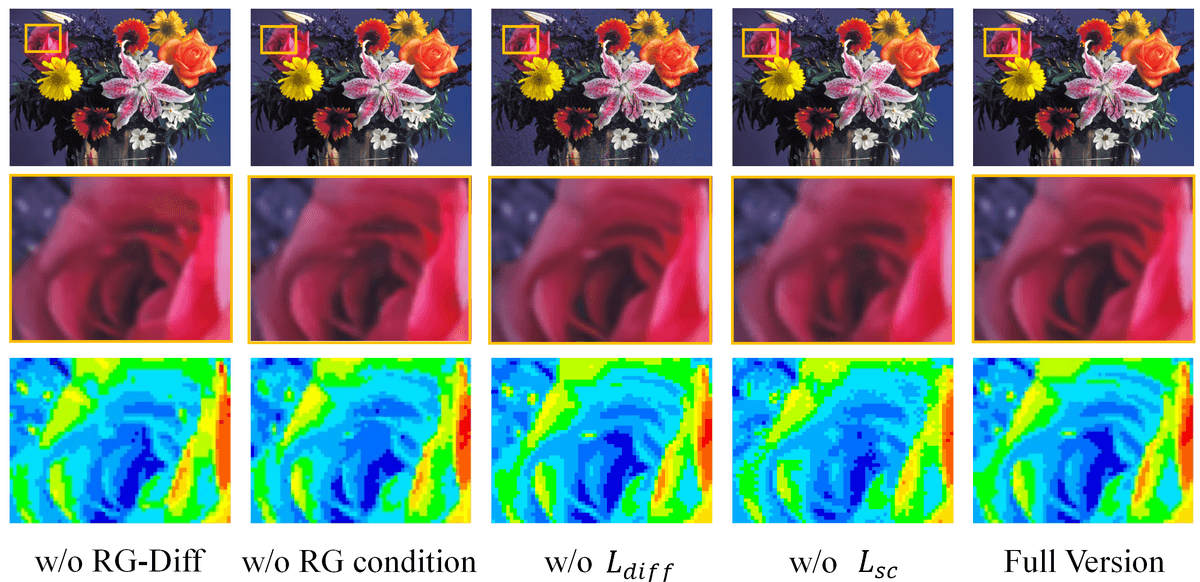
The ablation study confirms each component earns its keep. Removing RG-Diff entirely drops PSNR on Kodak from 32.41 to 31.97 dB. Replacing the sub-image conditioning in RG-Diff with plain Gaussian noise (turning it into an unconstrained generator) drops it to 32.25 dB. Removing the scale replay loss drops SIDD performance from 51.55 to 50.97 dB. The feature map visualizations show that before SAM fusion, the feature maps are noisy and diffuse; after fusion, they sharpen around edges and structural boundaries.

Where it fits and where it falls short
Prompt-SID is most useful when:
- You have no access to clean/noisy image pairs for supervised training
- You are working with real-world camera noise (smartphone sensors, DSLR RAW) or fluorescence microscopy data
- Preserving fine structural detail, text, or edges matters more than raw noise suppression speed
- You want a single model that generalizes across noise levels (σ ∈ [5, 50]) without retraining
The main limitation is training complexity. The pipeline involves two coupled networks (RG-Diff and SPIformer), three loss terms with tunable weights, and the scale replay mechanism, all trained on a single Nvidia RTX 3090. This is not a lightweight recipe. Additionally, because RG-Diff operates on compressed 1D structural vectors rather than full spatial feature maps, it captures global structural statistics but may miss very fine local textures that are not well-represented in the compressed encoding.
What is actually new here
The real breakthrough is not just better numbers. It is the idea of using a diffusion model as a prompt generator rather than as a direct image generator. Previous work applying diffusion to image restoration either generates the output directly (introducing randomness and hallucination) or fine-tunes large pretrained models (expensive and hard to deploy). This approach demonstrates the immense potential of the diffusion model and prompt-learning in image denoising tasks, using the degraded structural representations as conditional information to guide the recovery of undamaged ones. The diffusion model stays in a tiny 1D latent space, so it is fast, deterministic enough to be useful, and does not require a pretrained foundation model.
Training and testing code for synthetic denoising and real-world denoising has been released at the official GitHub repository. The paper is available on arXiv and was published at the AAAI 2025 conference.