
Tsinghua's OxyGen Makes Humanoid Robots 3.7x Faster Without Changing the Model
A new inference scheduler for Mixture-of-Transformers VLA models delivers up to 3.7x speedup by treating the KV cache as a shared resource across tasks.
 Pro
Takeaways
- OxyGen delivers up to 3.7x speedup on MoT VLA inference by unifying KV cache management across tasks and frames. Paper
- Cross-task KV sharing prefills the observation once and fans it out to both action and language experts.
- Cross-frame continuous batching decouples variable-length language decoding from the fixed-rate action control loop.
- Sustains 200+ tokens/s language throughput at 60 Hz action frequency on RTX 4090, 27 Hz on Jetson AGX Thor.
- Reproduces π0.5 LIBERO success rates within 0.8%, cutting energy per request by up to 78%.
- Code released for openpi integration. GitHub
Running a humanoid robot that manipulates objects while narrating its progress and remembering its surroundings sounds like a natural extension of modern Vision-Language-Action (VLA) models. In practice, the inference stack breaks down: language decoding blocks action generation, control loops miss their deadlines, and the robot stutters. A team from Tsinghua's Institute for AI Industry Research has just published OxyGen, a scheduling system that fixes this by rethinking how the KV cache is managed across concurrent tasks.
Why one model plus two tasks equals a stuttering robot
Recent VLA models have moved to a Mixture-of-Transformers (MoT) design, where a shared Vision-Language backbone routes to modality-specific experts. Models like π0.5, WALL-OSS, and Xiaomi-Robotics-0 adopt this architecture to route different output modalities to separate experts while sharing a common Vision-Language Model backbone, enabling a single model to jointly produce actions and language for long-horizon manipulation.
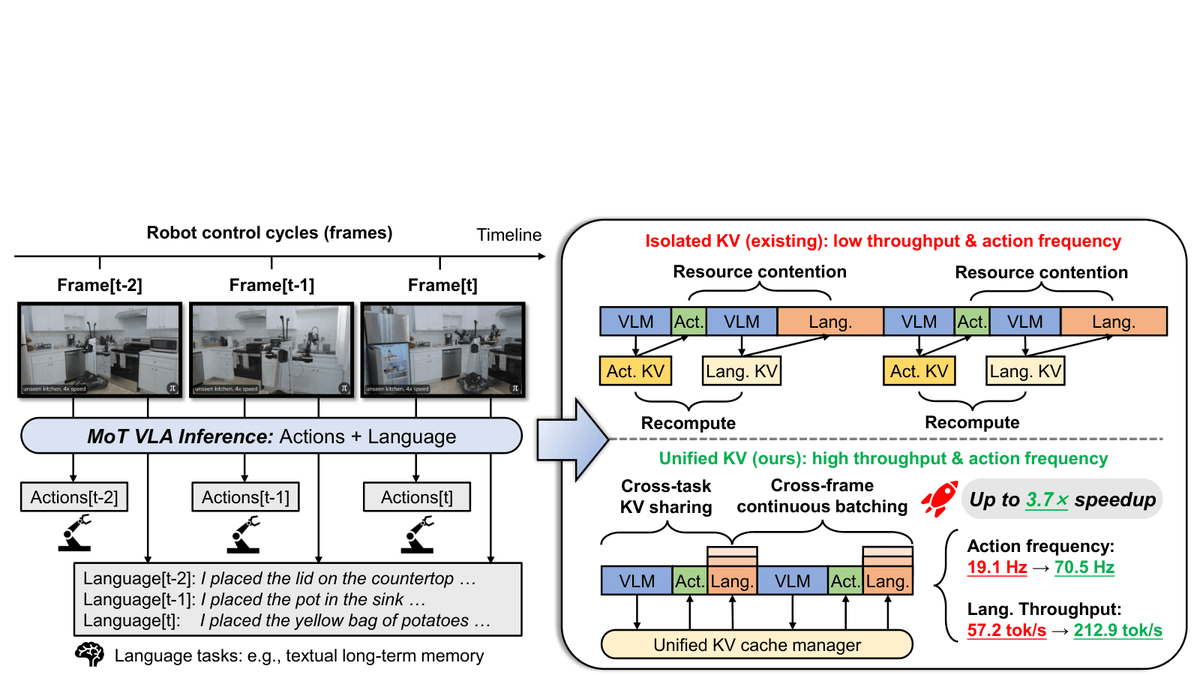
The architecture supports multi-task output, but the inference systems don't. Existing systems perform similarly to naive multi-model inference because they follow an inefficient paradigm the authors call isolated execution: each task runs through a separate forward pass of the same model, even when tasks share the same input observations. That produces two distinct pains:
- Redundant computation: the shared observation is encoded repeatedly, producing identical KV cache entries for each task, causing roughly a 1.4x slowdown.
- Resource contention: different tasks compete for a single GPU and block each other despite having different time constraints, causing a 2.6x slowdown.
Action denoising must complete within each frame, that is, within the robot control cycle, while language decoding may span multiple frames. Standard LLM tricks like prefix caching in vLLM or SGLang don't directly help, because the action expert reads the cache as read-only context across denoising steps while the language expert appends new KV entries per token. Naively sharing a mutable cache would corrupt the action expert's view.
KV cache as a first-class shared resource
OxyGen introduces a unified KV cache manager that exposes the cache as a resource coordinated across tasks and frames. Two optimizations sit on top of it:
- Cross-task KV sharing. Prefill runs once on the current observation. The resulting KV cache is fanned out to per-expert views: the action expert consumes it as read-only context across denoising steps, while the language expert gets its own view where it can append decoded token KVs.
- Cross-frame continuous batching. Language requests initiated on different frames are grouped into a single decoding batch. Each request advances by a calibrated number of tokens per frame, so the hard action deadline is respected while language throughput scales with the batch size.
Each in-flight request is tracked as a resumable state containing its KV cache, decoded token buffer, and a termination flag. The manager exposes standard Store, Retrieve, Update, and Remove operations, so a language generation can be paused at the end of one frame and resumed the next without recomputing anything.

The numbers
The authors implemented OxyGen for openpi, the official inference framework for π0.5. Benchmarks ran on both an NVIDIA GeForce RTX 4090 and a Jetson AGX Thor across three robotic configurations derived from LIBERO, DROID, and ALOHA. OxyGen consistently accelerates parallel multi-task inference by up to 3.7x, sustaining over 200 tokens/s language throughput at 60 Hz action frequency on RTX 4090 and 27 Hz on Jetson AGX Thor.
Ablations isolate the contribution of each optimization. Cross-task KV sharing provides the initial 1.4x speedup for short decoding by eliminating redundant prefill. Cross-frame continuous batching is crucial for scenarios with 10 or more decoding steps, where it maintains nearly constant action frequency of around 60 Hz on RTX 4090 and 27 Hz on Jetson AGX Thor, while the baseline drops from 49.9 Hz to 19.1 Hz.
Importantly, the speedups aren't paid for with quality. With the π0.5-LIBERO checkpoint, OxyGen reproduces the openpi-reported success rates within ±0.8% across LIBERO-Spatial, Long, Goal, and 10, while adding 15% memory overhead but reducing average power by up to 47% and energy per request by up to 78%. The energy savings come from batched decoding amortizing memory accesses to VLM weights.
Does it work on an actual robot?
The team deployed OxyGen on a real humanoid with an on-board Jetson AGX Thor. The per-frame breakdown tells the story cleanly. Baseline on-device inference takes 1030 ms and far exceeds the 333 ms action-execution window, blocking the next control cycle. OxyGen reduces total inference to 393 ms, and more importantly, the action-critical prefill and denoise stage takes 198 ms, fitting within the execution window while the remaining 195 ms of language generation runs after the action is produced and is largely hidden behind action execution.
Where it fits and what's next
OxyGen is a scheduling layer, not a model change, so it composes with existing VLA optimizations like RTC, SmolVLA, quantization, or token pruning. It targets a specific setting: MoT VLAs where one model must produce heterogeneous outputs from shared observations under asymmetric deadlines. If you're running an action-only VLA or serving cloud-scale text traffic, existing prefix caching in vLLM or SGLang is still the right tool.
The main limitation is scope. The evaluation covers one model (π0.5) with two experts. Generalizing to richer configurations with more concurrent experts, LoRA-adapted subtasks, or speculative decoding is discussed but not benchmarked. The code is open-source on GitHub, so extending it to WALL-OSS or Xiaomi-Robotics-0 should be tractable for anyone shipping an MoT VLA on-device.